
FROM IMPERIAL FABERGÉ TO TODAY’S COLLECTING TRENDS, THE LONGTIME SPECIALIST DISCUSSES THE OBJECTS, COLLECTORS, AND DISCOVERIES THAT CONTINUE TO INSPIRE HIM
Interview by Rhonda Reinhart | Portraits by Josh David Jordan | July 21, 2026
Nick Nicholson has spent more than three decades immersed in the world of decorative arts, building a reputation as one of the field’s foremost specialists. His expertise, particularly in Fabergé and Russian works of art, has brought extraordinary objects to Heritage Auctions and connected them with collectors around the world. Now, as Heritage’s newly appointed Deputy Chairman of Decorative Arts, Nicholson is taking on an even broader role. In addition to continuing to oversee the categories that first established his reputation, he is helping shape the strategic direction of Heritage’s Decorative Arts department, working alongside specialists across multiple disciplines to elevate scholarship, expand the company’s global reach, and secure important works for auction.
Nicholson’s passion for the field traces back to a childhood spent at the Forbes Magazine Galleries exhibition of works by Fabergé. “It was literally down the street from our house, and I went weekly,” he says. “I feel like I grew up in that gallery. It trained my eye and gave me a love of Russian artistic culture that has never waned.” That lifelong enthusiasm extends into his own home, where Fabergé picture frames, silver, and miniature eggs are enjoyed as they were intended rather than tucked away in a vault.

In March, Nicholson was announced as Deputy Chairman of Decorative Arts at Heritage Auctions.
In this conversation with Intelligent Collector, Nicholson discusses his new leadership role, the experiences that shaped his career, the importance of connoisseurship in today’s market, and why he believes decorative arts are meant to be lived with as much as admired.
What drew you to the world of decorative arts?
I’ve always thought of myself as an object person. At my core, I’m a social historian who uses objects to understand and tell stories about people, and one of the things that fascinates me is how little human nature has changed over the centuries. Fine art often shows the world as we wish it were and presents us as we wish to be seen and remembered, but objects tell more personal stories. The things we choose to live with, use, keep, and pass down reveal what we truly value, what we find beautiful, and what matters most to us. The decorative arts — furniture, bronzes, porcelain, glass, enamel, silver, and objects of vertu — sit at the intersection of history, craftsmanship, and human experience, which is what makes them so compelling. Unlike works of art created primarily to be viewed, the decorative arts are woven into daily life, and they tell extraordinary stories about the people who made, owned, and preserved them.
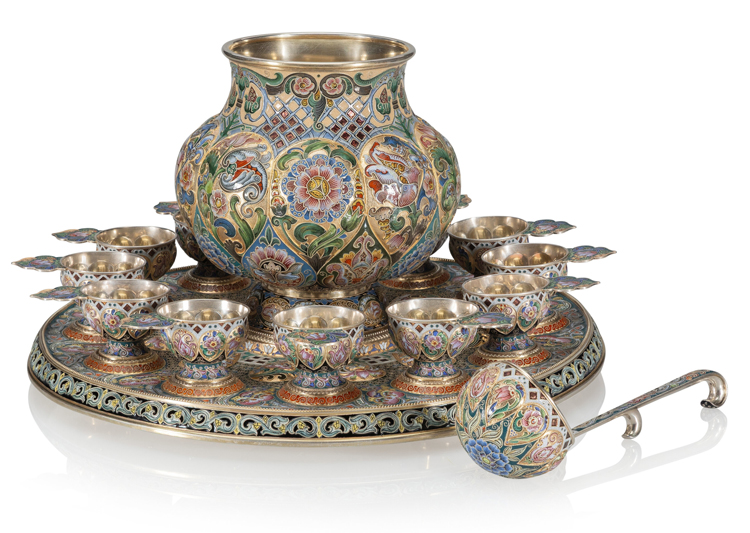
Among the extraordinary objects Nicholson has brought to auction is this Fabergé punch set by Feodor Rückert. Seized by the Bolsheviks in 1918, the rediscovered masterpiece realized $750,000 in a May 2025 Heritage auction.
OK. Sounds silly, but what are the decorative arts, and why are they important?
This is actually a very important question, because the term “decorative arts” can be somewhat misleading today. In contemporary usage, “decorative” often carries the unfortunate implication that something is merely ornamental or somehow less significant than painting or sculpture. Historically, however, that was not the case at all. For centuries, the finest makers of furniture, silver, ceramics, jewelry, glass, textiles, and luxury objects were regarded as artists of the highest order, and who often had received the same training, enjoying the same — or even greater — prestige than painters, sculptors, and architects. The workshops of Cellini, Jacob, Sèvres, Meissen, Tiffany, Fabergé, and countless others were celebrated for their artistic innovation, technical mastery, and cultural importance during their lifetimes.
So, what is the difference between fine and decorative arts?
Personally, I prefer the more academic term “material culture” because it better captures what these objects are and why they matter. This term would cover much of what Heritage offers, including the Ruby Slippers, Babe Ruth’s jersey, and important coins, as well as what are traditionally considered the decorative arts. But the difference, in general, is that the decorative arts also have a function, while fine arts don’t. They can broadly be categorized as everyday objects of use raised to the level of art. A magnificent silver centerpiece, an Imperial Russian snuff box, or a bronze-mounted and inlaid cabinet was meant to be lived with, used, and admired. That combination is what makes decorative arts so compelling and why they remain essential to understanding history and culture. When those of us in the field look at a magnificent English Regency dining table, we don’t just see the table. We see the generations of conversations over it.
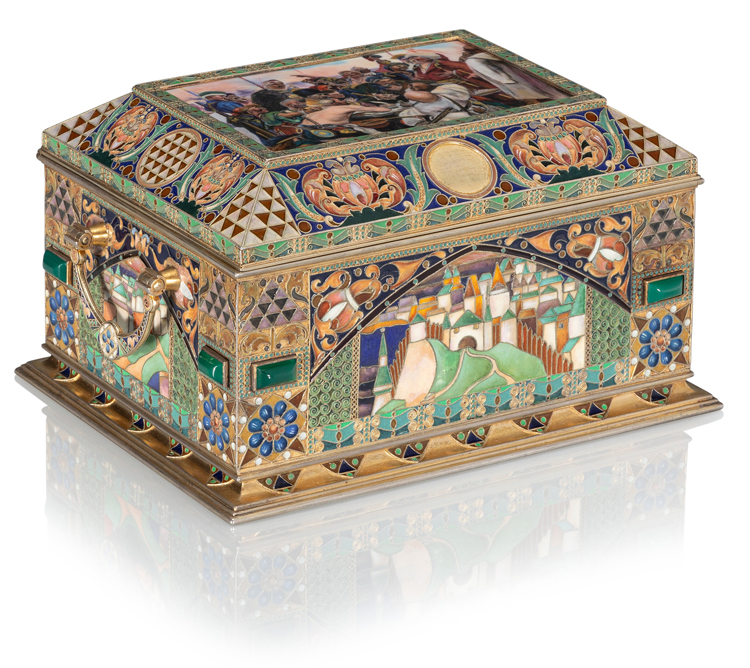
In December 2024, Heritage presented Masterpieces of Russian Enamel from an Important American Collection, which included this en plein and cloisonné enameled gilt silver casket after Ilya Repin’s ‘Reply of the Zaporozhian Cossacks.’ The casket sold for $625,000 and set a record for the Khlebnikov firm at auction.
How did you get into the auction business?
I was fortunate to begin my career at Christie’s during a period when the decorative arts were among the strongest sectors of the market. Eighteenth-century French furniture, English silver, Renaissance bronzes, and Fabergé often achieved prices that rivaled major paintings. It was there that I found my field, and I’ve never left it — working with decorative arts at auction, with dealers, as an advisor and appraiser, and as a museum curator.
But nothing compares to auction. It offers the privilege of encountering an ever-changing procession of objects and the opportunity to uncover and share their stories. An early mentor once told me, “You only get one chance to tell an object’s story, and it’s your obligation to tell it as well as you can. It may be the last time the world sees it before it disappears into a collection.” That idea has stayed with me throughout my career, and it’s one of the reasons I continue to believe that auction is the most exciting place in the art world.
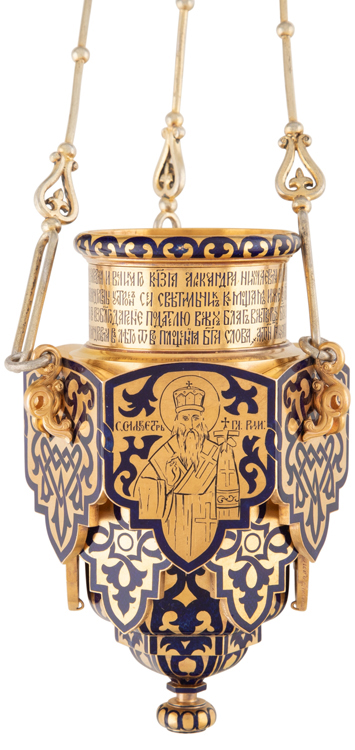
Held in May 2024, Heritage’s first auction dedicated to Fabergé and Russian works of art featured highlights such as this Imperial lampada that had not been seen in public since 1980. ‘It was the greatest pleasure for me as a specialist to rediscover [this piece] and watch it reach a historic price of $475,000,’ Nicholson said at the time.
In 2024, you led the creation of Heritage’s Russian Works of Art category and, since then, helped establish Heritage as the leading U.S. auction house for Russian art and Fabergé. Tell us about that journey.
Heritage has actually been selling Russian works of art since it began 50 years ago, and had sold Russian works in the past, fetching some very respectable prices for Aivazovsky, Fabergé, icons, and Russian silver, as well as in Heritage’s core business of coins, where the firm has long been the international leader in Russian numismatics.
But when I joined Heritage, the worldwide Russian market was in a dark period. Political concerns had overshadowed the truth that there was and is a vibrant market of international collectors of the material who recognize that 18th-century Russian paintings, 19th-century icons, and works by Fabergé don’t bear any guilt for the state of our world. When we started the department, it was because of a convergence of the material. The estates of Princess Maria Romanoff and collector Ruth Nelkin, as well as an impressive group of fresh-to-market pieces of Imperial Fabergé, drew international attention and set record prices. We threw an old-fashioned Russian sale with objects of fine and decorative art of a type the market hadn’t seen in a long time, and Heritage has gone from strength to strength ever since, attracting the best material for every auction.
In your opinion, what is it about Fabergé that speaks to collectors?
Some collectors are drawn to Fabergé because it is one of the few names in the decorative arts that enjoys universal recognition, like Cartier or Tiffany. But the most serious collectors tend to look beyond the name itself. They become interested in the extraordinary workmasters who actually created the objects, the technical innovations behind them, and the histories of ownership that connect each piece to the people and events that shaped its journey through time. For them, the appeal of Fabergé lies not only in its beauty and craftsmanship, but in the stories embedded within every object.
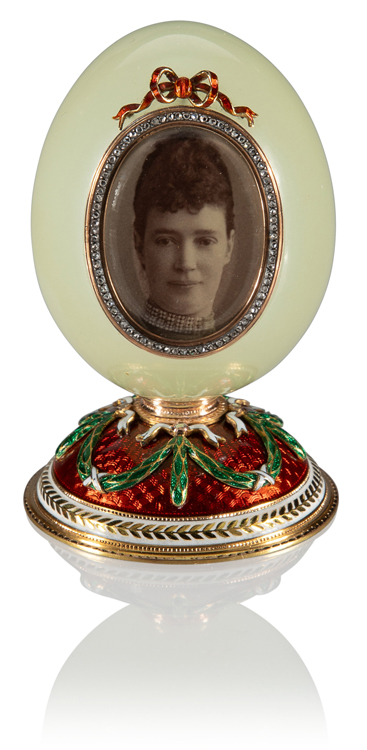
In a May 2024 Heritage auction, this Imperial Fabergé diamond-set and enameled bowenite egg-shaped frame realized $750,000, the highest recorded price for a Fabergé picture frame.
You also lead Heritage’s Museum Services initiatives. What does that work entail?
I have worked with and for museums for decades and sit on the board of the Merchant’s House Museum in New York. I came to Heritage with an understanding of the situations facing museums and institutions today and was clear on what Heritage could do to partner with institutions beyond the obvious route of sale through deaccession. Heritage has been gratified by the immediate response from the museum community, and in the past year we have conducted several important private sales; object appraisals for insurance, gift, and loan purposes; charity auctions; and collection analyses with major museums around the country. We are consciously expanding our role in this area.
In any given auction, you can’t always predict the lots bidders will respond to, but is there one area seeing increasingly impressive results right now?
It isn’t just one area. We are at the beginning of a comeback for the decorative arts. I am excited to see the growing momentum in Italian modern glass, where Heritage is setting records. I’m thrilled to see a revived interest in signed 19th-century furniture and objects. I love that younger collectors are looking at British ceramics in a new light. I think that our new collectors grew up in a banal era of Restoration Hardware and Crate & Barrel sameness that has opened their eyes to unique objects and crafts. They want things no one else has, and for the first time in decades, very fine 18th- and 19th-century works are affordable. It is an exciting time to collect.
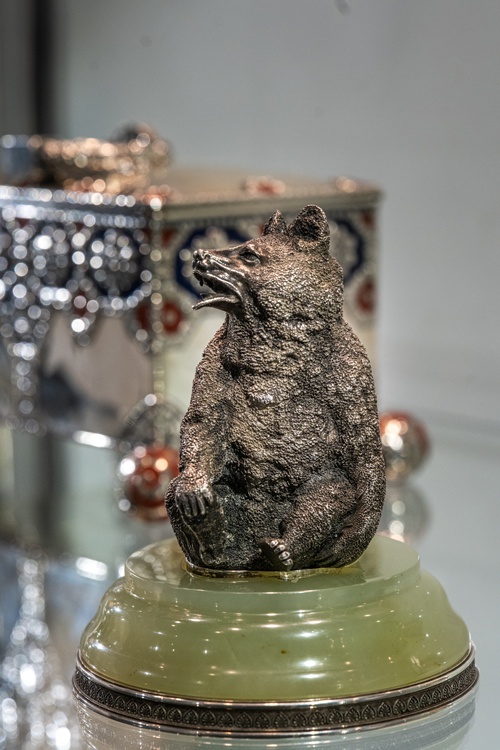

Scenes from Heritage’s London preview of Fabergé: A Gentleman’s Collection Signature® Auction, which the auction house debuted in May. A Showcase auction of the same collection takes place July 28.
Heritage’s next Fabergé auction takes place July 28. What are some of the highlights in that sale?
At Heritage we have Signature auctions and Showcase auctions. The July 28 auction is a Showcase sale of Fabergé and Russian silver from an important Geneva collection. While the works are at a lower price point, they are no less interesting than works in our Signature sales. There is an amazing page of Fabergé drawings of jeweled charki, or cups, and an exceptional and very rare Fabergé icon lamp in the form of a Byzantine silver lychnos, or oil lamp. There are some beautiful enameled pieces and Russian silver as well.
What else can we look forward to in 2026?
Hold onto your hat for this season. We have a wonderful general Russian Works of Art sale with paintings, porcelain, jewelry, silver, and Moscow enamels on December 8, and also we are excited for Fabergé: A Gentleman’s Collection, Part II, with extraordinary works by Fabergé, including works that belonged to the Imperial family, members of royal families and the aristocracy, and exceptional works such as a table clock that depicts a night sky in diamonds across blue enamel. It is a showstopper, and I am looking forward to it coming to auction.