
WHILE HIS PAINTINGS CAN COMMAND NINE-FIGURE PRICES, PICASSO’S PRINTS AND CERAMICS OFFER A COMPELLING AND ACCESSIBLE ENTRY INTO ONE OF ART HISTORY’S MOST PROLIFIC CAREERS
By Desiree Pakravan | April 21, 2026
Pablo Picasso is often synonymous with record-breaking auction prices and multimillion-dollar masterpieces, yet his market extends far beyond the rarefied world of blue-chip paintings. Over the course of his prolific career, Picasso worked across a wide range of media, including ceramics, prints, drawings, and editions, demonstrating the same inventiveness and immediacy that define his most celebrated canvases. His ceramics from the Madoura workshop and his extensive output of lithographs, linocuts, and etchings have become highly sought after in their own right, offering collectors a more accessible entry point into his oeuvre without sacrificing artistic significance.
These works reveal Picasso’s experimental spirit and playful engagement with form, line, and surface. A ceramic vase might become a face; a print might capture the same bold, expressive gesture found in his paintings. Importantly, these mediums allowed Picasso to explore repetition and variation, creating editions that bring his work within reach of a broader audience. As a result, collecting Picasso is not reserved solely for the ultra-wealthy; there are exceptional works available at far more approachable price points.
In Heritage’s April 23 Prints & Multiples Signature® Auction, collectors will find a selection of compelling Picasso pieces under $50,000. These works offer not only an opportunity to own a piece of art history, but also to engage with the breadth of Picasso’s creativity across mediums. Whether through a vibrant ceramic or a striking print, these accessible works underscore a key truth of the Picasso market: His genius is not confined to a single format, and meaningful collecting can begin at many levels.
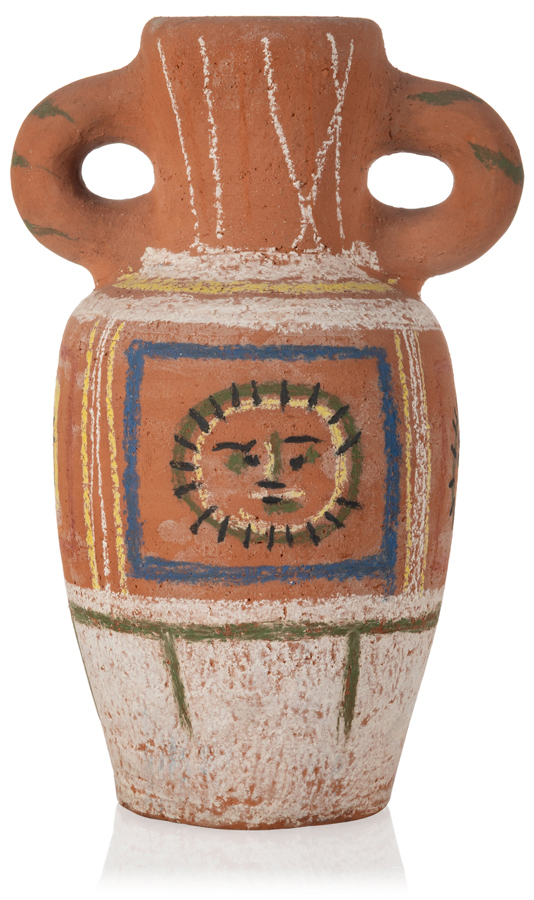
Pablo Picasso ‘Vase au décor pastel (A.R. 190),’ 1953. Chamotted red earthenware clay, decoration in pastels. 14 x 9 x 7-1/4 inches (35.6 x 22.9 x 18.4 cm) (overall). Ed. 55/200.
Of the many ceramics available, Picasso’s Vase au décor pastel is an exciting work to add to any collection. Estimated at $20,000–$30,000, it exemplifies his inventive approach to ceramics, where he treats the vessel not just as a functional object but as a surface for painterly experimentation. On the front, Picasso paints a stylized face, using fluid lines that echo his broader exploration of portraiture across media. The soft pastel decoration wraps around the form, integrating this visage with the contours of the vase so that image and object become inseparable. Both playful and expressive, the face animates the vessel, transforming it into a character-like presence.
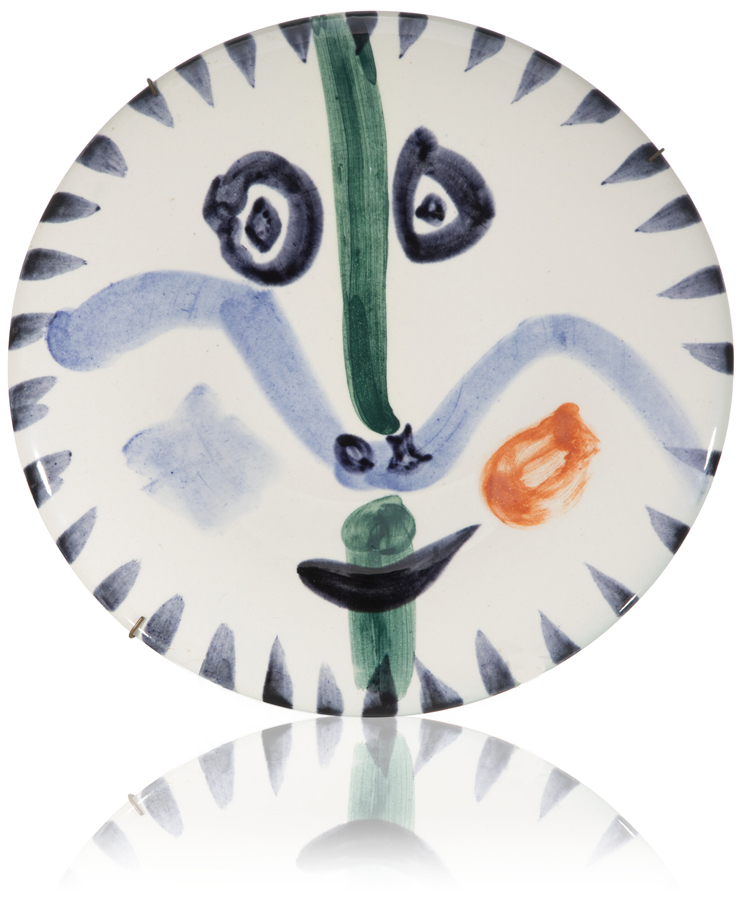
Pablo Picasso ‘Visage No. 111 (A.R. 476),’ 1963. White earthenware clay, decoration in engobes, and enamel under glaze. 10 inches (25.4 cm) (diameter). Ed. 98/500.
Another great example of his ceramic practice is Visage No. 111, estimated at $6,000–$8,000. In this piece, which captures the immediacy and inventiveness that define his work at the Madoura workshop, Picasso transforms a simple plate into a vivid, expressive face, using swift, confident lines and a limited palette to animate the surface. As with many of his ceramics, the object exists somewhere between sculpture and painting, blurring categories in a way that feels both spontaneous and deeply considered.
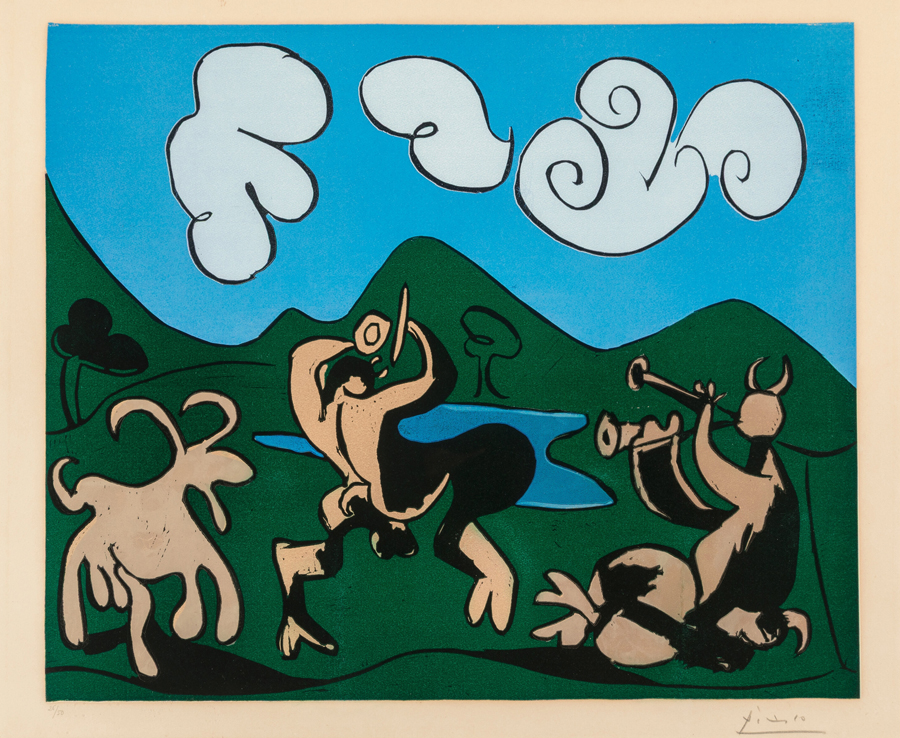
Pablo Picasso ‘Faunes et chèvre,’ 1959. Linocut in colors on Arches paper. 20-3/4 x 25 inches (52.7 x 63.5 cm) (image). Ed. 26/50 (aside from 20 artist’s proofs).
The auction features a variety of linocuts that are especially significant. Rather than treating linoleum printing as a straightforward, graphic process, Picasso pushed its technical limits, most notably by developing the reductive linocut technique, in which a single block is carved in successive stages to produce multiple colors. Faunes et chèvre is a striking example of this, as the composition brings together mythological and pastoral imagery, depicting fauns alongside a goat in a scene that feels both ancient and vividly immediate. As each cut was irreversible, Picasso built the image through layered colors and bold, interlocking forms, a method that required extraordinary foresight and precision. Estimated at $40,000–$60,000, this print is both vibrant and playful, and one a collector does not want to miss.
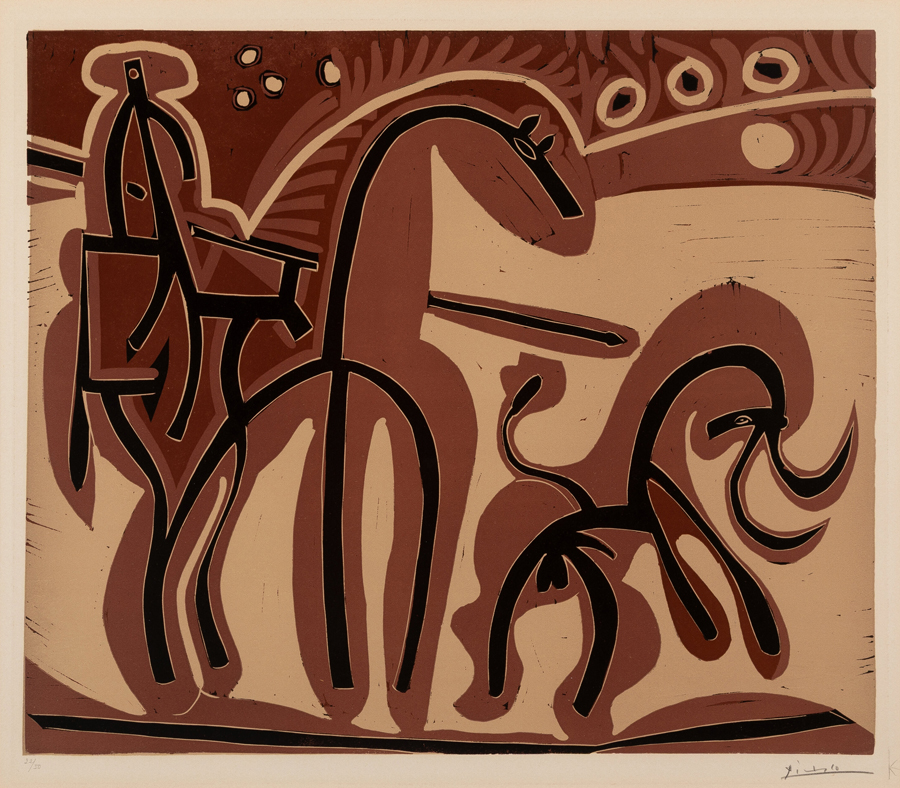
Pablo Picasso ‘Picador et taureau,’ 1959. Linocut in colors on Arches paper. 23 x 27 inches (58.4 x 68.6 cm) (sight). Ed. 22/50.
The bullfight scene was a prolific and deeply personal subject for Picasso, rooted in his Spanish heritage and lifelong fascination with the drama, ritual, and symbolism of the arena. Across paintings, prints, and drawings, he returned to this theme repeatedly, using it as a powerful vehicle to explore movement, conflict, and the interplay between man and beast. In Picador et taureau, he distills the dramatic encounter between rider and bull into bold, simplified forms, using strong contrasts and decisive lines to heighten the sense of tension and movement. The composition feels immediate and dynamic, capturing not just the spectacle of the scene but its underlying ritual and intensity. With an estimate of $20,000–$30,000, this print is a great investment and entry point for a collector to own a Picasso work.
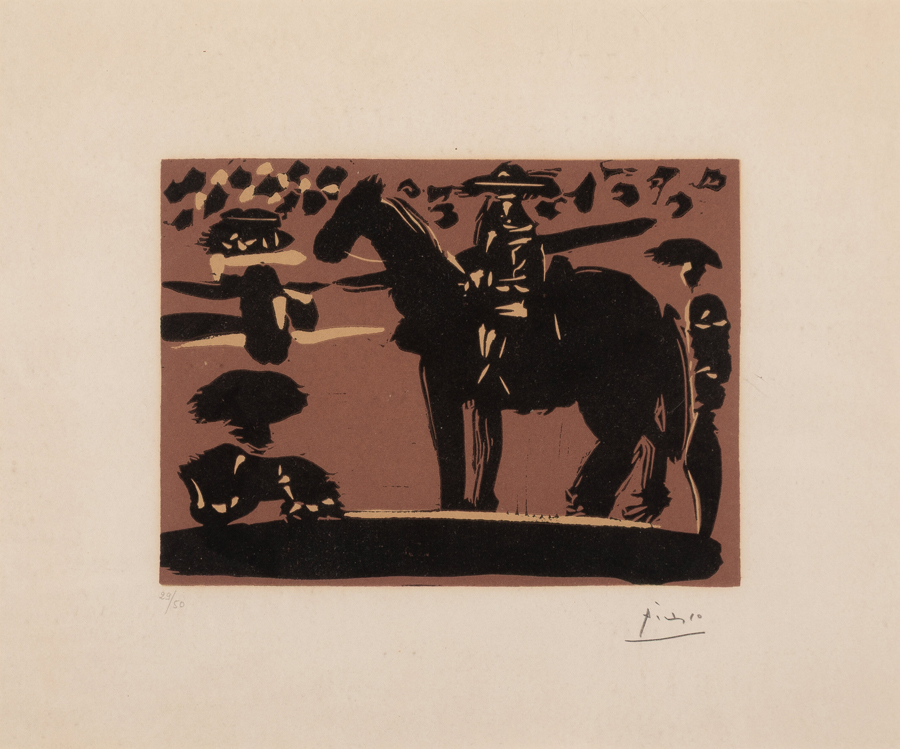
Pablo Picasso ‘Picador entrant dans l’arene,’ 1959. Linocut in colors on Arches paper. 11-3/8 x 13-3/4 inches (28.9 x 34.9 cm). Ed. 23/50.
While Picador entrant dans l’arene is a smaller linocut, it is a striking example. Estimated at $5,000–$7,000, this edition captures the charged moment of the picador entering the bullring. The composition is both bold and economical, with sweeping lines and carefully layered colors conveying movement, tension, and theatricality in a way that feels immediate and alive. Its compelling value offers an opportunity to secure a dynamic, recognizable image by Picasso.
For collectors, these works offer a strong value relative to their art historical importance and an opportunity to own a work that is both emblematic of Picasso’s playful experimentation and accessible within a more attainable price range, making them smart and rewarding additions to a growing collection.