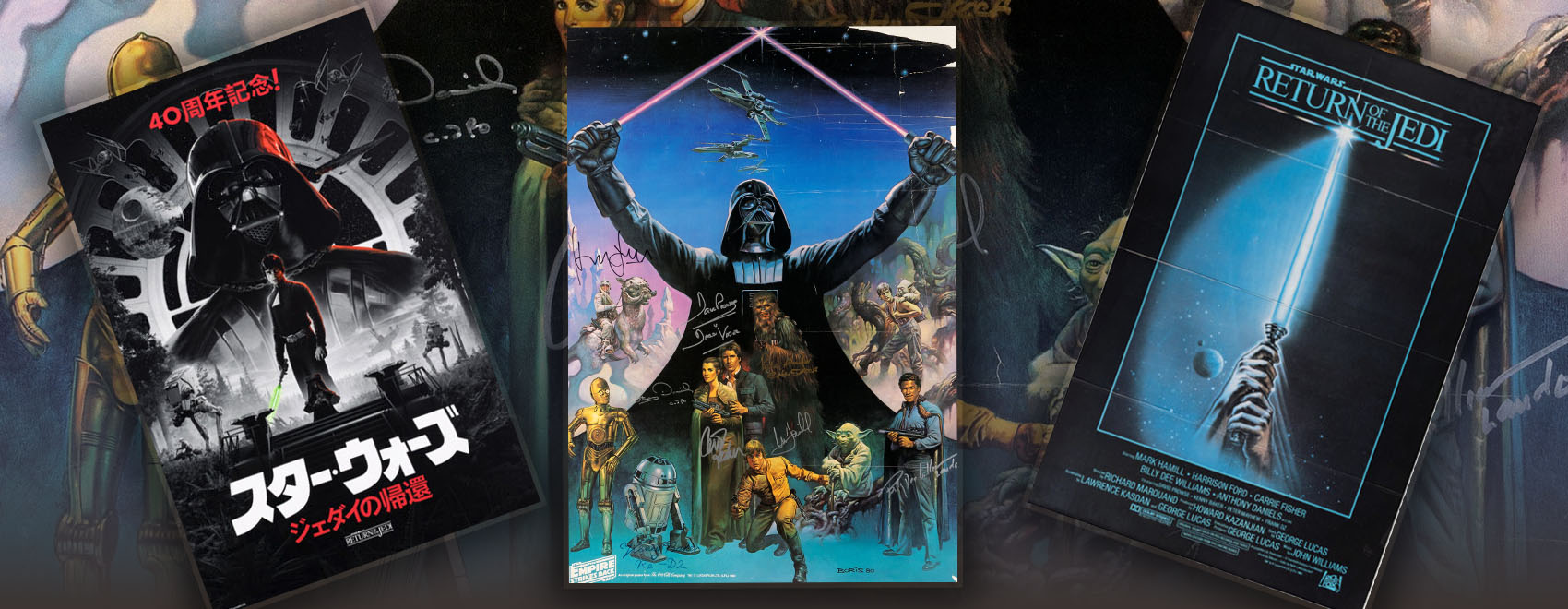
DARTH VADER’S SCREEN-MATCHED LIGHTSABER LEADS AN EXTRAORDINARY COLLECTION OF 28 ORIGINAL STAR WARS LIGHTSABERS THAT HELPED BRING A GALAXY FAR, FAR AWAY TO LIFE
By Colin Tait | October 20, 2026
Idon’t remember my life without Star Wars. I have vague memories of sitting in the long-vanished Shoppers World Mall at the age of 4, watching a movie that somehow changed my life forever. I couldn’t have understood the extraordinary achievement unfolding before me, much less imagined how central George Lucas’ universe would become to my life. I certainly never imagined that one day I would find myself holding the very weapons that helped bring that universe to life.
Like millions of children who grew up with Star Wars, I had my own lightsaber. It was a simple plastic toy with a blade that glowed green in the dark after being exposed to light. I remember fighting imaginary battles with my sister, bending the plastic hopelessly out of shape, and holding the battered blade beneath a lamp to recharge its fading glow. To a 4-year-old, it was enough.
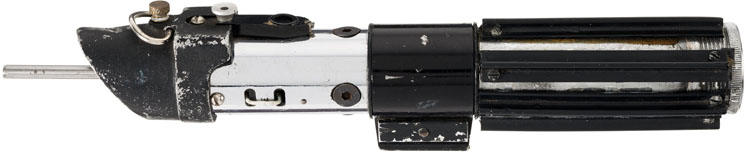
Darth Vader’s screen-matched hero dueling lightsaber from ‘Star Wars: The Empire Strikes Back’ and ‘Star Wars: Return of the Jedi’ is one of 28 lightsabers available in Heritage’s November 12 Ultimate Star Wars Auction.
Of all the remarkable inventions of Star Wars — spaceships, blasters, droids, and alien worlds — nothing captured the imagination quite like the lightsaber. Obi-Wan Kenobi called it “an elegant weapon for a more civilized age.” In the hands of a Jedi Knight, it represented discipline and restraint; in the hands of a Sith Lord, an instrument of terror.
Nearly half a century later, in preparation for Heritage Auctions’ November 12 Ultimate Star Wars Auction, I stood before 28 original lightsabers, including Darth Vader’s screen-matched dueling weapon.
I was about to hold the real thing.
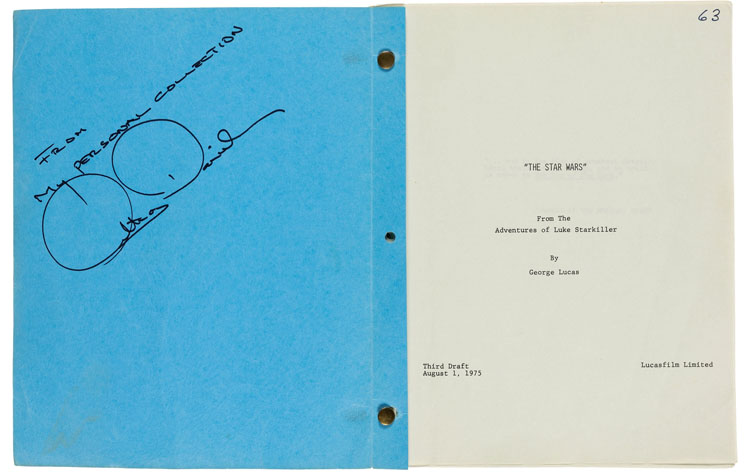
This original 1975 screenplay for what was then titled ‘The Star Wars’ is the signed personal copy of Anthony Daniels, who played C-3PO.
From Imagination to Illustration
When Lucas completed the earliest drafts of what was then titled The Star Wars, he understood that his extraordinary worlds and characters first had to be visualized. To translate those ideas into images, he turned to industrial designer and technical illustrator Ralph McQuarrie.
Among McQuarrie’s earliest production paintings was a dramatic confrontation aboard a spacecraft between a black-armored warrior and a Rebel hero, each wielding one of Lucas’ “laser swords.” Although the warrior character had not yet fully evolved into Darth Vader, the essential visual language was taking shape. The sweeping cape, respirator mask, imposing helmet, and glowing blade established an image that would become inseparable from Star Wars.
It fell to Academy Award-winning set decorator Roger Christian and the Star Wars art department to transform these concepts into practical objects. Rather than fabricate every component from scratch, the production team turned to existing industrial equipment. Darth Vader’s original lightsaber was constructed around a British M.P.P. Microflash camera flash unit, an unlikely piece of photographic equipment that became the foundation for one of cinema’s most enduring designs.
An object originally intended to illuminate photographs became the weapon of the Dark Lord of the Sith.
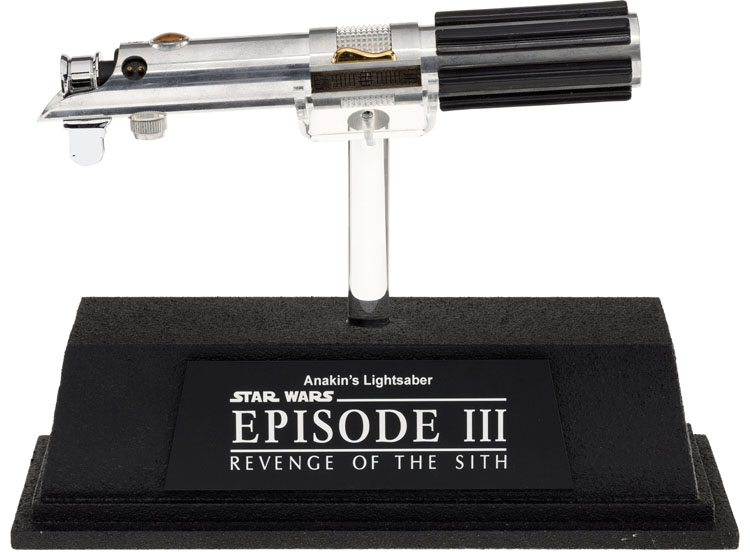
Anakin Skywalker’s hero lightsaber from ‘Star Wars: Episode III — Revenge of the Sith’ was designed to resemble the weapon carried by Luke Skywalker in the original ‘Star Wars’ trilogy.
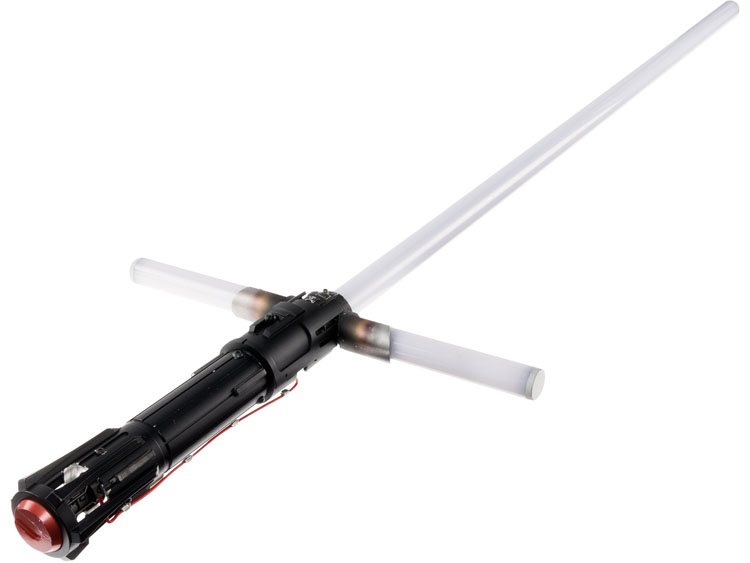
Kylo Ren’s FX bladed hero lightsaber from ‘Star Wars: Episode VIII — The Last Jedi’
Forged for Battle
By the time production began on The Empire Strikes Back (1980), the lightsaber had become the franchise’s defining dramatic language: a choreographed dialogue between master and apprentice, father and son, light and dark. The original film’s rotating blade system, incorporating Scotchlite reflective material, had proved mechanically challenging. For The Empire Strikes Back, the production developed reinforced dueling hilts with interchangeable wooden blades, their luminous appearance subsequently created through painstaking animation.
Vader’s M.P.P.-based lightsaber retained its distinctive black shroud, center band, and clamp. Seven black plastic T-track grips, calculator magnification bubbles, decorative wiring, and a D-ring for suspension from Vader’s belt transformed the photographic equipment into one of cinema’s most recognizable weapons. Unlike the separate bladeless hero hilt used for noncombat scenes, the present example was reinforced for demanding fight choreography.
The elaborate Cloud City duel, performed by Mark Hamill as Luke Skywalker and David Prowse and Olympic fencing champion Bob Anderson as Darth Vader, required extensive rehearsal under stunt coordinator Peter Diamond. The physical punishment was considerable. Grips originally attached with adhesive were reinforced with small screws after becoming dislodged during combat, while wooden blades, none of which are known to survive, were replaced as needed throughout filming.
Retained for Return of the Jedi (1983), Vader’s M.P.P.-based dueling lightsaber again served during the climactic confrontation with Luke aboard the second Death Star, giving the surviving weapon an exceptional connection to the defining relationship of the original trilogy.
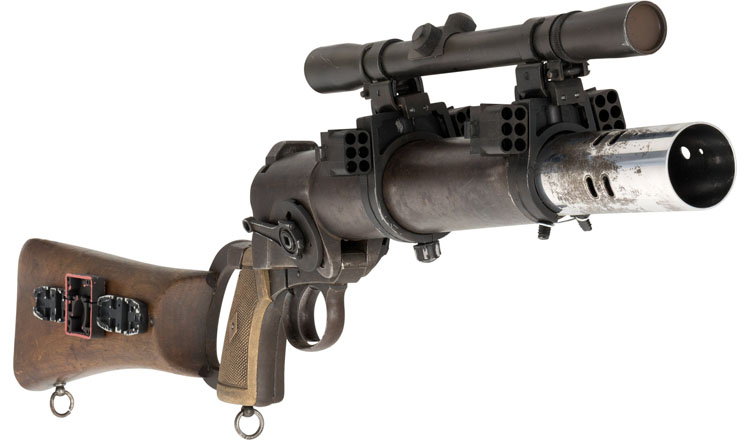
In addition to lightsabers, Heritage’s November 12 Ultimate Star Wars Auction features highlights such as Boba Fett’s signature weapon: this screen-, photo-, and serial number-matched EE-3 carbine rifle from ‘Star Wars: Episode V — The Empire Strikes Back.’
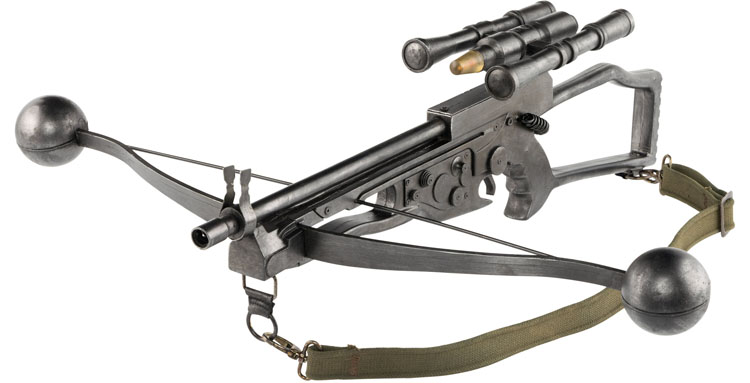
Chewbacca’s action bowcaster from ‘Star Wars: Episode VII — The Force Awakens’
Two Sides of the Same Story
Darth Vader’s lightsaber is forever linked to its dueling partner: Luke Skywalker’s hero lightsaber from the Cloud City confrontation in The Empire Strikes Back.
Together, these surviving weapons represent opposite sides of one of the most consequential relationships in motion picture history. In their first duel, Vader uses his weapon to sever Luke’s hand before revealing the truth of his identity: that he is Luke’s father. In their last, Luke lays down his weapon to prove that he will not become him.
The histories of the two lightsabers have remained intertwined beyond the screen. In July, Heritage Auctions sold Luke’s Cloud City lightsaber and severed-hand effects rig for a record-breaking $3,750,000.
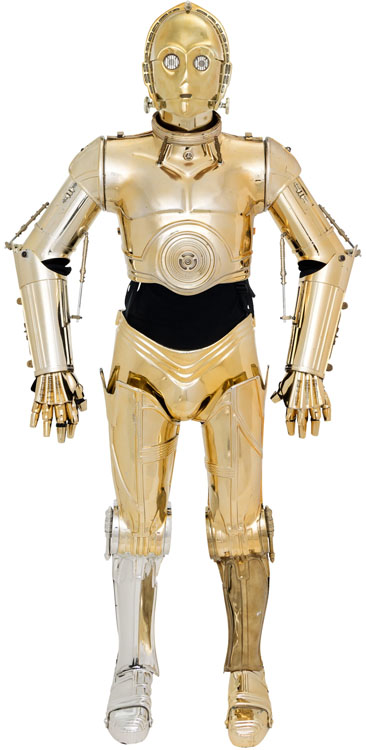
This circa-1990s walkabout C-3PO costume hails from the Disney Theme Parks ‘Star Tours’ attraction.
The Evidence Written in Metal
The history of Darth Vader’s dueling lightsaber is literally written into its surface.
Its reshaped upper shroud, impact marks, damaged T-track grip, mismatched repair screws, residual production adhesive, and accumulated wear together form a unique physical fingerprint. Most compelling are two distinctive characteristics connecting the hilt directly to the films. A recognizable curvature in the D-ring attached to the rear of the shroud allows the weapon to be photo-matched to a production still from The Empire Strikes Back. A prominent dent along the edge of the lower endcap provides an independent screen-match to a close-up in Return of the Jedi.
For collectors, the distinction between a production-made prop and a screen-matched example is enormously consequential. The latter provides a demonstrable connection between the surviving object and the images preserved on film.
The scratches, dents, and repairs cease to be imperfections. They become evidence.
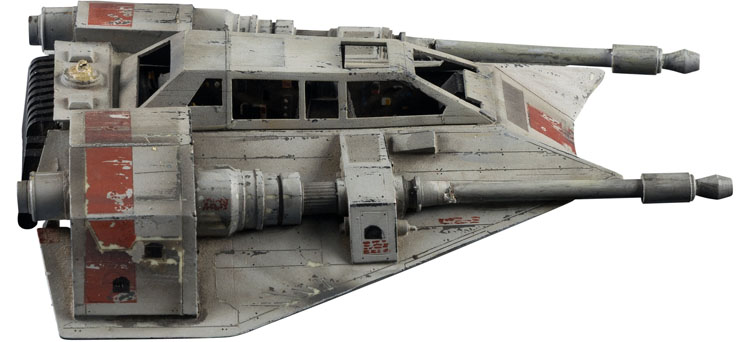
Carrie Fisher’s personal screen-used Snowspeeder miniature from ‘Star Wars: Episode V — The Empire Strikes Back,’ given to her by George Lucas
An Arsenal Across the Galaxy
Heritage’s November 12 auction brings together the largest collection of Star Wars lightsabers ever assembled for public auction: 28 original examples spanning the original trilogy, prequel films, sequel era, and television productions. Leading the collection is Vader’s screen-matched weapon, with a starting bid of $1 million.
The collection illustrates how lightsaber duels evolved into increasingly elaborate confrontations. Hero hilts, meticulously detailed for close-up photography, were accompanied by specialized dueling versions built to withstand repeated combat.
The prequel films introduced increasingly athletic lightsaber combat, requiring lighter, more maneuverable weapons with replaceable stunt blades. Among the auction’s highlights are two lightsabers associated with Darth Maul, whose double-bladed weapon transformed the familiar duel into something entirely new in The Phantom Menace (1999). Also featured are the dueling lightsabers wielded by Ewan McGregor’s Obi-Wan Kenobi and Hayden Christensen’s Anakin Skywalker in Revenge of the Sith (2005) during their climactic confrontation on Mustafar — a battle that marks the destruction of a friendship and the birth of Darth Vader.
The technological evolution of the lightsaber is perhaps nowhere more apparent than in the sequel films. Where the original trilogy relied on modified photographic equipment, wooden stunt blades, and animated effects, later productions introduced increasingly sophisticated materials, electronics, and lighting systems.
Among the most remarkable examples is Adam Driver’s Kylo Ren FX hero lightsaber from The Last Jedi (2017). Its distinctive crossguard design evokes a medieval sword, while its construction reflects a radically different approach to filmmaking. Equipped with internal LED lighting, rechargeable batteries, and a programmable DMX control system, the weapon could produce choreographed ignition, illumination, and clashing effects during filming, allowing its light to interact directly with performers and their surroundings.
While the lightsabers form the centerpiece of Heritage’s Ultimate Star Wars Auction, the offering extends far beyond the weapons of the Jedi and Sith.
Among the highlights is Boba Fett’s screen-, photo-, and serial number-matched hero EE-3 carbine blaster from The Empire Strikes Back, carried by Jeremy Bulloch as the mysterious bounty hunter who became one of the franchise’s most enduring characters. Built around a genuine World War I-era Webley & Scott signal flare pistol, the weapon exemplifies the ingenuity of the original trilogy’s prop department. There is also a hero E-11 Stormtrooper blaster from Rogue One: A Star Wars Story (2016), constructed around a British Sterling submachine gun. I had the opportunity to hold it, and it took nearly everything I had not to point it into the distance and say “pew, pew.”
Other highlights include Chewbacca’s bowcaster from The Force Awakens, Anthony Daniels’ signed 1975 screenplay for The Star Wars, Carrie Fisher’s personal screen-used Snowspeeder miniature from The Empire Strikes Back, a nine-piece Disney Star Tours C-3PO walkabout costume, original concept art, and vintage collectibles.

Obi-Wan Kenobi’s bladed dueling lightsaber from ‘Star Wars: Episode I — The Phantom Menace’
Holding the Galaxy
There is a famous story about Ewan McGregor filming his early lightsaber scenes as Obi-Wan Kenobi in The Phantom Menace. So immersed in the experience, McGregor reportedly made the familiar humming and swooshing sounds himself, requiring reminders that sound effects would be added later.
It is a story that makes perfect sense to anyone who grew up pretending to wield a lightsaber. I had the opportunity to hold one of McGregor’s original blades, along with the plethora of other weapons available in Heritage’s Ultimate Star Wars Auction. Yet nothing quite compared to holding Darth Vader’s lightsaber from the original trilogy. Its dents, nicks, repairs, and accumulated wear were the surviving physical evidence of the battles that had captivated audiences for decades.
I thought about that battered green plastic lightsaber from my childhood, the one I had held beneath a lamp to coax a little more light from its blade. I never could have imagined that one day I would hold Darth Vader’s actual lightsaber.
For a moment, the distance between the child in the movie theater and the writer and fan standing before these remarkable artifacts seemed to disappear.
The galaxy was no longer quite so far, far away.