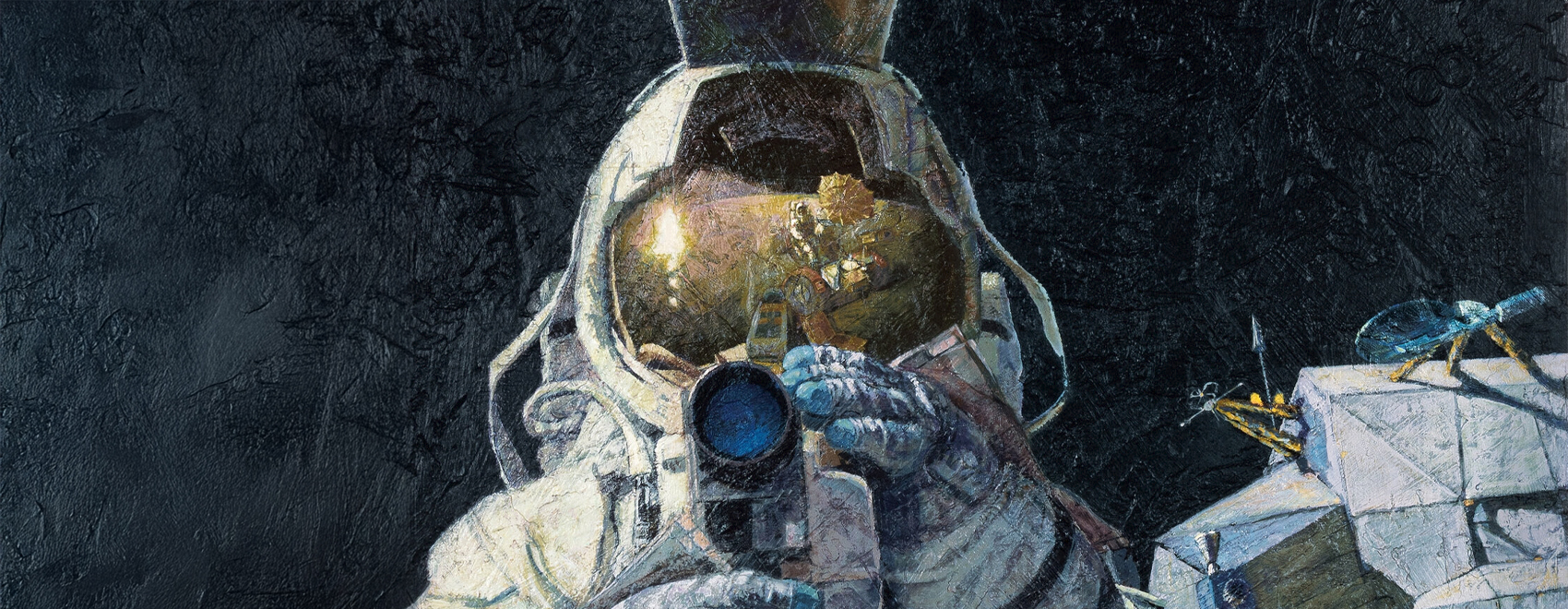
ALAN BEAN’S ESTATE COLLECTION TRACES HIS JOURNEY FROM APOLLO 12 AND SKYLAB ASTRONAUT TO A LIFETIME SPENT PRESERVING THE EXPERIENCE OF SPACEFLIGHT THROUGH ART
By Michael Riley | July 21, 2026
Few astronauts left a legacy as human, tactile, and visually memorable as Alan Bean. He was the fourth person to walk on the moon, commander of the second crewed Skylab mission, and later the only moonwalker to devote his post-NASA life to painting the lunar experience from firsthand memory. The Alan Bean Estate Collection, offered during Heritage’s July 23-24 Space Exploration Signature® Auction, brings those identities together in a way rarely seen in the space collecting field: not as separate chapters, but as one continuous story of exploration, ingenuity, humor, and art.
Bean flew to the moon as Lunar Module Pilot of Apollo 12, NASA’s second successful lunar landing. On November 19, 1969, he and Commander Charles “Pete” Conrad landed the Lunar Module Intrepid in the Ocean of Storms while Richard Gordon orbited above in Yankee Clipper. Apollo 12 was a precision landing, a science mission, and a working expedition. It was also, characteristically, one of the most personality-filled flights of the Apollo era. That spirit is vividly represented in one of the collection’s most famous artifacts: Bean’s lunar surface-flown LMP wrist checklist containing the legendary Playboy prank images and hand-drawn cartoons.
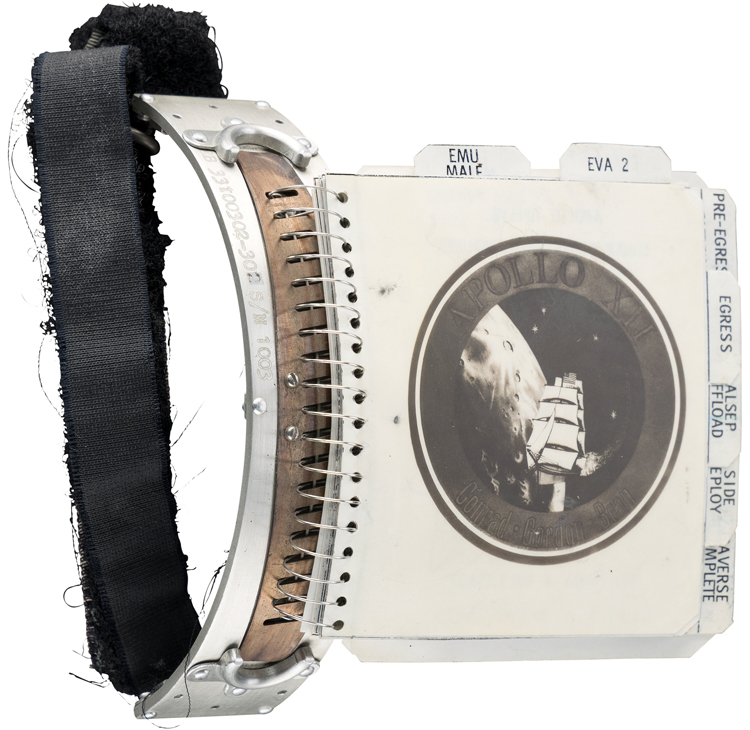
This Lunar Module Pilot wrist checklist, carried to the moon by Alan Bean, is a serious piece of lunar field equipment, but it also preserves one of the best-known private jokes ever smuggled onto the moon.
The checklist was a serious working document, cuff-mounted for extravehicular activity (EVA) use and filled with time-coded procedures for egress, traverse requirements, sample collection, Surveyor III inspection, EVA termination, emergency operations, and deployment of the Apollo Lunar Surface Experiments Package (ALSEP). But hidden among those pages were reduced Playboy images and cartoons placed as a private joke by fellow astronauts. The result is one of the most compelling cultural artifacts ever carried to the moon: a survival-critical procedural tool that also preserves astronaut camaraderie at its most irreverent. It is funny, yes, but it is also profoundly human. It reminds us that Apollo was not only machinery, mathematics, and national purpose. It was also people under pressure, doing impossible work while still finding room to laugh.
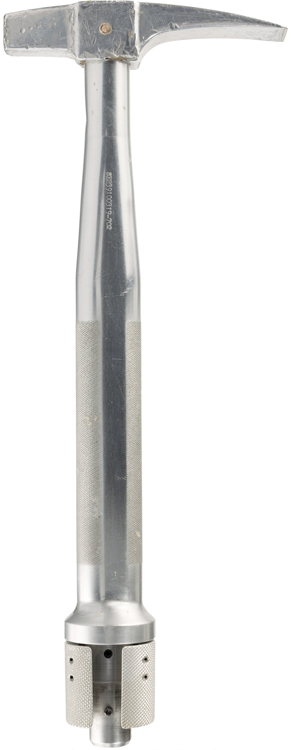
Bean’s Apollo 12 geological hammer, later used in the creation of his lunar artwork
Several of the estate’s strongest objects speak directly to Bean’s hands-on work on the lunar surface. His Apollo 12 geological hammer is one of the defining artifacts of the collection. Bean used a hammer during the deployment of the Apollo Lunar Surface Experiments Package and in lunar geology work, including sample collection and core-tube activity. His famous advice, “Don’t ever come to the moon without a hammer,” captures the practical reality of lunar exploration. The moon demanded improvisation. A tool designed for geology could become, in the moment, a problem-solver, a persuader, and a universal implement.
The hammer continued its service long after Apollo 12. Bean later used it in his studio to texture the surfaces of his lunar paintings. That second life gives the object unusual depth. It is not only a flown and surface-used lunar tool; it became part of the process by which Bean translated the physical experience of the moon into art. The same can be said of the Apollo 12 surface-used core tube bit in the collection. First used in lunar sampling, it later helped Bean create the textured surfaces of his paintings, linking scientific field work on the moon to the visual memory of Apollo on Earth.
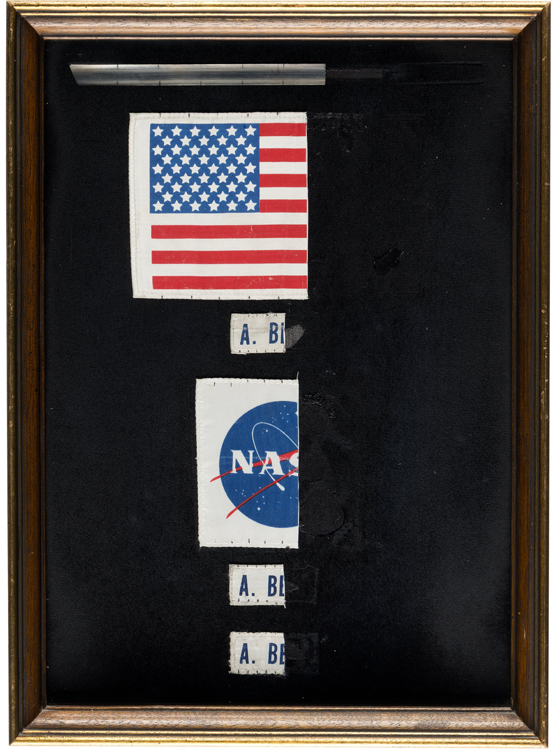
This framed display of Bean’s Apollo 12 PLSS-related patch and studio-material remnants comprises an American flag patch, a partial NASA insignia patch, three partial A. BEAN name tag sections, and a narrow metallic strip mounted above.
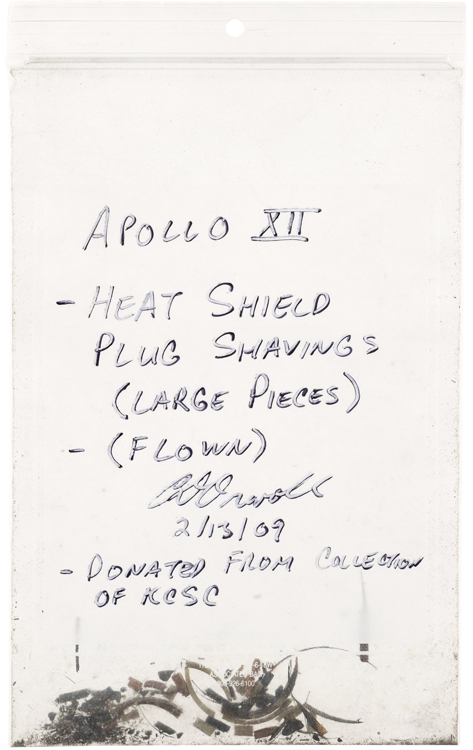
Bean used these Apollo 12 heat shield shavings in surface texturing for his paintings.
That bridge between artifact and artwork is one of the most distinctive aspects of the Alan Bean Estate Collection. Bean’s art was never merely representational. He incorporated the material reality of spaceflight into his paintings: impressions from lunar tools, textures inspired by bootprints, and tiny fragments of flown or mission-used materials. The estate includes patch remnants from Bean’s Portable Life Support System (PLSS), Apollo 12 patch remnants, and studio materials tied to his artistic practice, including pieces cut from spacesuit patches, Kapton foil from the Command Module Yankee Clipper, and heat shield shavings. These are not conventional souvenirs. They are the raw matter of Bean’s artistic method, the residue of a moonwalker transforming his own equipment and memory into paintings.
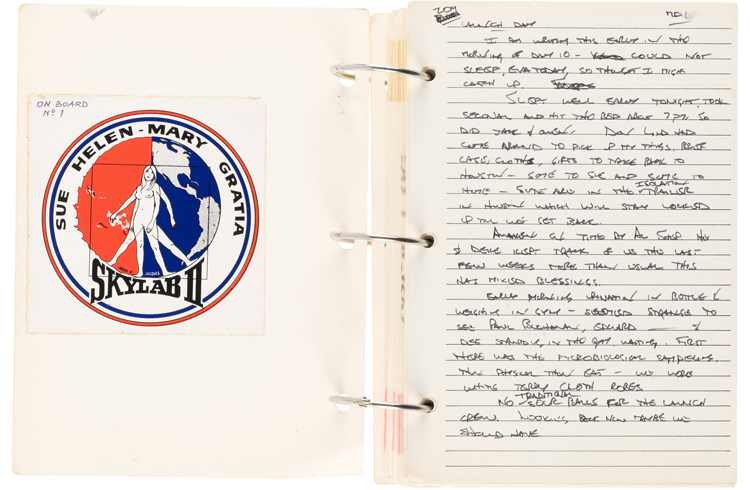
The collection also powerfully represents Bean’s second mission: Skylab II, officially designated SL-3. In 1973, Bean commanded a 59-day expedition aboard America’s first space station with Owen Garriott and Jack Lousma. Skylab was a different kind of spaceflight from Apollo. Apollo was a visit; Skylab was habitation. Bean himself captured the difference in his handwritten Commander’s Crew Log with the line, “In Apollo you go for just a visit or trip to zero G. In Skylab you live it.”
That logbook is among the most intimate artifacts in the estate. It records the rhythms of long-duration spaceflight: launch, adaptation, sickness, work pressure, morale, Earth observation, family calls, humor, fatigue, and professional pride. It is not a polished memoir written years later. It is the in-flight voice of a commander living aboard an orbital workshop and thinking in real time. For collectors, such a document offers something beyond provenance. It offers presence.
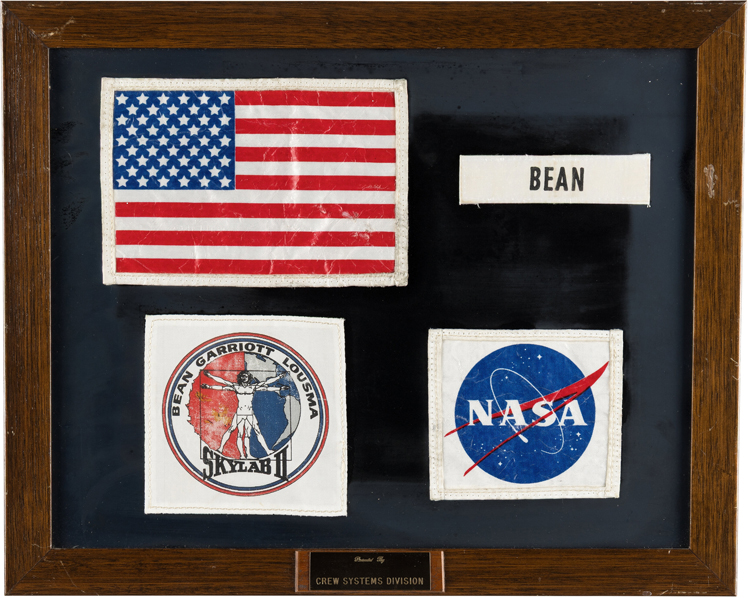
A complete framed set of four flown and worn spacesuit patches removed from Bean’s Skylab II EVA spacesuit
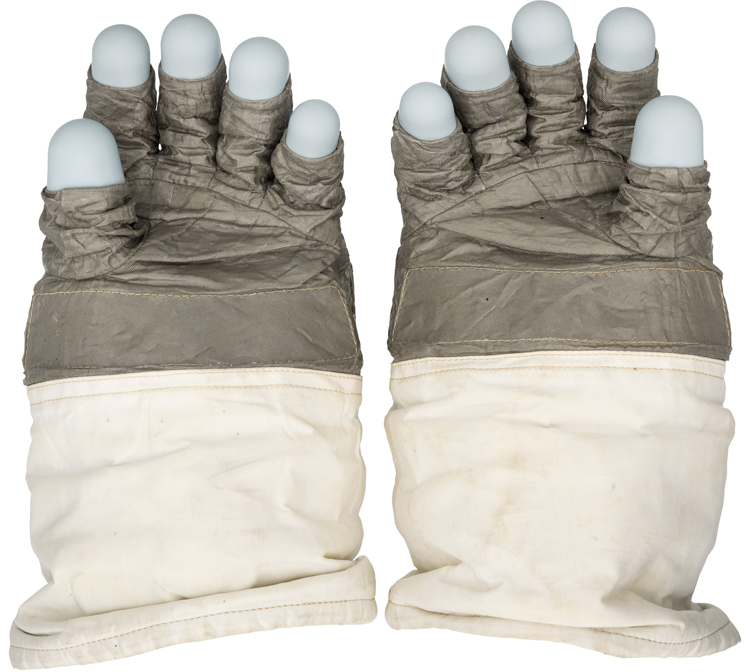
Other Skylab material in the collection carries the same immediacy. Bean’s flown and worn A7LB EVA gloves are exceptional examples of Apollo-Skylab spacesuit technology, adapted for orbital station work rather than lunar surface exploration. During Skylab, astronauts used these systems for exterior maintenance and scientific support, including work associated with the Apollo Telescope Mount. Bean’s flown spacesuit patch set, removed from his Skylab EVA suit, gives a striking visual signature of the mission: flag, NASA insignia, Skylab II emblem, and BEAN name tag. His flown coverall patches, cut from clothing before disposal aboard Skylab, add a more domestic but equally revealing detail. There was no laundry in Skylab. Clothing became consumable, and Bean preserved what mattered before the garment was discarded.
The estate also includes informal astronaut-created material, such as the humorous “Conrad Hilton Hotel” welcome sign left aboard Skylab by Pete Conrad, Joe Kerwin, and Paul Weitz for Bean’s incoming crew. It is a perfect Skylab artifact: improvised, personal, flown or onboard, and never meant for formal display. Objects like this are important because they show the emotional architecture of spaceflight. Crews lived in machines, but they humanized them with jokes, notes, nicknames, and rituals.
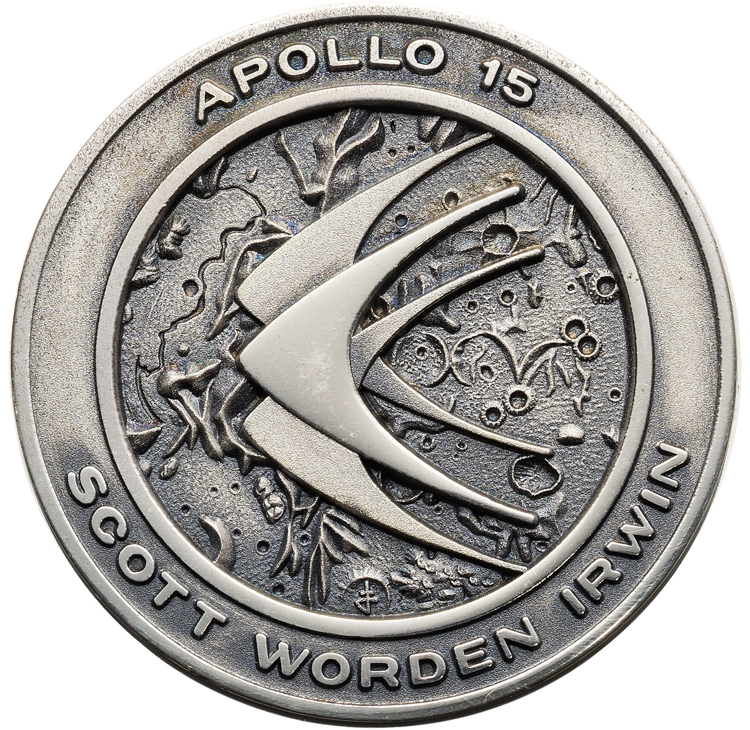
This sterling silver Robbins medallion is one of only 127 flown to the moon aboard Apollo 15 in 1971.
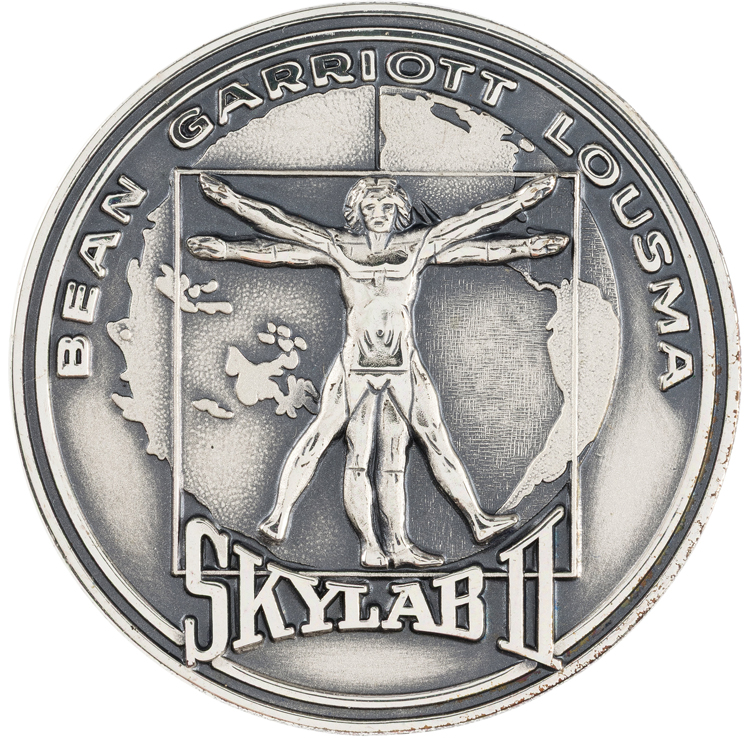
A sterling silver Robbins medallion commemorating Skylab II
The collection is rounded out by flown and unflown Robbins medallions, Manned Flight Awareness medals, Apollo and Skylab hardware, spacesuit-system components, flown-metal presentations, and engineering objects that reflect the breadth of Bean’s collecting life and career. Some pieces are classic space collectibles; others are deeply technical. Still others are nearly impossible to categorize because they occupy the borderland between artifact, relic, and art material.
That is what makes the Alan Bean Estate Collection so compelling. It is not simply a group of objects owned by a famous astronaut. It is the material biography of a man who walked on the moon, commanded a space station, preserved the humor of the astronaut corps, and then spent decades trying to show the rest of us what the moon felt like. Bean understood something collectors also understand: Objects carry memory. A hammer, a checklist, a glove, a patch fragment, a logbook page — each can hold a moment that would otherwise disappear. In this collection, the story of Apollo and Skylab is not distant or abstract. It is physical. It has worn edges, handwritten notes, Velcro straps, scratched metal, stained fabric, and the unmistakable evidence of use. These are artifacts from the working life of exploration, saved by one of the few people who could truly understand their meaning.