
WARTIME PINUPS AND GROUNDBREAKING COMIC ART — STEWARDED FOR DECADES BY COLLECTOR ROGER CLARK — CHART THE REMARKABLE EVOLUTION OF A SINGULAR BRITISH TALENT
By Rhonda Reinhart | March 3, 2026
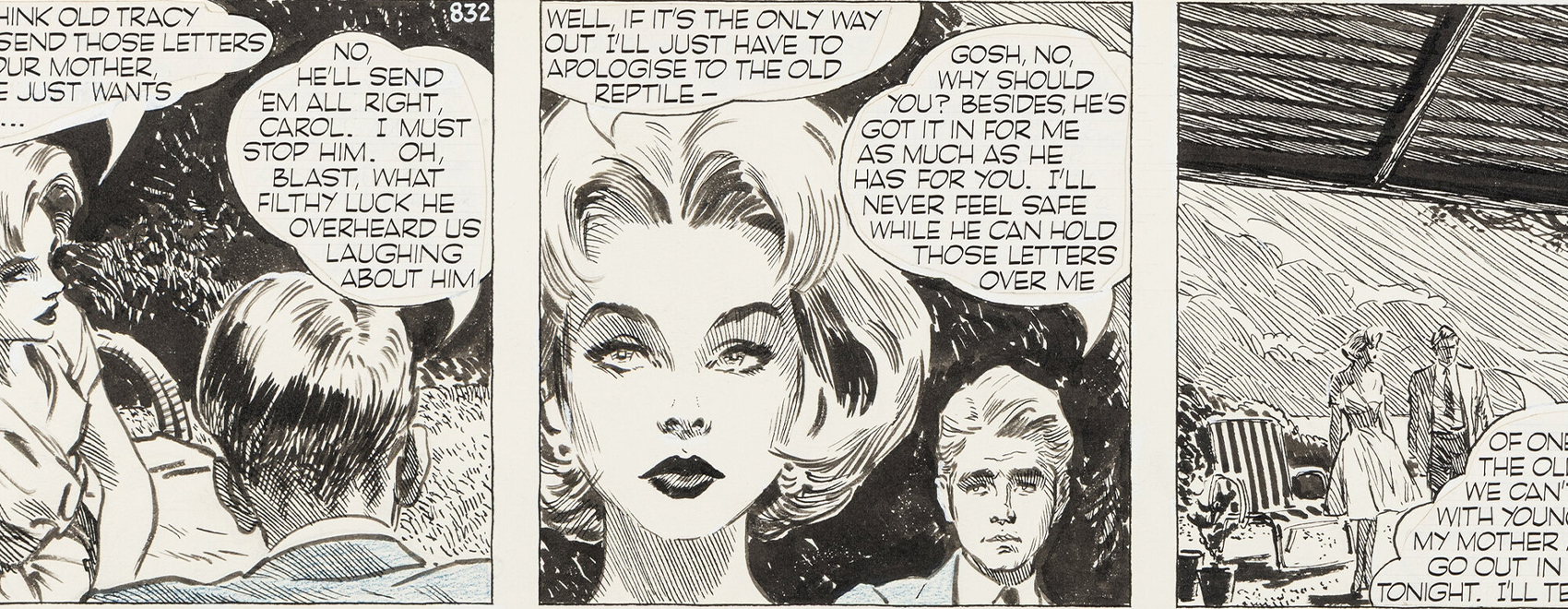
Long before Carol Day became a sensation in the pages of London’s Daily Mail, David Wright had already secured his place in British visual culture. During World War II, Wright’s elegant “lovelies” appeared in The Sketch magazine and adorned barracks walls across Britain, the refined sensuality of his images standing apart from the bold theatrics of American contemporaries like Gil Elvgren and Alberto Vargas. Where others leaned into wink-and-nudge spectacle, Wright offered poise: women adjusting a stocking, brushing their hair, or caught in a moment of unguarded glamour. His art suggested that beauty required no narrative flourish — only light, line, and restraint.
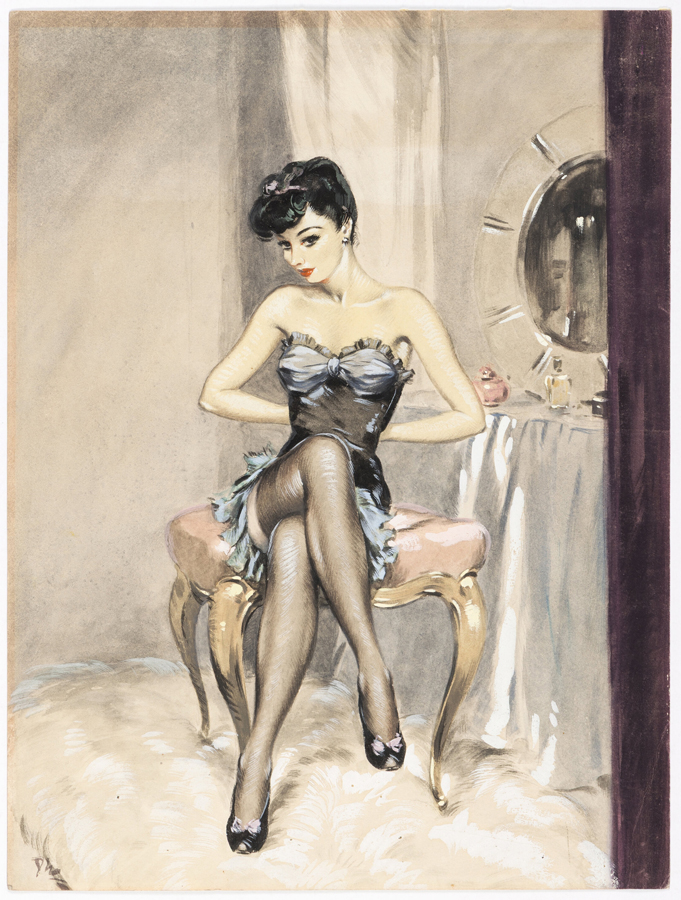
This glamour girl pinup, one of Wright’s famed ‘lovelies,’ appeared in a 1945 edition of ‘The Sketch’ magazine, right at the height of the artist’s wartime popularity.
That same mastery of line would later define Carol Day, Wright’s sophisticated newspaper strip about the adventures of a stylish young model. Celebrated for its cinematic compositions and fashion-forward realism, the strip, which ran from 1956 to 1967, cemented his reputation as one of Britain’s finest illustrators, but it was built upon decades of work in advertising, commercial illustration, and wartime pinups.
Now, Heritage presents a rare opportunity: originals from across Wright’s multifaceted career, offered from the collection of Roger Clark, a longtime steward of the Wright legacy and publisher — along with fellow collectors Chris Killackey and Guy Mills — of several Carol Day books. From early sketches and lush landscapes to Sketch pinups and Carol Day dailies, the March 5 auction reveals the full arc of an artist whose understated elegance helped define an era. Below, Clark shares insights into Wright’s enduring appeal and why his artistry still resonates today.
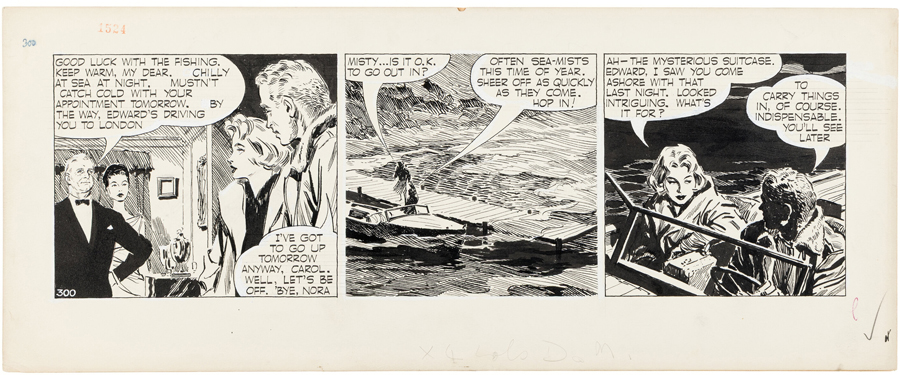
‘Carol Day’ No. 300 comic strip original art (‘Daily Mail,’ 1957)
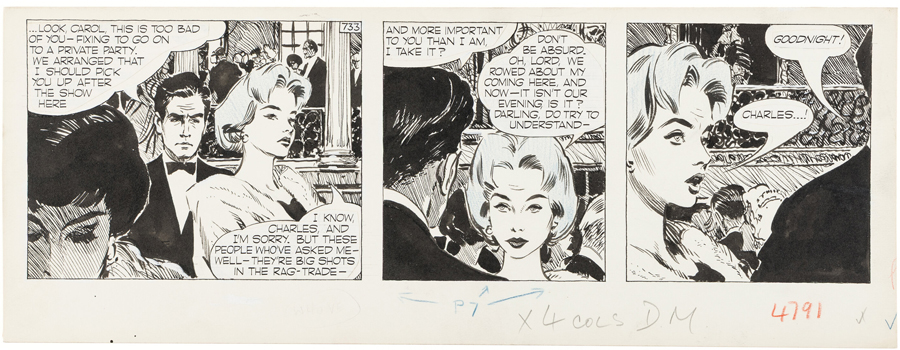
‘Carol Day’ No. 733 comic strip original art (‘Daily Mail,’ 1959)
INTELLIGENT COLLECTOR: When did you first come across David Wright’s work?
ROGER CLARK: It was in the early 2000s. A UK comic artist and critic named David Roach wrote an article in Comic Book Artist called “The Best Artist You Don’t Know.” I read that article, and that got me interested in David Wright. And then a few years later, another collector that I knew got interested in David Wright and Carol Day. He was a little more ambitious than I was at the time, and he tracked down David Wright’s son, who was the executor of his estate at that time, and connected with him. It turned out that the son had just had all of the original art returned to him, and he was looking to sell it. And so this other collector, after he bought the art that he wanted, gave my name to David Wright’s son. So he got ahold of me, and as soon as I saw it, I kind of went crazy. I just told him, “Look, I’ll buy everything. Just tell me how much you want.”
IC: Are we talking hundreds of pieces or thousands?
RC: Thousands. It was about 2,300 Carol Day originals. He drew a total of slightly over 3,500 of them, and some of them got dispersed in the 1960s, ’70s, and ’80s when one of David Wright’s sons raided the stash to sell some to collectors. But as you can see, it was largely intact. I bought about two-thirds of the entire corpus. And then over time, as people knew that I was a David Wright fanatic, I bought a few hundred more. So I ended up owning under 3,000 of them but probably about 80 or 85% of the entire run.
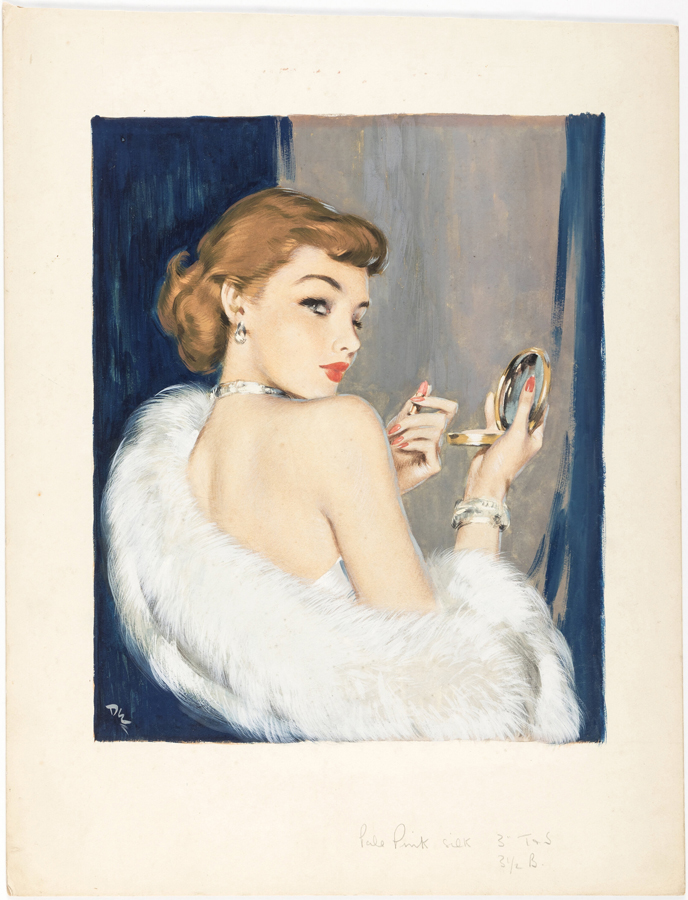
Wright’s work often romanticized the ritual of women getting ready, as evidenced by this circa-1949 painting of a woman applying lipstick.
IC: What was it about Carol Day that interested you specifically?
RC: The art is just fantastic. It’s unbelievable how good this artist is and that he wasn’t very well-known outside the UK. But the most intriguing part of it all, I think, is that the stories are just really good, and the characters are good. So when you combine that with the art, you have a comic strip that you just don’t see in the U.S. that has really sophisticated stories, sophisticated characters, and beautiful art. And so it just sort of brings everything together into a great comic strip.
IC: It was unusual for someone of David Wright’s caliber and achievement to want to draw comic strips. Is that accurate?
RC: That is accurate. He started his career as a commercial artist and as a fashion artist and pinup artist during World War II. He was Great Britain’s version of Vargas, and he was the most popular pinup artist in the country by far. He was very well-known and very well-recognized. But then in the early 1950s, he decided to make a move into comics, which was really weird because illustration art and pinup art and fashion art are so much better paid than comics. Everybody who’s in comics always wants to move the other way. They want to get into commercial art so they can start getting better paychecks. So it was a very strange move for him, but he did it, and he continued to do some commercial work after he went into comics. But for most of the rest of his life, he devoted it to comic strips.
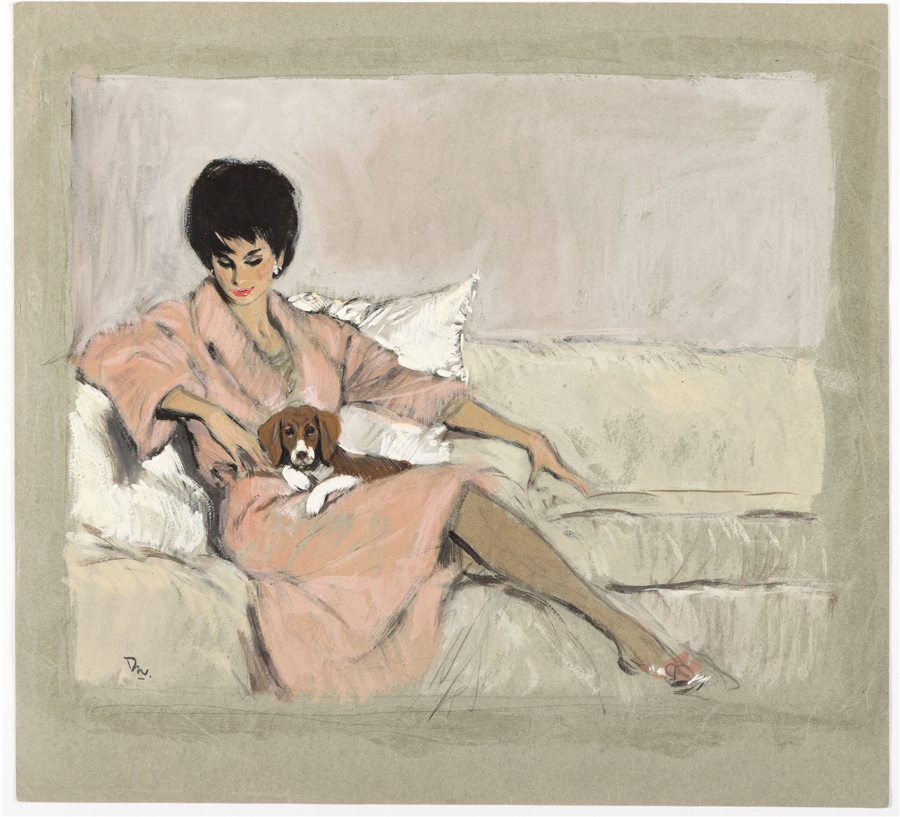
Many of Wright’s ‘lovelies’ were modeled on his wife, Esme, as was this circa-1960 work depicting a woman lounging on a sofa with her dog in her lap. The image appears on page 163 of Terry Parker’s 2013 book ‘Sirens: The Pin-Up Art of David Wright.’
IC: He must have been really dedicated to this story or these characters.
RC: He certainly was. It was his own creation, so that was part of it. Unfortunately, there aren’t very many people alive anymore who were close to him at that time who I can talk to and who can give me insight into what he was thinking. His only surviving son was way too young at the time. He hardly even knew that Carol Day existed. So I’d really like to know what the motivations were, but I haven’t been able to discover that.
IC: Do you have some personal favorites in the auction?
RC: The one called Esme Illustration Original Art from 1937 — that’s a heavy favorite. That is a magnificent piece. And Study of a Woman’s Torso — that’s a masterpiece in my mind. All of the “lovelies” are favorites of mine. And then the one titled Model with Beagle on Sofa. It’s actually his wife, Esme. I love that one, too. It is just so cool. I don’t know why I decided to sell it, frankly.
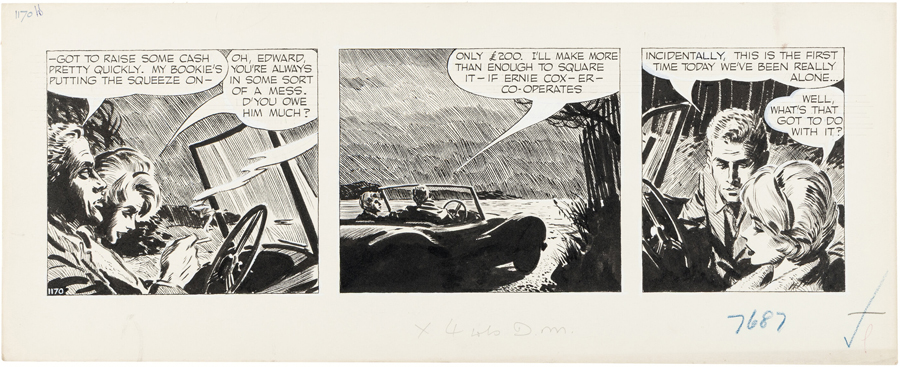
‘Carol Day’ No. 1170 comic strip original art (‘Daily Mail,’ 1960)
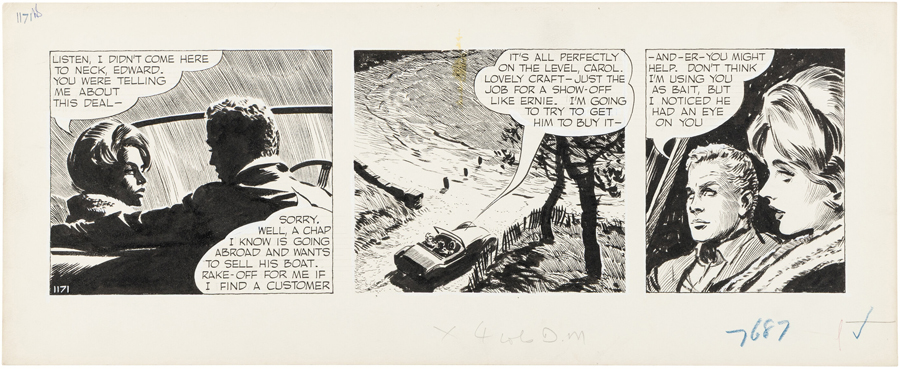
‘Carol Day’ No. 1171 comic strip original art (‘Daily Mail,’ 1960)
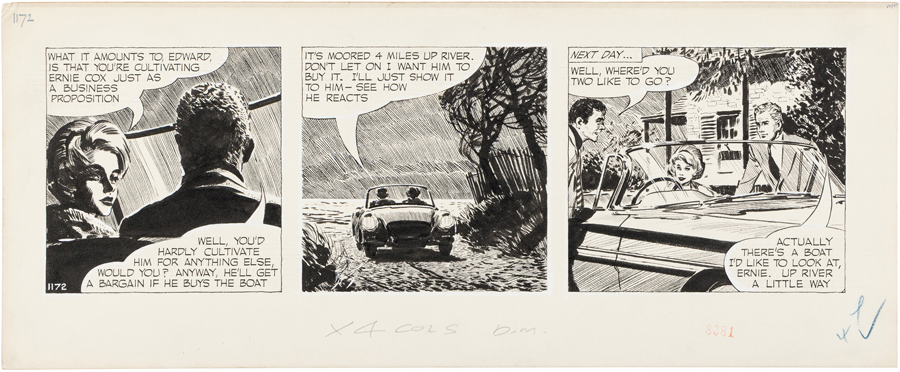
‘Carol Day’ No. 1172 comic strip original art (‘Daily Mail,’ 1960)
IC: Of the Carol Day comic strips in the auction, which ones stand out?
RC: A couple of my favorites in the strips are Number 300 — that’s a really important one — and 733. And the sequence 1170, 71, and 72. That sequence is just fantastic for the way they drive along the coast. You get the play of shadow and light on the seat while they’re driving around and talking. It’s just magnificent.
IC: When you started on this collecting journey two decades ago, David Wright was well-known in the UK but not so much in the States. Did you find yourself educating everyone you encountered?
RC: He was well-known in the ’60s and ’70s, I would say, in the UK, but by the turn of the century, he was pretty much forgotten. So one of our missions with our little publishing company was, like you just said, to educate the world about the importance of this artist and resurrect his reputation, because we just think that all of us comic art nuts should know more about this guy. His work is so beautiful.
