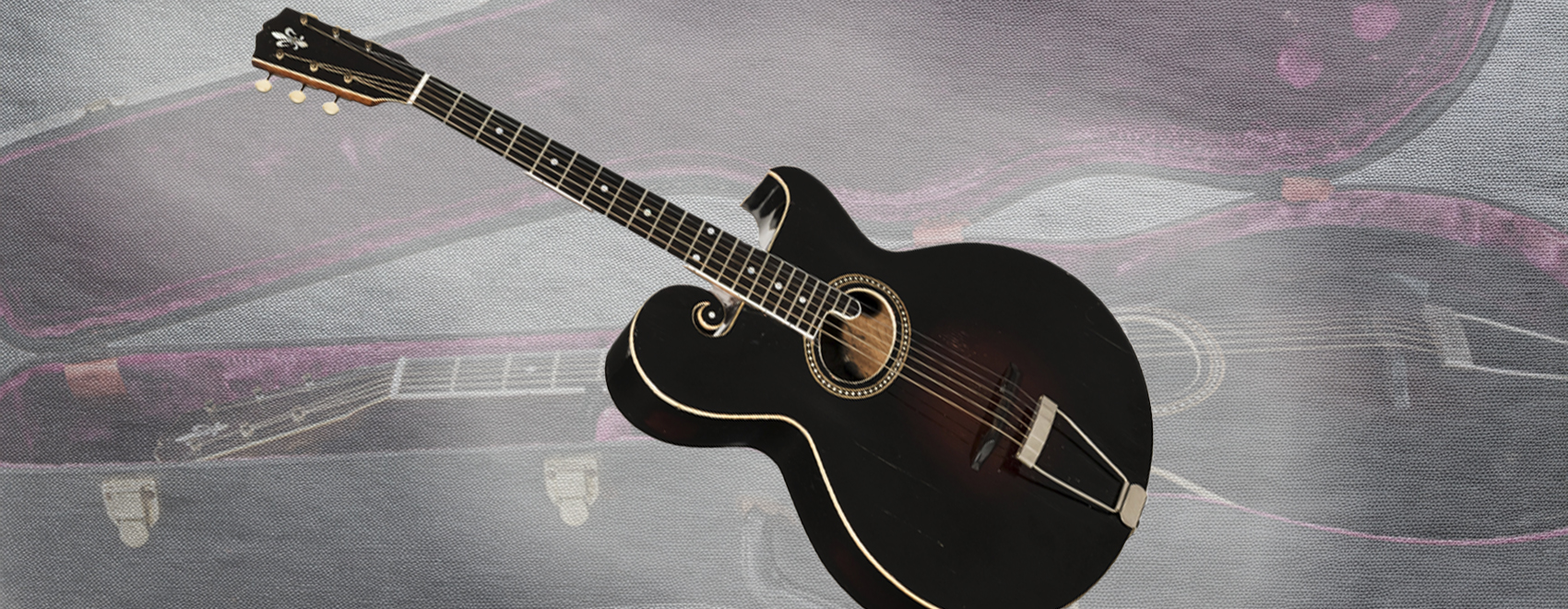
ERIC CLAPTON’S 1913 GIBSON ‘PATTIE,’ PLAYED ALONGSIDE GEORGE HARRISON DURING THEIR FABLED 1960S WRITING SESSIONS, CROSSES THE BLOCK AT HERITAGE
By Jesse Hughey | April 21, 2026
Despite some self-defeating controversial latter-career statements and stances, it would be no exaggeration to call Eric Clapton a legend. In the 1960s and ’70s, his fans might have even called that an understatement. “Clapton Is God” was among the popular sentiments expressed via graffiti in England.
He was the hotshot featured guitarist on John Mayall’s 1966 album Blues Breakers with Eric Clapton; co-founder of supergroup Derek and the Dominos, whose 1972 hit single “Layla” provides an unforgettable needle drop in Martin Scorsese’s 1990 gangster masterpiece Goodfellas; the talent behind one of the bestselling live albums of all time, Unplugged, featuring the tear-jerking “Tears in Heaven” and a reimagined version of “Layla”; and the founder of the Crossroads Guitar Festival.
But in October 1968, Clapton was at something of a crossroads himself. Cream, his power trio with Jack Bruce and Ginger Baker, was weeks away from its farewell London shows and would record the band’s October 19 concert at the Forum in Los Angeles, from which live recordings of “I’m So Glad,” “Politician,” and “Sitting on Top of the World” would be included on the band’s final album, Goodbye, the following year.
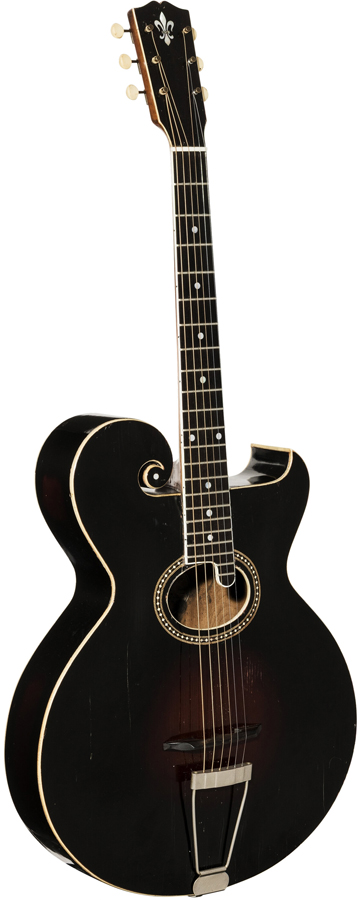
Affectionately known as ‘Pattie,’ Eric Clapton’s 1913 Gibson Style O archtop acoustic guitar is available in Heritage’s May 8 Vintage Guitars and Musical Instruments Signature® Auction. The guitar was a recurring character in the late-1960s love triangle involving Clapton, George Harrison, and Pattie Boyd.
Meanwhile, George Harrison — a close friend of Clapton’s, as well as a rival in music and more — was also at a turning point in his career, pondering a solo album and life after the Beatles as the most revered band in rock history was on the precipice of its own end. As if that weren’t enough drama, Clapton was in love with Harrison’s wife, Pattie Boyd.
Earlier that year, in the midst of this emotional and professional turbulence, Clapton had acquired a beautiful 1913 Gibson Style O archtop acoustic. The history of the guitar, serial number 14106, before Clapton possessed it has been lost to time, but it seems a safe assumption that it had been well cared for. It retained its original sunburst finish and distinctive scroll design on the upper bout — a stylish hallmark of Gibson’s pioneering archtop craftsmanship.
When he was in town for Cream’s L.A. show, Clapton brought the guitar to the Laurel Canyon home of Alan Pariser, manager of the husband-and-wife act Delaney & Bonnie. There, he met up with Harrison, and the pair had some of the most fruitful songwriting and workshopping sessions in music history. Among the songs that had their geneses in what would come to be known as the “Garden Guitar Sessions” are “Here Comes the Sun,” “Something,” “I Me Mine,” “All Things Must Pass,” “Let It Rain,” and “Presence of the Lord.”
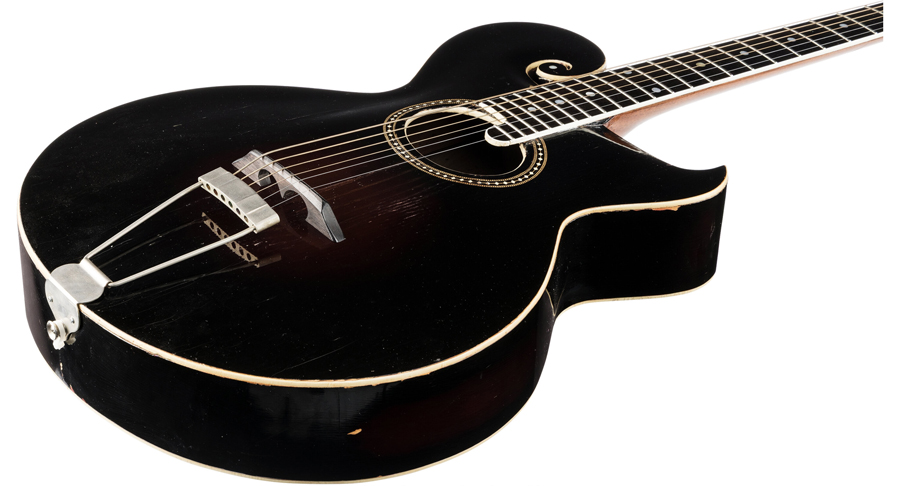
The guitar retains its original sunburst finish and stylish scroll design on the upper bout.
It was also during this time Clapton and Harrison co-wrote “Badge,” which would be released by Cream the following year — with Harrison on rhythm guitar, credited as “L’Angelo Misterioso” for contractual reasons. Fittingly, Clapton’s “Layla,” a rousing rocker about the maddening pain of forbidden love based on a seventh-century Persian poem, also sprang from these sessions.
What better name, then, for the iconic guitar the two musicians shared during these sessions than “Pattie,” after the woman in their triangle of creative and romantic collaboration and rivalry?
In the years following their Garden Guitar Sessions, Harrison had a successful solo career after the breakup of the Beatles. The title track to his first post-Beatles solo album was “All Things Must Pass,” which had its roots in Pariser’s garden, as did the Beatles’ “Something,” “I Me Mine,” and “Here Comes the Sun.” Clapton developed an addiction to heroin and stayed out of the public eye during a self-described “exile” from 1970 to 1974, but not before collaborating with Delaney & Bonnie and Blind Faith and then forming Derek and the Dominos. He recorded songs from the garden sessions with all three. Clapton kicked his heroin habit in 1973. Boyd split from Harrison in 1974 and began dating Clapton, marrying him in 1979. The marriage lasted until 1989. Harrison remained friends with both, was a guest at their wedding, and called Clapton his “husband-in-law.” The two continued to collaborate until Harrison’s 2001 death.
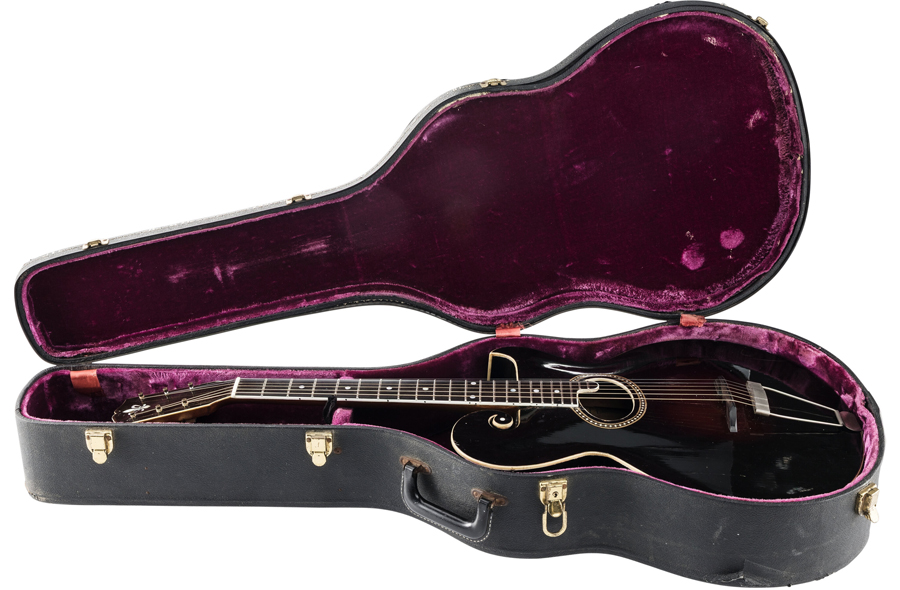
At more than a century old, ‘Pattie’ remains in good, playable condition.
As for “Pattie” the guitar, Clapton passed the 1913 Gibson on to Delaney Bramlett around 1970 during his collaboration with Bramlett’s band Delaney & Bonnie. It remained in Bramlett’s possession for nearly four decades, until his 2008 death, after which it was sold in the 2013 Bramlett estate auction.
“Pattie” is the headline lot at Heritage Auctions’ May 8 Vintage Guitars and Musical Instruments Signature® Auction, offering serious collectors the opportunity to own one of the most remarkable artifacts of rock history. It still boasts that beautiful sunburst finish and stylish scroll. Now, more than 110 years old, it remains in good, playable shape.
“Few instruments capture a personal and artistic story as vividly as ‘Pattie,’” says Aaron Piscopo, Heritage’s Director of Vintage Guitars & Musical Instruments. “This guitar sits at the intersection of love, collaboration, and some of the most influential songwriting of the late 1960s.”