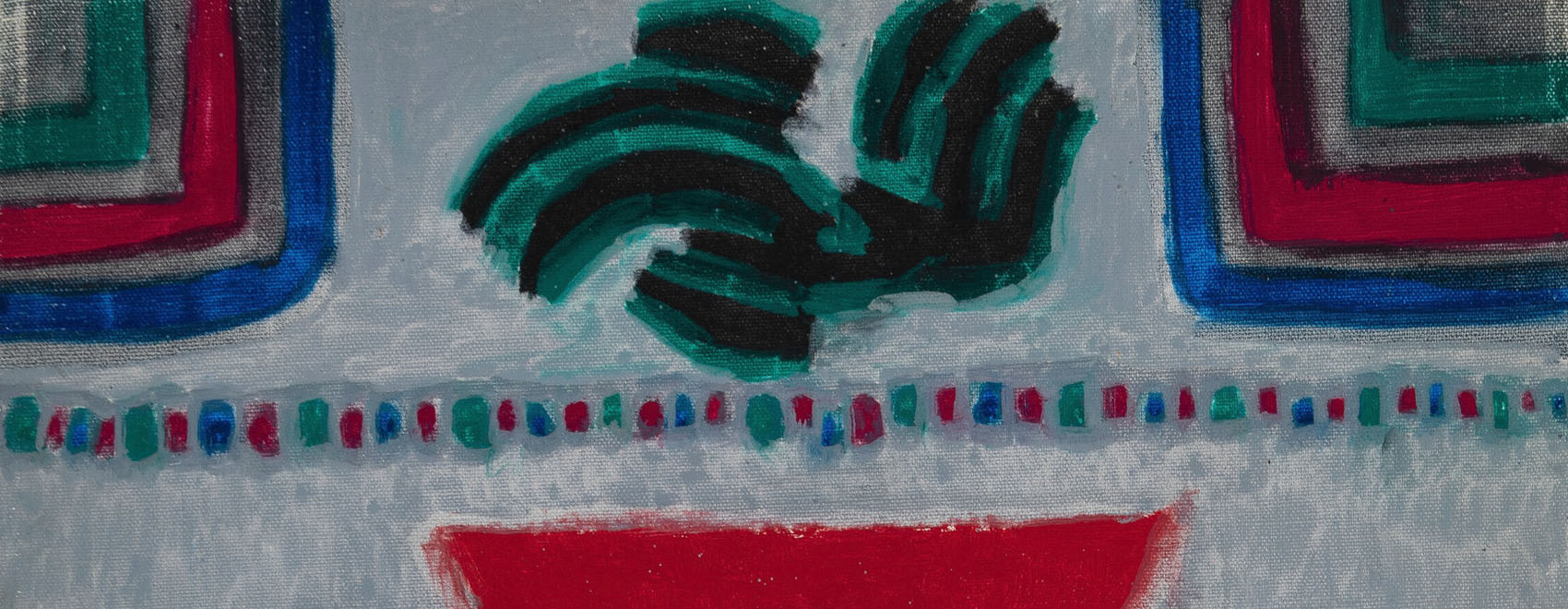
TWO NEWLY SURFACED PAINTINGS OFFER CLUES TO WHY THE KOREAN MODERNIST BRIEFLY SIGNED HIS WORK WITH A LESS FAMILIAR NAME
By Charlene Wang | October 20, 2026
Kim Whanki (Korean, 1913–1974; 金煥基) was a pioneer of Korean modernist and abstract art. Having studied in Tokyo, he worked in Seoul, Paris, and New York at different stages of his life. He was known for his warm personality, exceptional talent, and lifelong dedication to expressing the spirit of traditional Korean art through a modern visual language.
Today Whanki holds the top records for the most expensive Korean artworks sold at auction, including $11.3 million for a 1971 painting in a November 2019 auction. But long before his revered dot paintings were commanding millions, he was counting dimes in New York.
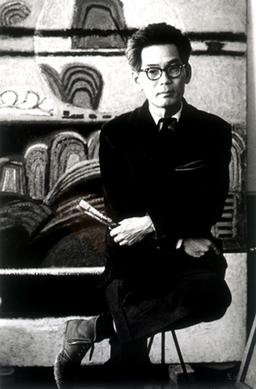
Kim Whanki, 1961
The Moon and Six Cents
When Whanki arrived in the city in 1963, he was already an established artist. He had served as president of the Korean Fine Arts Association, taught at Hongik University, and represented South Korea at the São Paulo Biennial. None of this, unfortunately, made Manhattan rent any cheaper.
He wrote in his letters to his family:
October 27, 1963
“I … had a cup of coffee and two slices of toast. I also bought another cup of coffee and a well-buttered roll for later on. Each item cost me ten cents.”
November 11, 1963
“Rent: 12 dollars a week. The room is very small and overheated because the heating regulation system is not working. … once my situation improves I shall find a larger room.”
December 12, 1963
“when I put it [a cap] on I looked terrible, I had not realized my hair was so long. So I went to a barber ($1.10, a tip of 10 cents). That was my second hair cut since leaving Seoul.”
Like many people arriving in New York City for the first time, Whanki struggled to find his footing, facing difficulties with housing, the harsh winter, costly art materials, and homesickness. He often looked at the moon and the night sky and wondered whether he had made the right choice. At times, he imagined returning to Korea, building a four-story house and turning it into a private museum. Decades later, his wife would realize a version of that dream with the establishment of the Whanki Museum in Seoul. But in the early 1960s, it remained a fantasy entertained from a small, overheated room.
His wife, Kim Hyang-an, a writer and translator, joined him in New York in 1964. She applied on his behalf for an artist grant from the John D. Rockefeller III Fund. The grant immediately improved their circumstances, enabling Whanki to move into a more suitable studio and continue painting. That same year, with support from the Rockefeller-affiliated Asia Society, he held a solo exhibition at Asia House Gallery in New York.
For a moment everything seemed promising. Whanki and Hyang-an became friends with the artist Adolph Gottlieb and his wife and met other New York dealers, artists, and curators. Yet the Asia House exhibition did not produce the breakthrough they had hoped for. A review in The New York Times interpreted Whanki’s work largely through the lens of American Abstract Expressionism and questioned its distinctly Asian character.
The review was disheartening. To Whanki, the imagery in his paintings, including the moon, mountains, birds, and varied shades of blue, was inspired by his Korean roots. His formal language may have been modern and international, but the emotional geography of his work remained deeply Korean.
Perhaps the review influenced the Fund’s decision, and the institutional purchase the couple had hoped for never materialized. Whanki still needed to find another source of income and representation.
In 1966, through a friend’s recommendation, Whanki was offered a solo exhibition at Tasca Gallery, then located at 888 Madison Avenue. Its owner, Alicia Tasca, presented him with a contract. Because his English was limited and he believed that the agreement concerned only the exhibition, Whanki signed it without reading it closely. Hyang-an later discovered that the contract also gave the gallery control over his work for a period of two years.
To make matters worse, according to Hyang-an’s account, the gallery sold several paintings but failed to pay the artist. Repeated attempts to contact Tasca became a prolonged game of hide-and-seek. The gallery eventually closed following a fire. Rumor had it that Tasca had started the fire to collect insurance money. Regardless of the fire’s cause, Whanki was never paid.
Arts International, Gallery of Discoveries
In 2025, Heritage Auctions was presented with two oil-on-canvas works by Whanki from this period. They came from a private collection in Gladwyne, Pennsylvania. The collectors had acquired the paintings from Arts International between 1966 and 1967, and the works had remained in storage until recently.
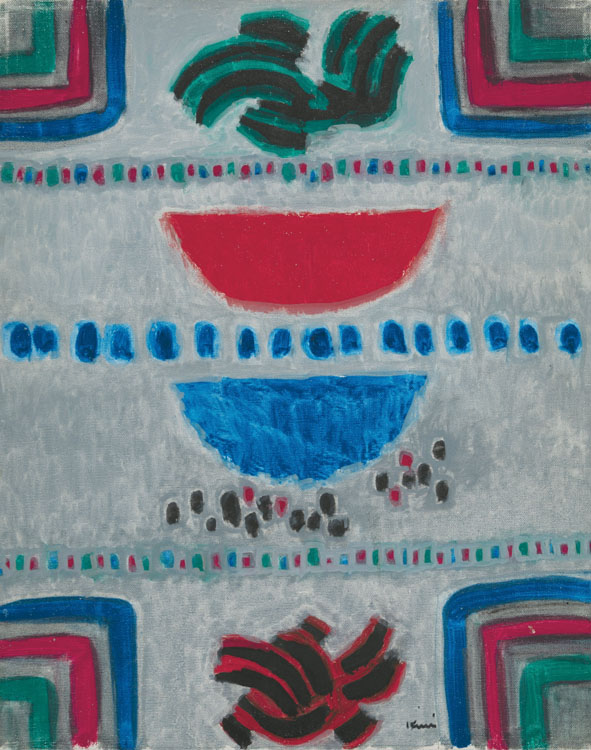
Kim Whanki ‘Untitled,’ circa 1960s. Oil on canvas. 20 x 16 inches (50.8 x 40.6 cm). Available in Heritage’s November 10 Modern & Contemporary Art Signature® Auction.
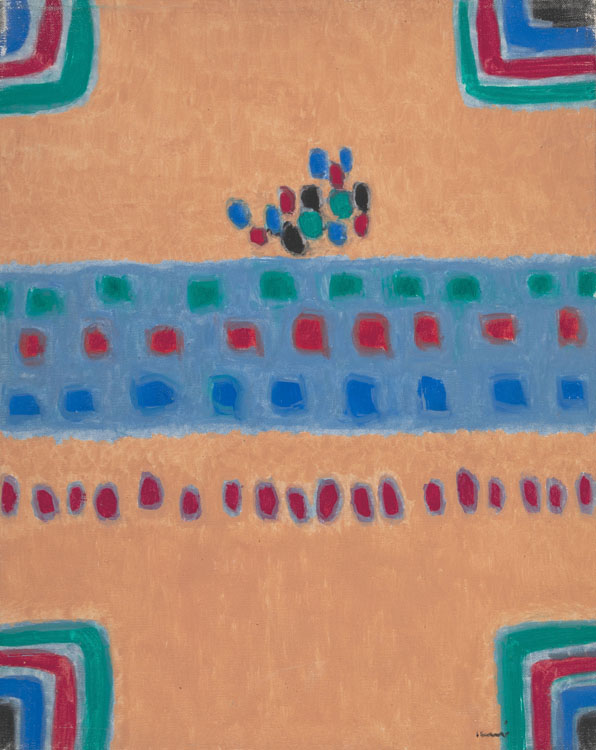
Kim Whanki ‘Untitled,’ circa 1960s. Oil on canvas. 20 x 16 inches (50.8 x 40.6 cm). Available in Heritage’s November 10 Modern & Contemporary Art Signature® Auction.
Highly characteristic of Whanki’s work from this New York period, the paintings combine blocks, geometric lines, vertical forms, and subtle modulations of color. Although abstract, they can be read as New York landscapes, evoking the city’s crossroads, street grid, and buildings.
Because Whanki’s connection to Arts International never appeared in his exhibition history, establishing the paintings’ provenance and authenticity became a prolonged research process. Fortunately, earlier this year, the Whanki Foundation and Whanki Museum confirmed that one of the paintings had already been recorded in their archive.
Two questions remained: What was Arts International, and why had it been omitted from Whanki’s biographies and exhibition histories?
Research led to a gallery network founded in 1965 by the art dealer Jack Solomon, who also established Circle Fine Art in Chicago. Unlike a conventional fine art gallery, Arts International, whose name was sometimes followed by the phrase “Gallery of Discoveries,” operated as a broad commercial enterprise, maintaining galleries and organizing touring exhibitions in cities including Chicago, New York, Scottsdale, Philadelphia, and Clayton, Missouri. Surviving works bearing Arts International labels, inventory markings, and stamps suggest that the company worked with international and lesser-known artists. It showcased their works in art fairs and trade exhibitions, giving audiences an opportunity to “discover” unfamiliar works by serious artists such as Whanki.
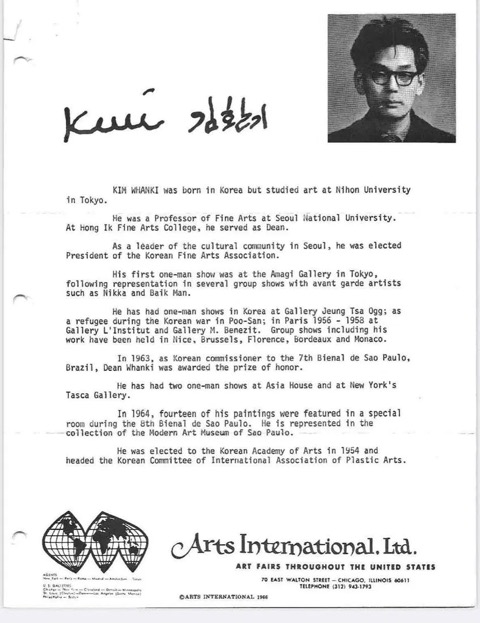
A biography of Whanki distributed by Arts International
Further research uncovered an article in The Philadelphia Inquirer reporting on an Arts International exhibition titled Lagniappe. Held in Philadelphia from December 1966 through January 1967, the five-artist group exhibition included Whanki. The location and dates correspond closely to the Gladwyne, Pennsylvania, provenance and the reported period of acquisition.
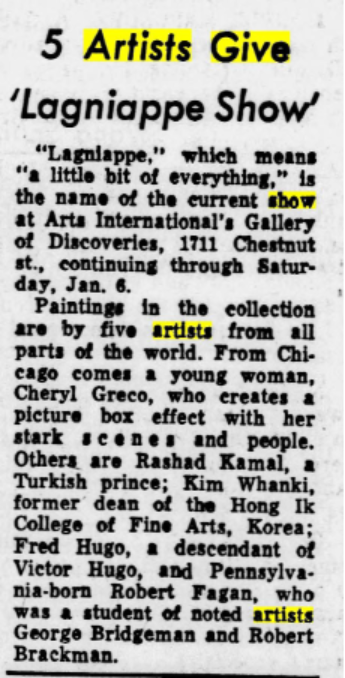
A 1966 ‘Philadelphia Inquirer’ article about an Arts International exhibition featuring Whanki
and four other artists
“Kim”
Whanki almost always signed his paintings “Whanki,” yet the two works now open for bidding in Heritage’s November 10 Modern & Contemporary Art Signature® Auction, bear the signature “Kim.” Several works in museum collections and documented exhibitions are likewise signed “Kim” and typically date from 1966. The reason for this change has never been explained.
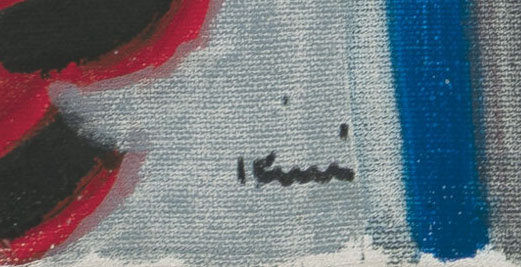
The signature on one of the untitled 1960s Whanki paintings available in Heritage’s November 10 Modern & Contemporary Art Signature® Auction
At that time, Whanki was bound by the two-year exclusive contract with Tasca Gallery, from 1966 to 1968. Without payment from Tasca or the freedom to work with other galleries, Whanki had to find creative ways to survive. He began making collages and painting on newspaper, while Hyang-an found a job to help support them both.
Although no published letters confirm the arrangement, the available evidence suggests that Whanki worked with Arts International in 1966 primarily to support the household. The works would have been exhibited outside New York. His choice to sign them “Kim” would also make sense: It was a less distinctive signature than “Whanki” and may have helped him remain discreet, perhaps out of fear of legal action from Tasca for breaching his exclusive contract.
Hyang-an managed her husband’s archive and later established the Whanki Foundation. Although she kept extensive records of his works and experiences, she never mentioned Arts International in his biography or in her book, probably for the same reason. After all, Arts International appears to have functioned as a commercial outlet rather than as Whanki’s formal gallery representative, so the relationship would not necessarily have been included in the artist’s official exhibition history.
The change in signature does not rewrite Whanki’s career, but it changes the way we see it. There is a missing chapter between the abstracted landscapes that made his name in Korea and the metaphysical dots paintings that today make millions. Before Whanki became an icon of Korean modernism, there was simply “Kim,” an immigrant artist who was forced to lose his name, in order to make his name in New York City.