

DECADES AFTER DEFINING THE LOOK OF THE 1980S, THE ARTIST’S MINIMALIST GLAMOUR IS BACK IN DEMAND AND RESHAPING HIS LEGACY
By Monica Moynihan | April 7, 2026
Patrick Nagel has been misunderstood by connoisseurs of fine art for too long. But if the past 13 years of surging sales at Heritage Auctions are any indication, the artist is finally getting his due. Known for a bold, sleek style that epitomized the 1980s, Nagel has regained popularity and a firm hold on the fine art market, all while keeping his cool factor.
In 2013, Heritage achieved its first auction record for a Nagel canvas when Her Seductive Look — featuring a wild-haired Playboy Playmate Cathy St. George wearing ’80s knee-high scrunch boots and not much else — soared to $158,500, more than tripling the artist’s previous benchmark price. Seven years later, another Nagel canvas realized $350,000. Now, during its April 21 Illustration Art Signature® Auction, Heritage is offering three standout Nagel canvases that are hitting the market for the first time.
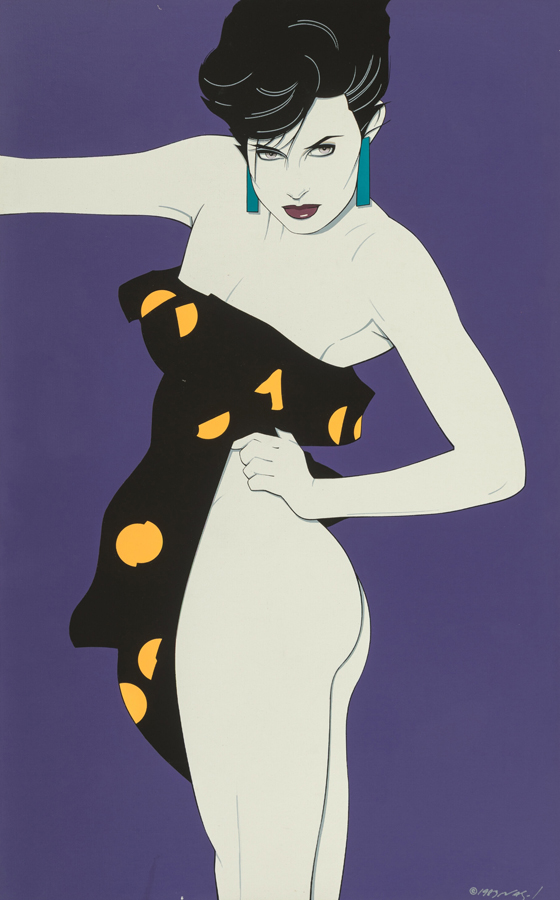
Patrick Nagel ‘Untitled (Tracy Vaccaro in Polka Dot Dress),’ 1983. Acrylic on canvas. 40-1/8 x 25-1/8 inches (101.9 x 63.8 cm). Available in Heritage’s April 21 Illustration Art Signature® Auction.
Nagel is most celebrated for painting Duran Duran’s iconic 1982 Rio album cover. The band’s sophomore album, now synonymous with the ’80s sound, cemented Duran Duran’s legacy, both musically and visually. In June 2024, Nagel’s source image for Rio was revealed on Instagram as a 1981 Vogue Paris photo featuring model Marcie Hunt. The story was covered by media outlets ranging from BBC News to Rolling Stone and even earned an Instagram repost by a surprised Duran Duran. A month later, the Rio cover charted at No. 40 on Rolling Stone’s list of “The 100 Best Album Covers of All Time.”
When Nagel died of a heart attack at 38 in February 1984, he left a body of work that defined the aesthetic of the decade. While Andy Warhol, Keith Haring, and Jean-Michel Basquiat were making their marks on the New York City art scene, Nagel was breaking ground on the West Coast. Although he was born in Dayton, Ohio, Nagel spent most of his life in Los Angeles and called himself an “LA kid.” He attended the prestigious Chouinard Art Institute in Los Angeles, where he studied fine art, and received his bachelor of fine arts degree from California State University, Fullerton in 1969. He also studied and served as a professor at the ArtCenter College of Design in Pasadena.
However, to truly understand Nagel’s work, popularity, and lasting impression on today’s art scene, one can’t dismiss the unique relationship between the artist and his publisher Karl Bornstein, gallery owner and president of Mirage Editions, Inc. The business relationship was vital to Nagel’s success and catapulted him to art stardom in the ’80s, yielding acrylic paintings, limited-edition graphics, and, of course, posters. Oh, the posters! Nagel was one of the first artists to successfully retail high-quality advertising posters as a fine art collectible, influencing how pop art was consumed. The hand-signed posters released while he was alive are still desirable, often selling in the thousands if in prime condition.
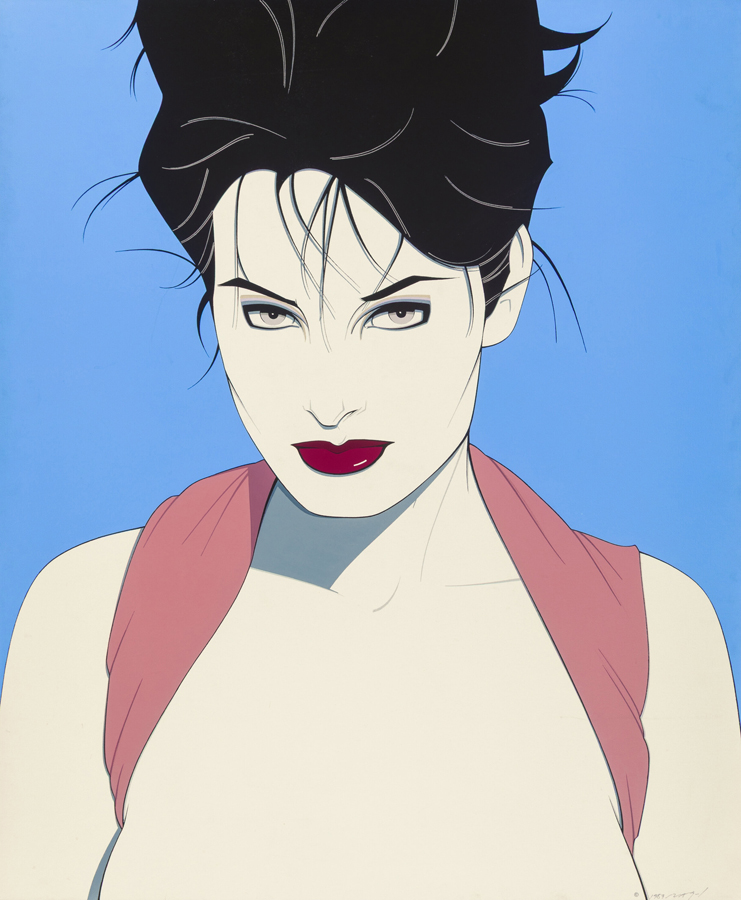
Patrick Nagel ‘Untitled (Close Up – Heidi Sorenson),’ 1983. Acrylic on canvas. 48 x 40 inches (121.9 x 101.6 cm). Available in Heritage’s April 21 Illustration Art Signature® Auction.
Nagel would go on to accumulate a prolific portfolio of editorial art for publications including Architectural Digest and Harper’s Magazine, but it was his nearly 10-year stint contributing to Playboy that earned him worldwide attention. Created for columns such as “Playboy Forum” and “After Hours,” his illustrations depicted glamorous women in high fashion and often in the buff. The loved images even found their way into Playboy editions in Europe and Australia.
Known for its flat, cool colors, Nagel’s Art Deco-influenced work depicting the female form transcended simple illustration. His unique compositions and configuring space showed off his graphic design skills and valued aesthetic perfection over strict adherence to reality. Nagel often used unusual angles and loved to boldly break the frame, likely influenced by Golden Age illustrator J.C. Leyendecker. Over time, he developed a more minimalist approach, with his artwork between 1980 and 1981 revealing a clear shift, as he looked for additional ways to strip details from his final rendered paintings. In creating the “Nagel woman,” he eliminated her eyelashes and gradients in her cheeks; her eyes became unnaturally squared, yet he left the fundamental nature of the woman’s being. Less was more. Readers of Playboy might suggest Nagel’s shift toward a more minimalist style was a practical move, one that would prevent the blurred results of his earlier, more detailed paintings being reduced to 3-by-2-inch images inside the magazine. From this decision — be it a stroke of genius or no-nonsense practicality — emerged Nagel’s signature aesthetic, which would be copied by generations of artists.
Nagel never thought himself a fine artist (“With all the world’s craziness, my work is a nice thing to rest one’s eyes on,” he told US Magazine in 1983), but his partnership with Bornstein changed the world’s view of his talent. In an era of excess, power, and materialism, Bornstein, also acting as Nagel’s manager, was always looking for more mediums to fill his gallery showroom and the Art Deco-inspired living rooms of his Mirage clients. Nagel would eventually create some two dozen large fine art pencil illustrations on board and two bronzes, but his coveted canvases, which he started painting in 1982, became the medium that solidified his status as a fine artist.
Barry Haun, Nagel’s technical assistant, witnessed the creation of each Nagel canvas but recalls the artist’s initial reluctance to work on them. “I felt Pat could appeal to a wider audience by working on canvas,” says Haun, who was in his early 20s at the time, “but Pat was concerned about the non-rigidness of material since his art was extremely precise. No hand-drawn lines, everything done with French curves. I assured him that by using lauan plywood as a backing surface, he could achieve the effect he was after, and also, by painting the edges of his pieces, no framing would be necessary.”
Haun, it turns out, was absolutely right. Nagel, Bornstein, and Mirage clients were so pleased with the results of the side-painted wrapped canvases that the workaholic artist couldn’t keep up with the demand, and the paintings instantly sold out, often before a gallery show had a chance to exhibit them. Today, Nagel’s canvases are the most sought-after artworks from his catalog.
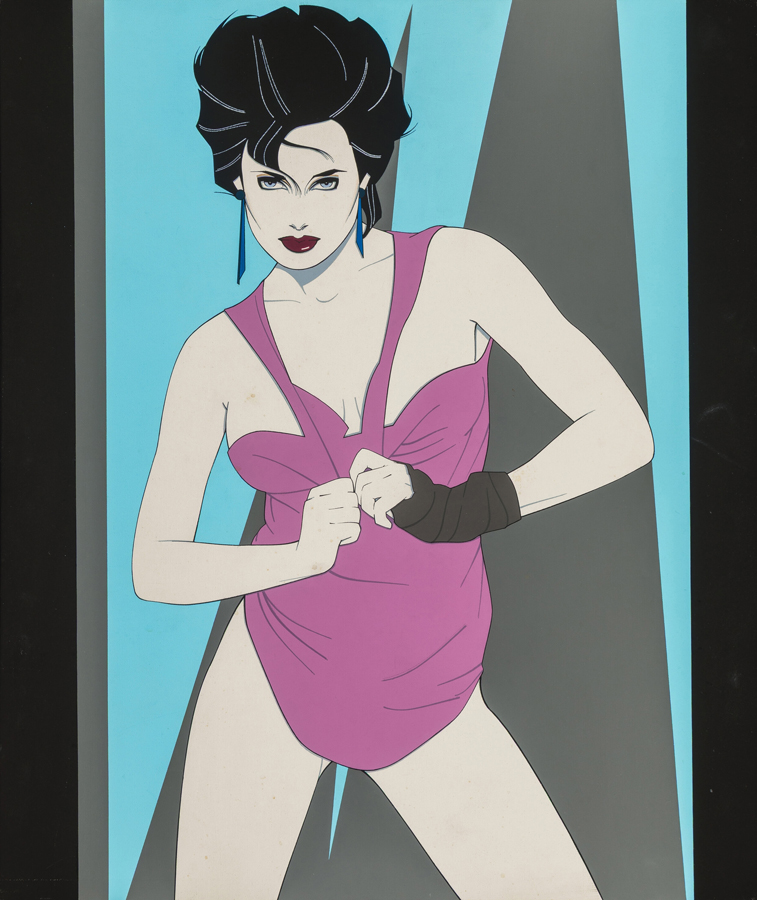
Patrick Nagel ‘Untitled, Playboy interior,’ February 1984. Acrylic on canvas. 30 x 25 inches (76.2 x 63.5 cm). Available in Heritage’s April 21 Illustration Art Signature® Auction.
All three Nagel canvases now available at Heritage were initially designed as illustrations on board for Playboy columns during the height of his career in late 1983 and early 1984. Two offer exquisite examples of Nagel’s high fashion illustration combined with his graphic design sensibility and feature fan favorite model 1983 Playboy Playmate Tracy Vaccaro. The first in line for bidding, known to collectors as Tracy in Polka Dot Dress, presents bright, bold color, including the subject’s long teal earrings and Nagel’s frequently favored use of purple and yellow. The second figurative canvas of Vaccaro displays a retro graphic “lightning” behind the model’s confident, seductive stare. The painting is ’80s decorator-friendly with a palette of gray, pink, and turquoise. Found in Nagel’s studio after he died, the work is one of the last canvases the artist would paint.
Close Up, meanwhile, is a masterful demonstration in Nagel portraiture following the massive impact of his 1982 Duran Duran Rio portrait. Nagel put himself on the map as the post-Warhol portraiture and celebrity artist on the West Coast with canvases of Dynasty’s Joan Collins, Blade Runner’s Joanna Cassidy, and ’80s “It Girl” Brooke Shields. Bornstein had plans for other celebrity portraits, too. In the foreword of 1985’s The Art of Patrick Nagel, Elena G. Millie, who was the curator of the poster collection at the Library of Congress at the time, noted that Nagel was scheduled to create a series of limited-edition silk-screen portraits of Mick Jagger.
But Close Up hit closer to home for Nagel, featuring Playboy Playmate Heidi Sorenson, a favorite model of the artist. Nagel photographed and painted Sorenson repeatedly and would tell associates, “Heidi has the perfect nose.” Another important canvas featuring Sorenson — Untitled (Heidi), 1983 — resides in the collection of Duran Duran keyboardist Nick Rhodes.
While Nagel scholars don’t know exactly how many canvas paintings by the artist exist today, some experts estimate he completed approximately 120. With attrition, that number is likely much lower now. Thankfully, with the upcoming Heritage auction, out of the shadows come three new opportunities to acquire a rare — and exceptional — Nagel canvas.
