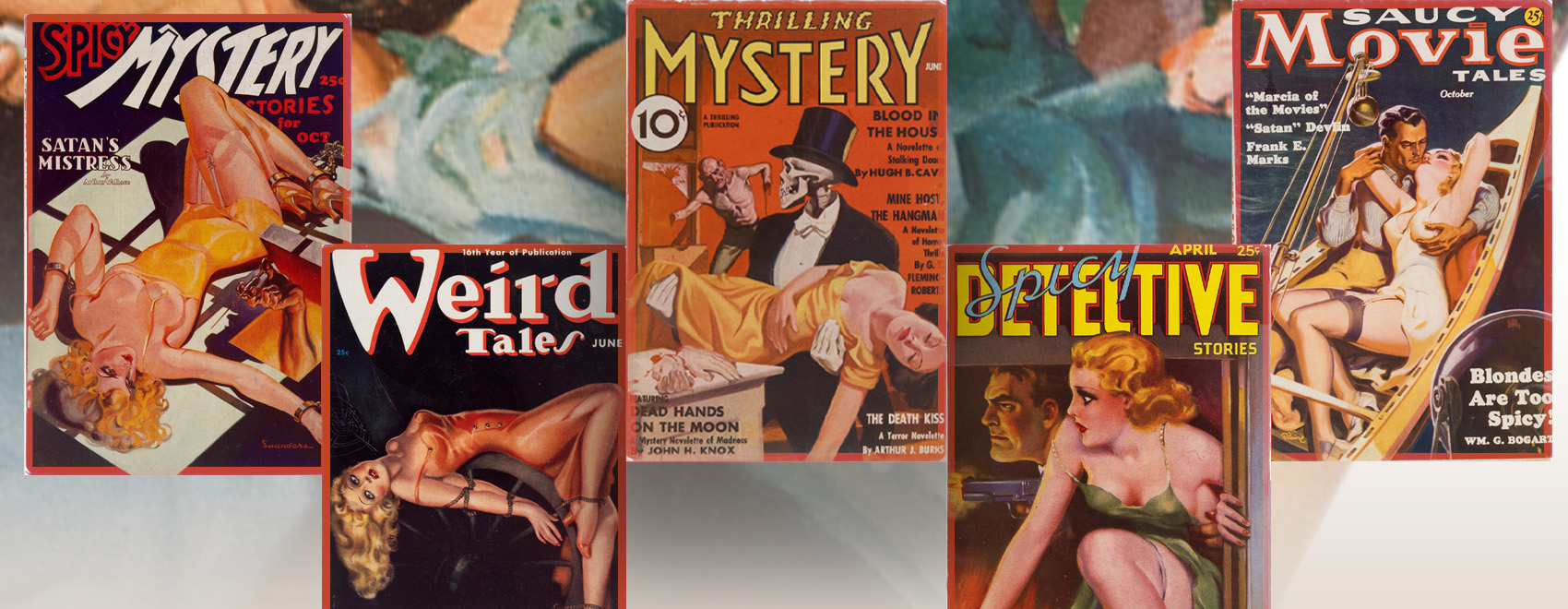
OVER 50 YEARS, DR. MELI AMASSED WHAT MIGHT BE THE GREATEST COLLECTION OF PULPS ON THE PLANET
By Jesse Hughey | November 18, 2025
I could tell he was trouble as soon as he walked into the editor’s office I cadged for the interview. Dr. Richard Meli had a story to sell, and I was in the market. Something told me this one wasn’t going to be the usual job, but that might have been the bourbon and cigarettes talking – more precisely, the lack of both in my borrowed office. Some editor. Anyway, I was in no position to turn down work. My bookie and a few various collection agents were having a friendly discussion over whose turn it was to turn out my pockets this time, a winner was going to emerge soon, and our subsequent conversation wouldn’t be so cordial. Not nearly as amicable as my conversation with Dr. Meli, that’s for sure.
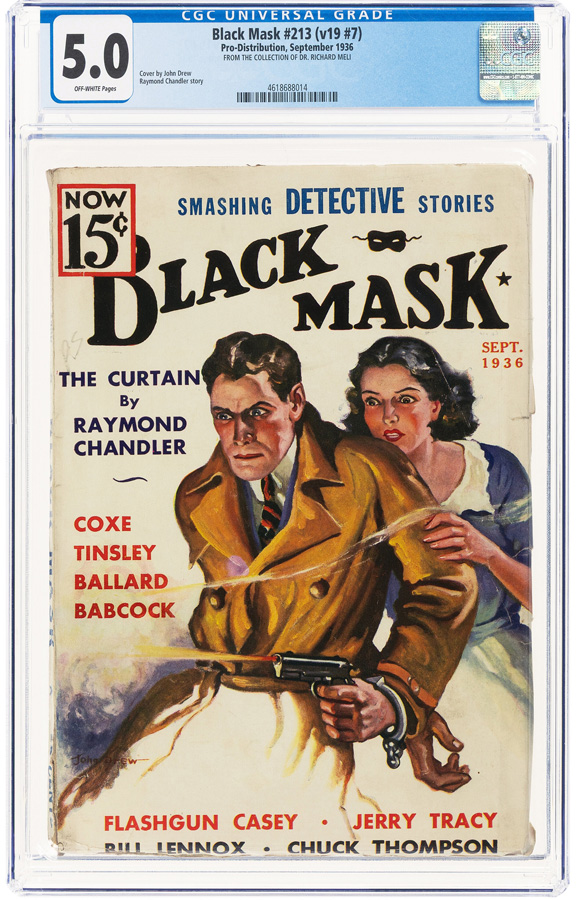
‘Black Mask’ No. 213 from September 1936 features the Raymond Chandler story ‘The Curtain.’ This copy of the issue, graded VG/FN 5.0 by CGC, is from the Dr. Richard Meli Collection and available December 4-6 at Heritage Auctions.
Dr. Meli, you see, has spent the past 50 years building one of the greatest collections of pulp magazines ever assembled, which is what got me channeling a world-weary reporter from a 1930s detective story. Renowned for his completism and his discernment, Dr. Meli has gathered the highest-quality copies possible of thousands of pulp titles. With help from his wife, Dione, whose eyes are sharpened by her work in the design and fashion world, he learned to spot the fine differences in page whiteness, cover art color, gloss, and spine condition that set the best copies apart from the rest. Dr. Meli has managed to collect high-grade complete runs of many of the most desirable pulp titles: countless classic covers, first appearances, and one-of-a-kind rarities, in unrivaled conditions. This is an accomplishment, as the cheap paper that gave pulps their name is not durable.
Now Dr. Meli is ready to share his five decades of finds with other pulp magazine collectors. December 4–6, Heritage Auctions will hold The Dr. Richard Meli Collection Pulps Signature® Auction, the company’s first Signature® auction dedicated to pulp magazines.
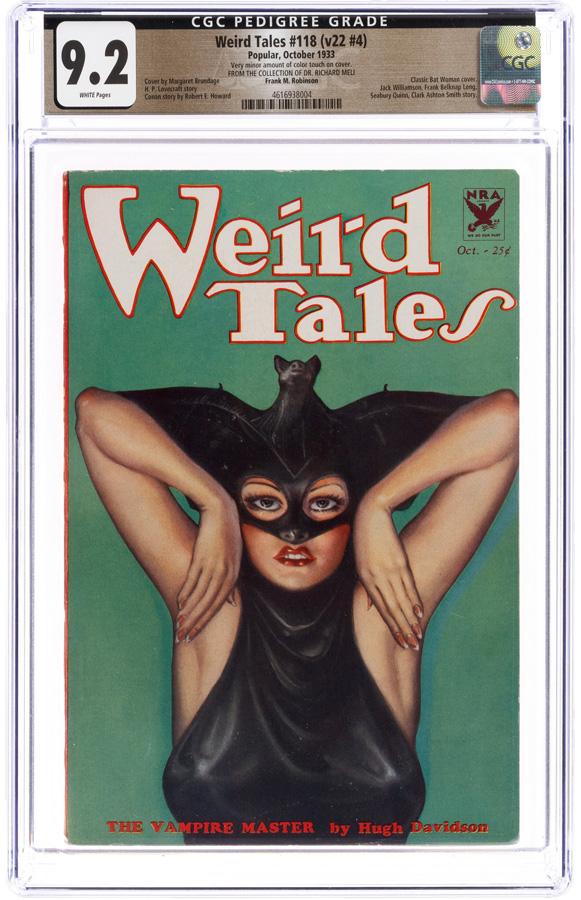
Margaret Brundage’s classic bat woman image graces the cover of 1933’s ‘Weird Tales’ No. 118. This example from Dr. Meli’s collection, graded NM- 9.2 by CGC, is the sole highest-graded copy of the single most popular pulp magazine.
Considered an antecedent to comic books, pulps date back to the 1890s and enjoyed their greatest popularity in the 1920s to 1940s. They were known for sensational and lurid genre fiction – science fiction, mysteries, horror, adventure tales – but the category also encompassed family-friendly popular fiction. Legendary horror writer H.P. Lovecraft, Tarzan creator Edgar Rice Burroughs, and Conan the Barbarian creator Robert E. Howard were among those who got their starts in pulps, not to mention detective authors like Raymond Chandler and Agatha Christie. Detective tales feature prominently in Dr. Meli’s collection, which includes some of the earliest issues of the iconic mystery title Black Mask. Renowned cover artists like Margaret Brundage, best known for her Weird Tales cover paintings, and Norman Saunders, remembered for creating the Mars Attacks cards of the 1960s, figure heavily as well.
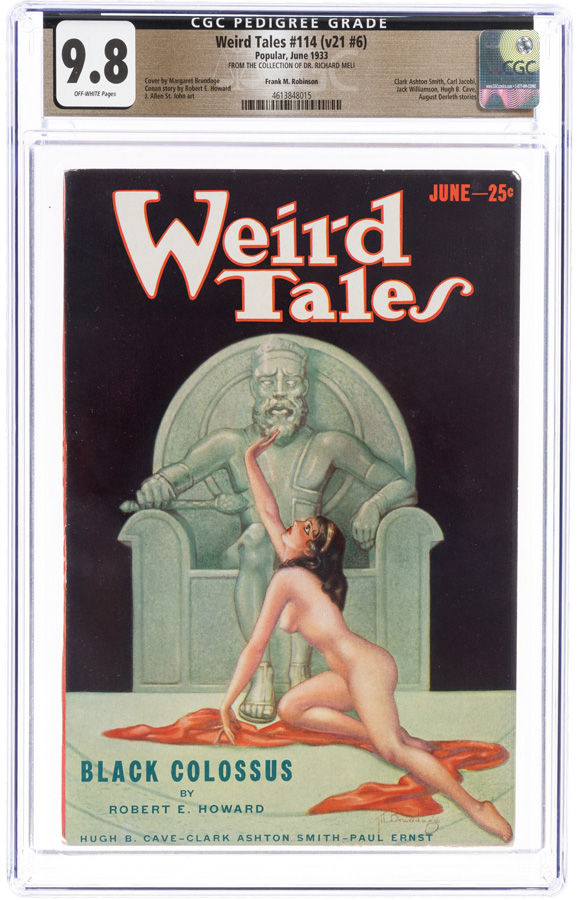
Graded NM/MT 9.8 by CGC, this copy of ‘Weird Tales’ No. 114 from June 1933 is the nicest example that exists of this highly coveted issue. The cover is by Margaret Brundage for the Conan story ‘Black Colossus’ by Robert E. Howard.
Following are highlights of my conversation with Dr. Meli, edited for length and clarity.
INTELLIGENT COLLECTOR: What are some misconceptions about pulps, or things people are surprised to find out?
RICHARD MELI: This was pre-World War II, and some even World War I, a time when people didn’t have TV, so pulps were read to the whole family. There were pulps for things like war; there were pulps for mystery. In the early 20th century, they were general. They started with a pulp called Argosy in 1896. It was a magazine that became a pulp, and they had fiction stories. It was basically popular culture entertainment for people who didn’t have television, and everybody read them. They had love pulps for women; they had general pulps that were very adventure-oriented, in the 1900s. And in the ’20s and ’30s they started to specialize in detective. All science fiction came from the pulps. [Publisher] Hugo Gernsback actually coined the term scientifiction. He started a title called Amazing Stories. All today’s household names – the pioneers of science fiction like Isaac Asimov, Ray Bradbury, Robert Heinlein – they came up in the pulps. A lot of them were teenagers. All that writing that has evolved into what we have today, the roots are back in those science-fiction pulps and detective pulps.
There are so many different series and characters that comics took hold of and really expounded on them in a more illustrative way rather than a fictional way. [Superman creators Jerry Siegel and Joe Shuster], they were teenagers reading Amazing Stories, and they used to write in to Letters to the Editor. So a lot of comic book people and writers came from the pulps.
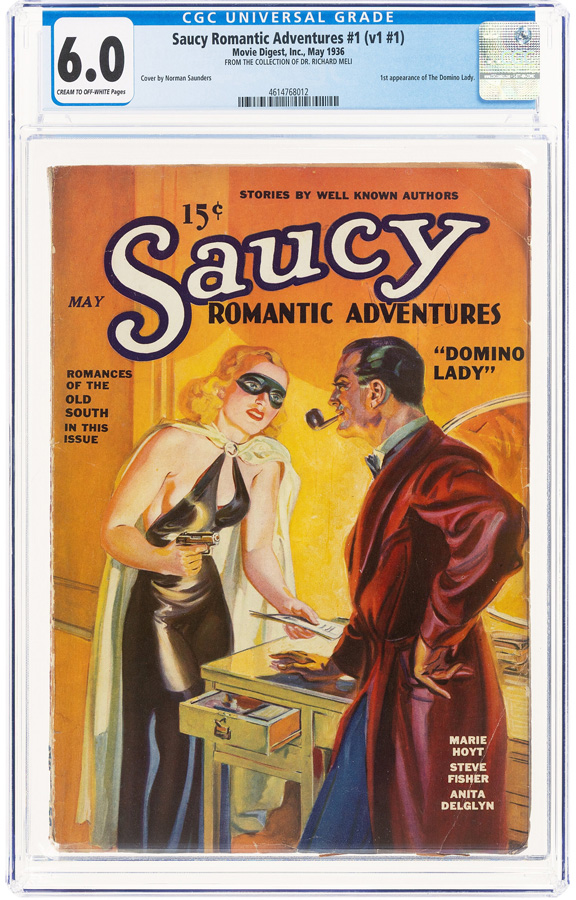
IC: It seems like the fragility of pulps is part of their appeal to collectors. You’ve said there is an art to preserving them.
RM: That’s the challenge in finding them. They were printed on newsprint. That’s where the word pulp comes from, and they found a cheap way to mass-produce paper. The sun yellows them in a couple hours. They become very brittle. So that was my challenge, to find ones in beautiful shape. They were printed in the thousands, but very few survived in beautiful shape. So I’ve searched for 50 years to find the ones in the most beautiful shape, which I feel they’re one of a kind and almost beautiful pieces of art.
IC: How do you keep them in such good shape?
RM: I’ve had them all my life in an air-conditioned room, completely darkened, in mylar bags, temperature- and humidity-controlled. I drove a lot of air-conditioning folks crazy over my life. You know, 68/68 is what we look for: 68 degrees and 68% humidity. And in the dark – I would never open the window.
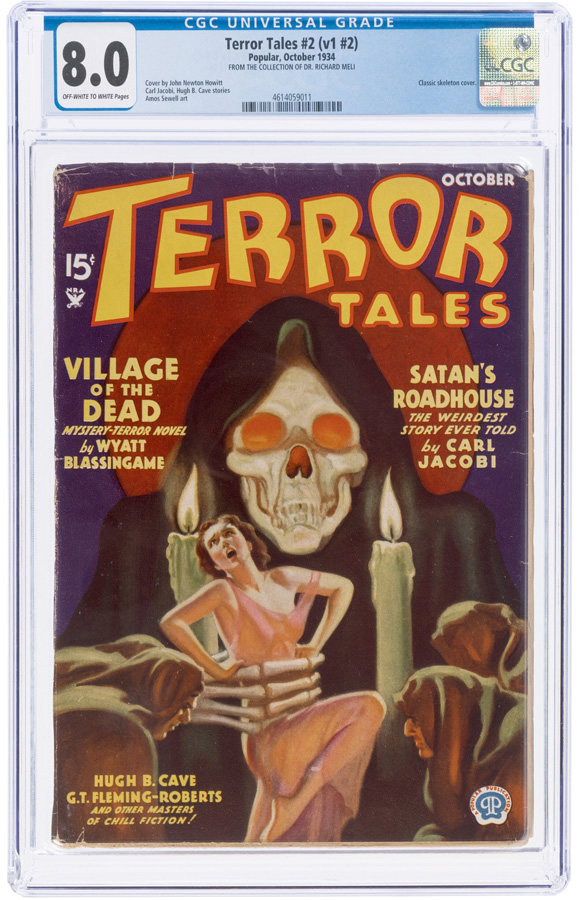
John Newton Howitt provided the classic skeleton cover for 1934’s ‘Terror Tales’ No. 2. This copy of the issue, graded VF 8.0 by CGC, is in exceptional condition.
IC: So before CGC [the third-party grading company, which expanded from comics and trading cards into pulp magazines in 2024], was it basically the eyeball test?
RM: Exactly. What I would do when I upgraded and I would have two, I would ask my wife, because she has the sharper art eye: What has the better cover gloss, what looks better? And the two of us would put it in the light to make sure we could see. We would switch them around [to compare them to each other], make sure it wasn’t the glare.
IC: How did you find good copies without using the internet?
RM: It was very hard. It would be advertising in the Comics Buyer’s Guide and then at conventions. And whenever I would go into a city, I would look at every bookstore in the city. I would go to sellers’ houses. It was all through long-distance phone calls, which was expensive, and letters and advertising in magazines. A lot of travel.
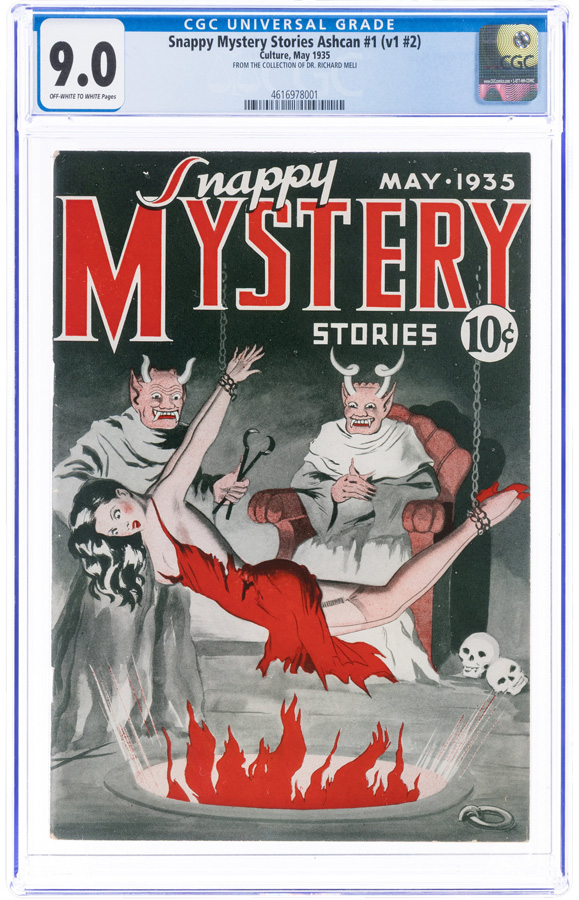
This rare ashcan for May 1935’s ‘Snappy Mystery Stories’ No. 1 is the only known copy in existence. It preceded the launch of ‘Spicy Mystery Stories’ the following month.
IC: Do you have a particular trip that stands out?
RM: Well, my favorite experience was when I’d visit Frank Robinson. [Robinson was an author and influential pulps collector known for obtaining high-grade complete series runs. CGC now recognizes the Frank M. Robinson Pedigree.] We used to go to San Francisco. It’s a beautiful city, and my wife and I loved to go there. We loved to go to Frank’s house. He was really the pioneer connoisseur of beautiful, high-grade pulps, and he would show us these beautiful, beautiful pulps. When his collection went to auction, that was really the seminal event of my collecting. I used to have all the Mystery Detectives and Spicys in beautiful shape, but he had every single science fiction and Weird Tales pulp in immaculate condition, and I bought almost every single one of his complete runs.
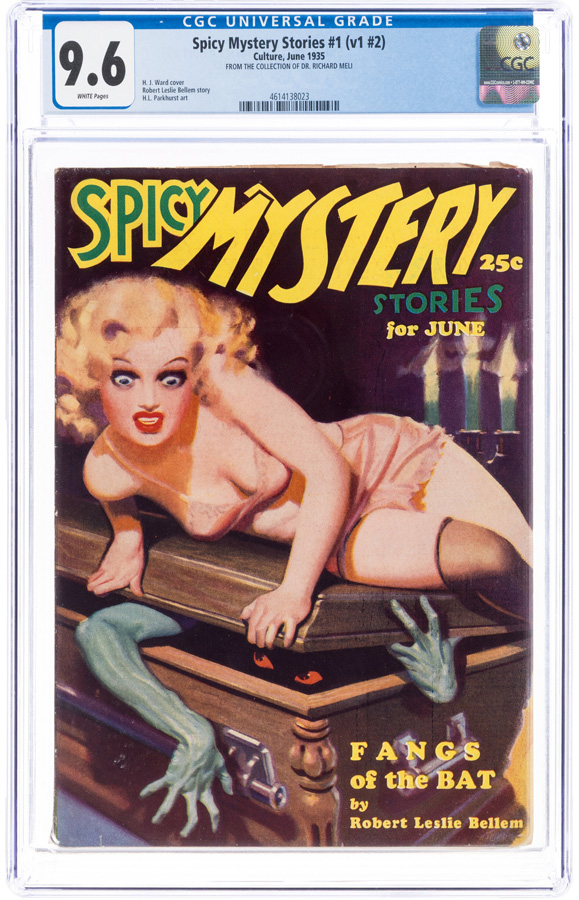
Not only is this copy of 1935’s ‘Spicy Mystery Stories’ No. 1, graded NM+ 9.6 by CGC, the highest-graded example of the issue, but it is also the sole highest-graded CGC copy of any ‘Spicy’ pulp.
IC: Are either of your sons interested in pulps?
RM: My younger son, Thomas, is a little. He started working with me a little on them.
IC: I imagine you’re holding back a lot to pass on to him.
RM: No. Not a single book. My entire collection is at Heritage. I wasn’t going to hold back a few good ones. I gave them every single pulp.