IN HIS LANDMARK 1986 PORTFOLIO, THE POP ART MASTER REIMAGINES THE PEOPLE, OBJECTS, AND MYTHS THAT SHAPED AMERICA’S VISION OF THE WEST
By Aviva Lehmann and Desiree Pakravan | October 6, 2026
“This is the West, sir. When the legend becomes fact, print the legend.” —Maxwell Scott, portrayed by Carleton Young, in The Man Who Shot Liberty Valance
The American West has always existed somewhere between landscape and romance. It is a place on the map, but also a place in the imagination — a horizon shaped by adventure, freedom, danger, conquest, love, and loss. Long before Andy Warhol turned his attention to the subject, the West had been transformed by dime novels, Wild West shows, Hollywood films, television, advertising, and political memory. Its figures had become larger than life, its objects heavy with symbolism, and its history inseparable from the stories America chose to tell about itself.
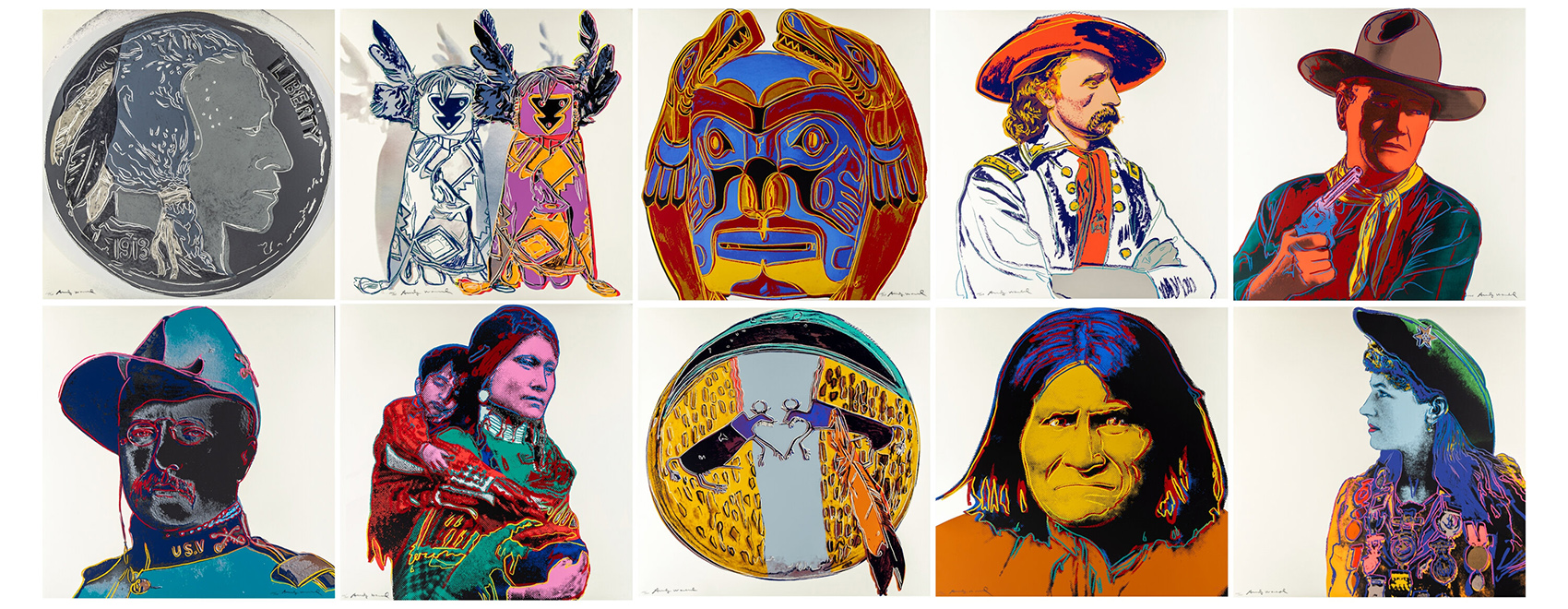
Warhol understood the power of those stories. Growing up in Pittsburgh, he was fascinated by Hollywood and especially by Westerns. He later made two Western films of his own: Horse in 1965 and Lonesome Cowboys in 1968. In the portfolio Cowboys and Indians, created in 1986, Warhol returned to the subject on a grand scale. Across 10 monumental screenprints — offered in Heritage’s October 22 Prints & Multiples Signature® Auction as a complete portfolio with its original box — he brought together actors, historical figures, Native American subjects, ceremonial objects, and commercial symbols. Each image belongs to the history of the West, but each also belongs to the history of representation.
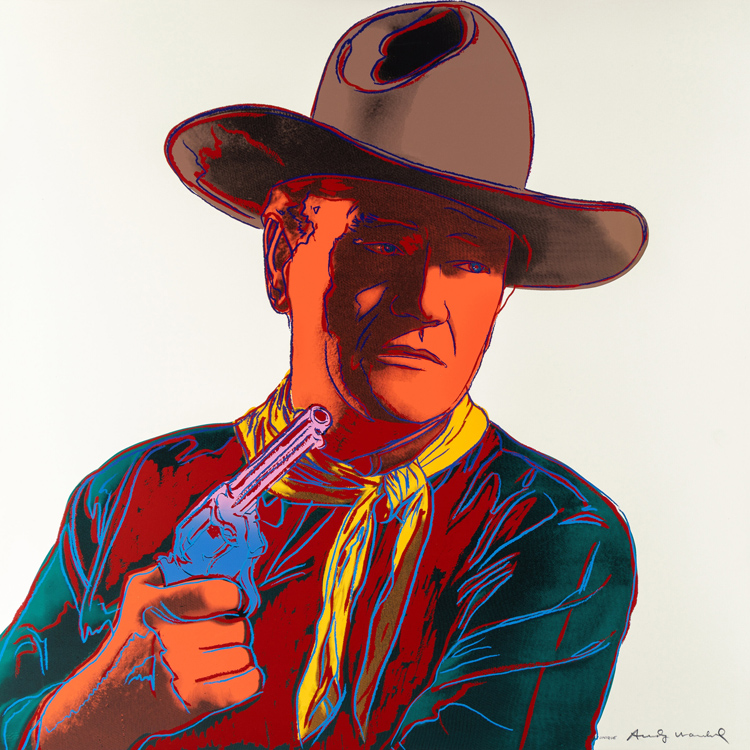
Andy Warhol’s ‘John Wayne,’ from ‘Cowboys and Indians,’ 1986, a complete portfolio of which is available in Heritage’s October 22 Prints & Multiples Signature® Auction
In a discussion of Warhol’s prints, the philosopher and critic Arthur C. Danto identified this talent precisely: “Warhol’s political gift was his ability to make objective as art the defining images of the American consciousness.” In Cowboys and Indians, Warhol applies that gift to one of America’s most powerful inventions: the myth of the West. He takes images already embedded in the collective imagination and makes them unmistakably his own. Familiar faces and forms are removed from their original settings and recast as Warhols — bold, brilliant, and immediately recognizable.
Warhol’s cast of characters moves easily between celebrity and history. He approaches these Western subjects with the same visual language he used to immortalize Marilyn Monroe, Elizabeth Taylor, and Jacqueline Kennedy. Beginning with photographs or objects already shaped by public circulation, he crops away the surrounding world, isolates each face or figure, and reconstructs it through silkscreen, emphatic outlines, and unexpected color. Just as Marilyn came to represent Hollywood glamour and Jackie a nation’s grief, the figures in Cowboys and Indians reflect the people, stories, and symbols that shaped America’s idea of the West.
In John Wayne, Warhol begins not with a cowboy from history, but with Hollywood’s definitive performance of one. The image derives from Wayne’s appearance in John Ford’s 1962 film The Man Who Shot Liberty Valance. Beneath his broad-brimmed hat, Wayne stands with one hand holding his revolver. Warhol heightens every element of the pose: the shadow beneath the brim, the flash of the scarf, the hard outline of the gun, and the physical authority of Wayne’s stance.
Wayne is transformed from actor into archetype. The cinematic cowboy is reduced to a single, instantly understood image. Warhol’s method recalls his treatment of Marilyn Monroe, whose face he borrowed from a studio publicity photograph and separated from the complicated life behind it. Both figures become portraits of America projected through fantasy: Marilyn embodies the dream of beauty and fame, while Wayne embodies the dream of masculine courage and frontier justice. The present impression carries the additional distinction of being designated “unique,” setting it apart from the editioned impressions associated with the portfolio.
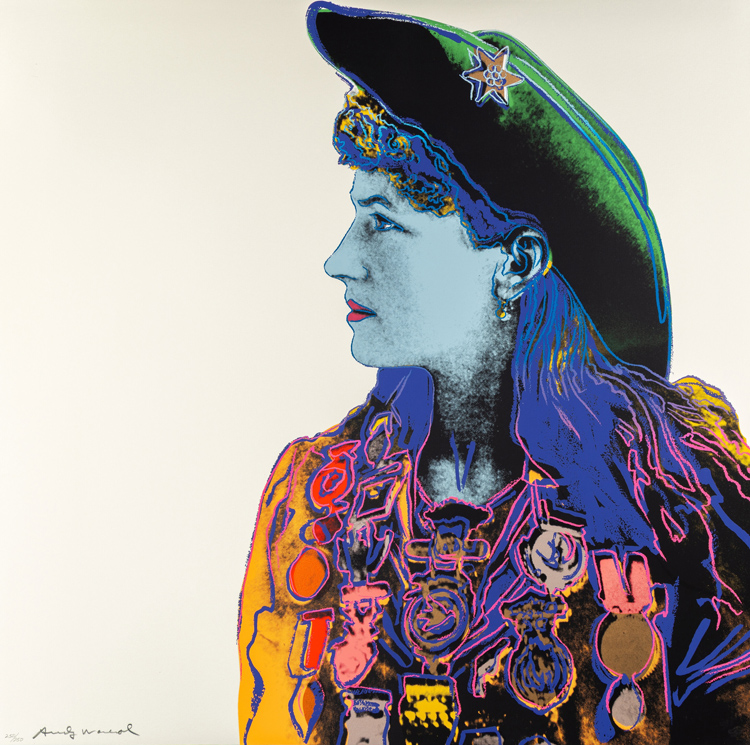
Warhol’s ‘Annie Oakley,’ from ‘Cowboys and Indians,’ 1986
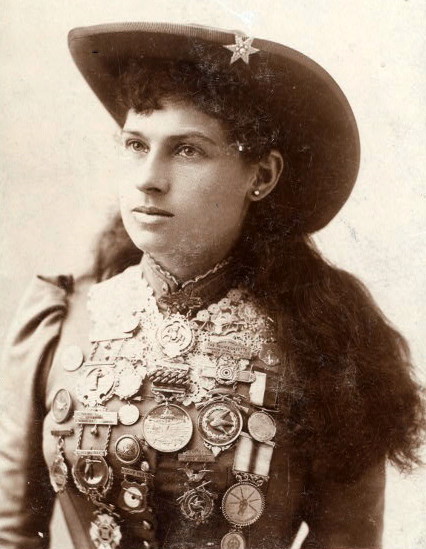
The circa-1890 portrait of Oakley that inspired Warhol’s depiction of the legendary sharpshooter
Annie Oakley possesses a different kind of glamour. Warhol draws upon a circa-1890 cabinet-card portrait showing the celebrated sharpshooter in profile, her jacket crowded with medals and ribbons. He translates those decorations into a cascade of violet, orange, and blue. Warhol turns the medals and ribbons marking Oakley’s many achievements into the colorful details of a celebrity portrait.
Oakley understood the power of self-presentation long before Hollywood perfected it. Through Buffalo Bill’s Wild West, studio photographs, posters, and international appearances, she became both an accomplished performer and a carefully constructed public image. Warhol recognizes her as an early American superstar — a woman whose fame depended not only upon what she could do, but also upon how she was seen.
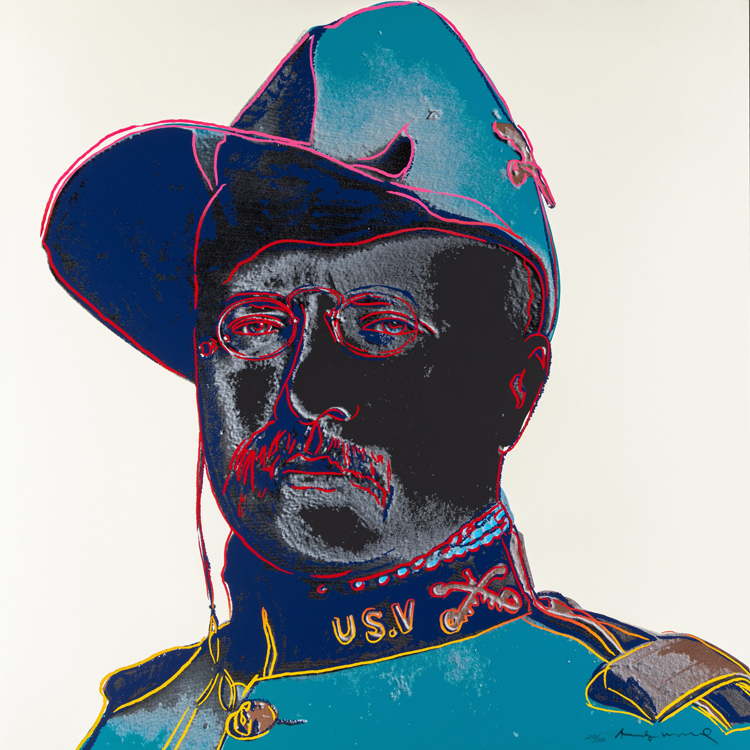
Warhol’s ‘Teddy Roosevelt,’ from ‘Cowboys and Indians,’ 1986
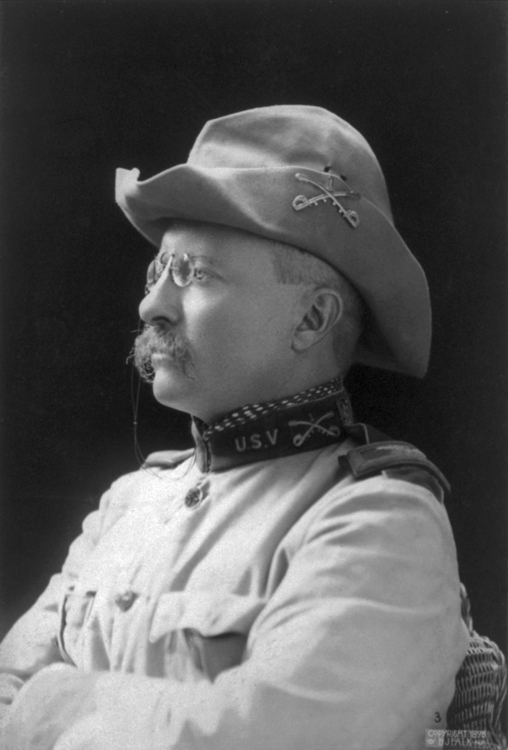
Warhol based his Roosevelt portrait on this 1898 photo of the future U.S. president.
In Teddy Roosevelt, Warhol uses an 1898 photograph of the future president dressed in his Rough Rider uniform. Deep blues cover much of Roosevelt’s face, while the details of his uniform, insignia, and crossed sabers stand out in bright color. Warhol makes the uniform as important as Roosevelt himself, turning him into a powerful symbol of strength, patriotism, and America’s heroic view of the West.
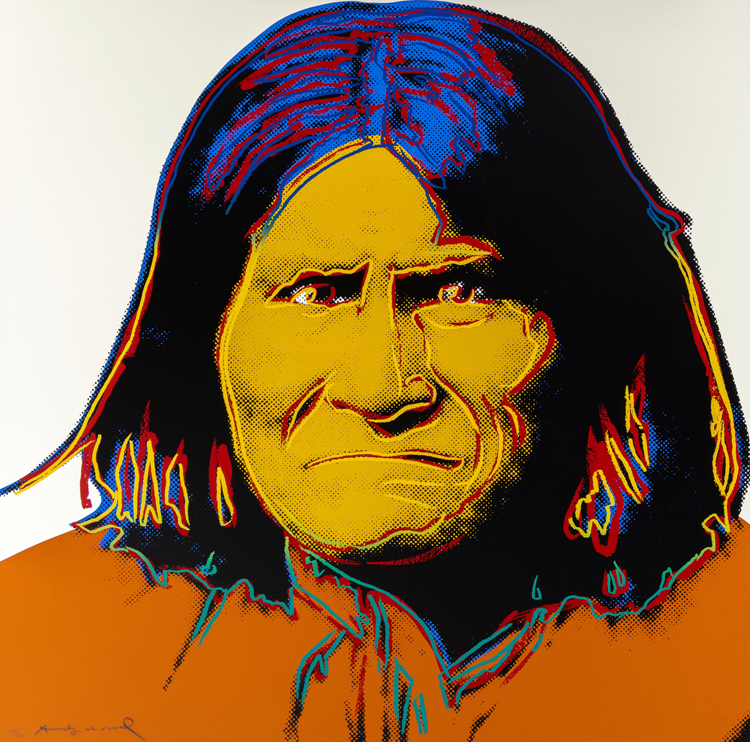
Warhol’s ‘Geronimo,’ from ‘Cowboys and Indians,’ 1986
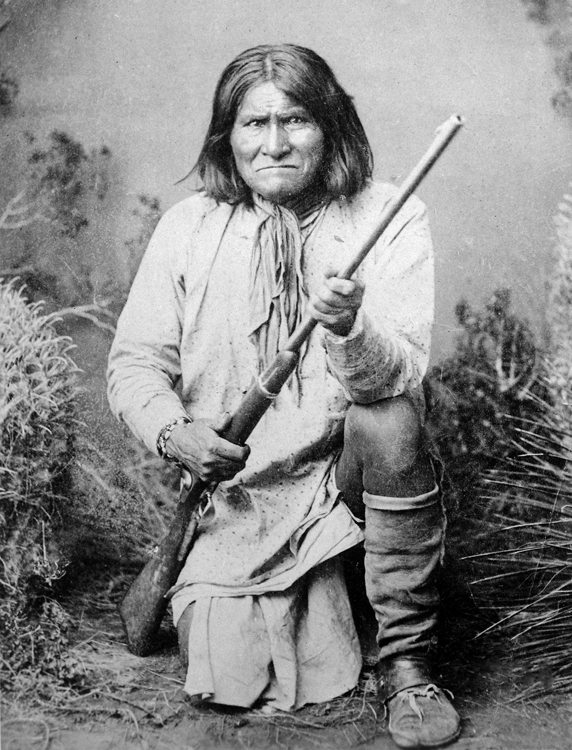
A photo by the American frontier photographer A.F. Randall inspired Warhol’s image of Geronimo.
Geronimo is arguably one of the portfolio’s most striking images. Warhol based the print on a late-19th-century photograph by A.F. Randall, cropping the portrait closely and adding bold areas of yellow, orange, black, and blue. With no background to distract us, the focus stays on Geronimo’s face and direct gaze. His serious expression stands in sharp contrast to the more theatrical image of John Wayne’s Hollywood cowboy.
The contrast is deliberate and unsettling. Wayne represents the West as Hollywood imagined it, while Geronimo was a real person whose life and image also became part of American legend. Warhol places them in the same portfolio without explanation, leaving the viewer to consider the very different histories behind these equally familiar images.
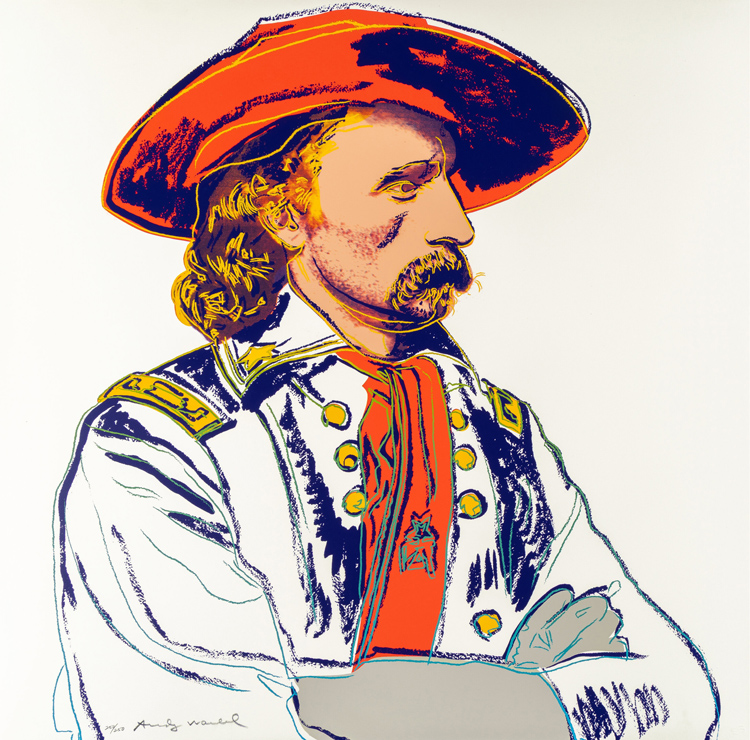
Warhol’s ‘General Custer,’ from ‘Cowboys and Indians,’ 1986
In General Custer, Warhol takes a formal portrait and turns it into a bold image of American ambition. Custer appears not simply as a man, but as a legendary figure tied to both the romance of the frontier and the disastrous Battle of Little Bighorn. Like many of Warhol’s celebrity subjects, Custer’s public image has become more familiar than the complicated history behind it. Warhol does not tell us how to judge him; he simply presents the image and allows us to bring our own understanding of history to it.
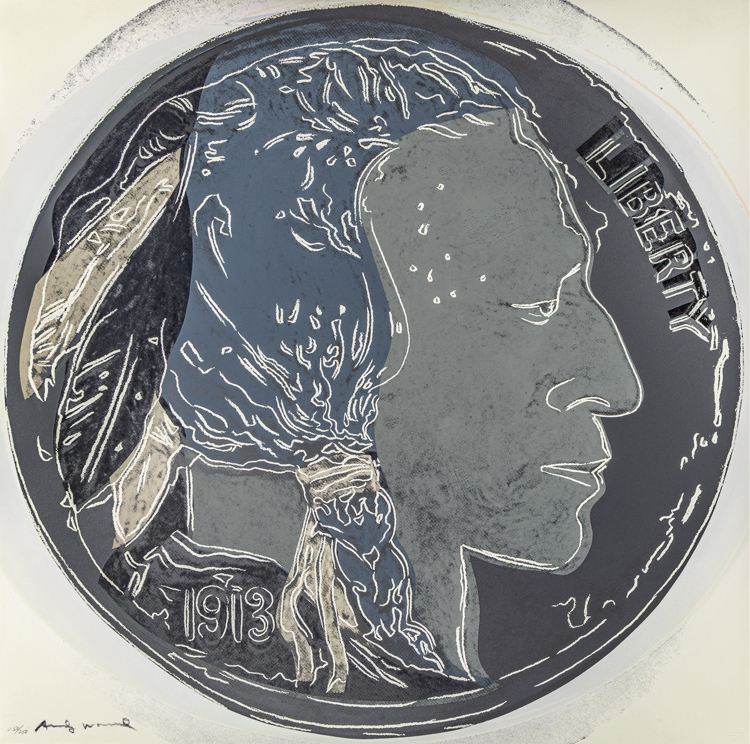
Warhol’s ‘Indian Head Nickel,’ from ‘Cowboys and Indians,’ 1986
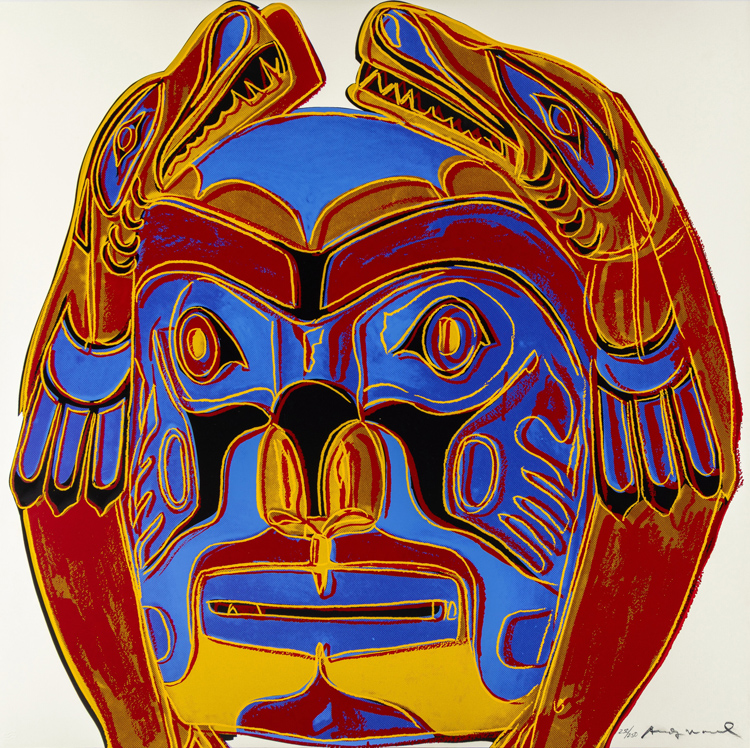
Warhol’s ‘Northwest Coast Mask,’ from ‘Cowboys and Indians,’ 1986
Alongside these famous individuals, Warhol includes a Native American mother and child, a Northwest Coast mask, katsina figures, a Plains shield, and the Native American profile from the Indian Head nickel. Together, these images broaden his vision of the West beyond famous personalities to include family, ceremonial objects, cultural symbols, and even the money Americans carried in their pockets.
In Northwest Coast Mask, Warhol illustrates a ceremonial mask representing Sisiutl, the powerful two-headed sea serpent associated with the Kwakwaka’wakw people of northern Vancouver Island and the surrounding coastal areas of British Columbia. Its bold symmetry and electric color make it one of the portfolio’s most hypnotic images. At the same time, Warhol turns an object with a specific cultural meaning into a bright Pop image. The result is beautiful, but it also reminds us how easily ceremonial objects can be separated from their original purpose and presented simply as works of art.
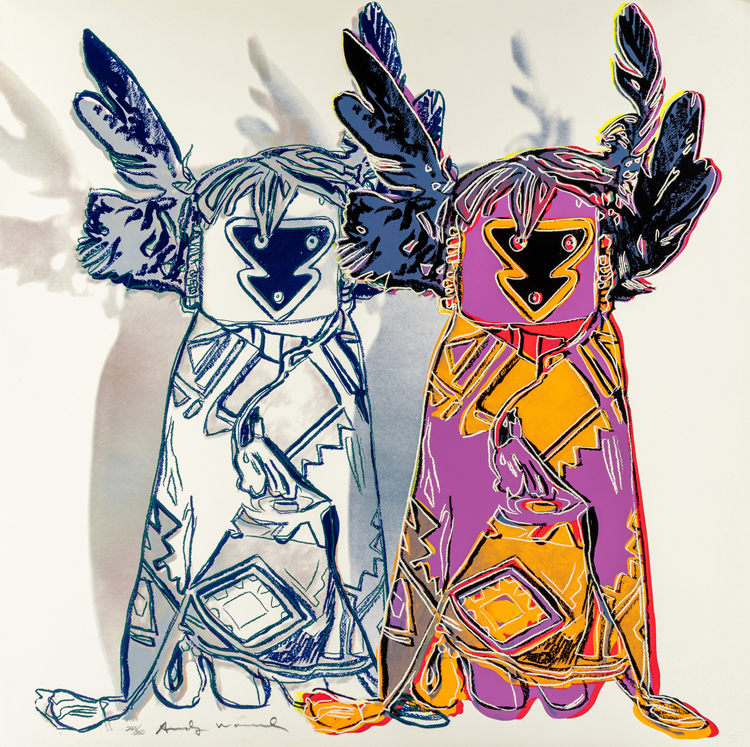
Warhol’s ‘Kachina Dolls,’ from ‘Cowboys and Indians,’ 1986
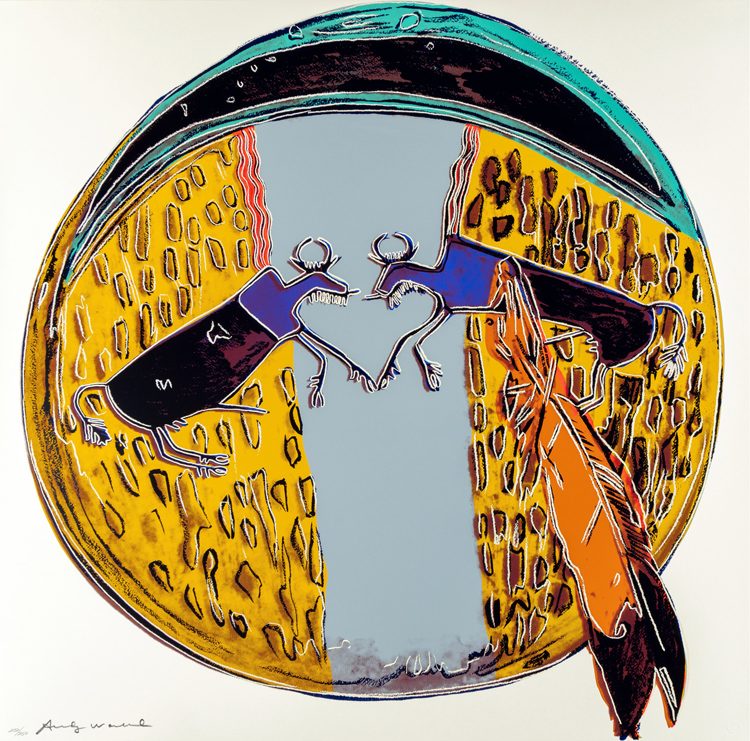
Warhol’s ‘Plains Indian Shield,’ from ‘Cowboys and Indians,’ 1986
With Kachina Dolls, Warhol uses bold color to emphasize the different shapes and personalities of the Hopi katsina figures. They may not be celebrities, but he treats them much like his famous subjects — isolating and enlarging them so that each one stands out. The print adds a spiritual element to the portfolio and shows Warhol’s interest in objects that already held deep cultural meaning.
The circular shield in Plains Indian Shield flares across the composition like a brilliant sun. Warhol heightens its feathers, markings, and strong geometry through an unexpected palette, transforming a protective object into a commanding visual emblem. Its beauty is immediate, but the history of conflict surrounding it remains close beneath the surface.
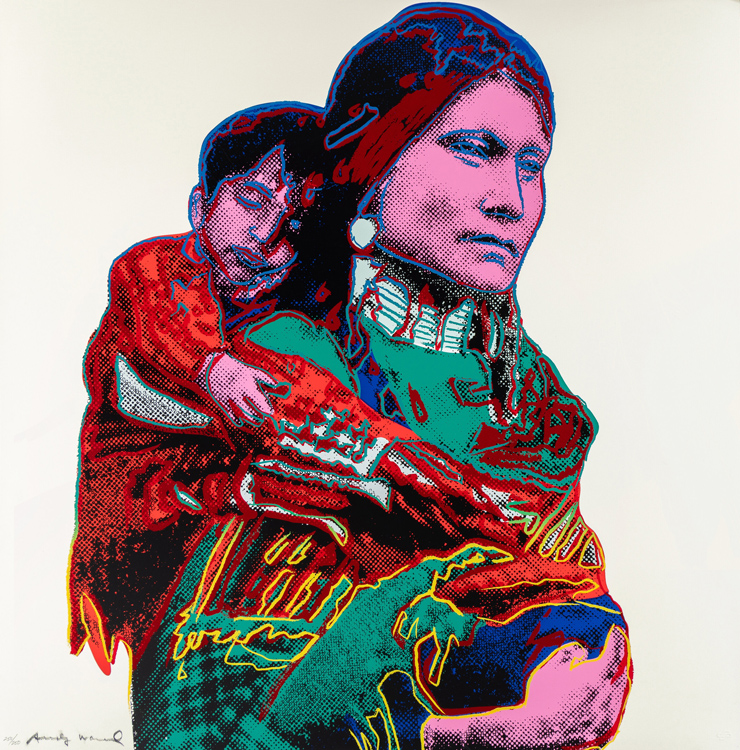
Warhol’s ‘Mother and Child,’ from ‘Cowboys and Indians,’ 1986
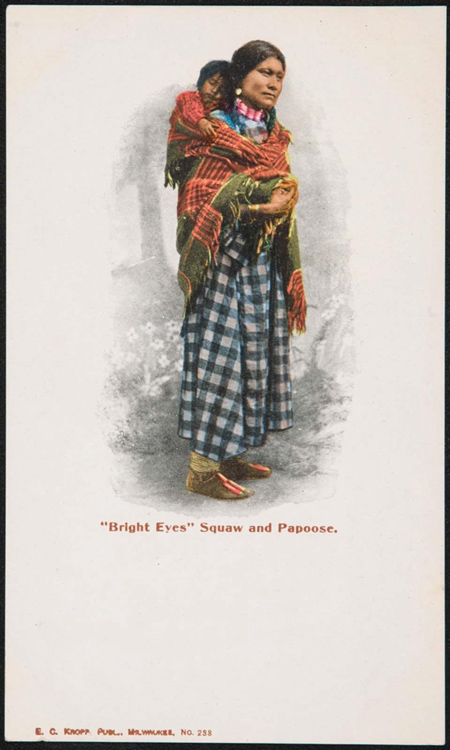
The early-20th-century postcard that inspired ‘Mother and Child’
Drawn from an early-20th-century postcard, Mother and Child is the portfolio’s most intimate and tender image. Brilliant color emphasizes the closeness between the two figures without disturbing the quiet strength of their bond. Amid celebrated men, military uniforms, weapons, and ceremonial objects, this deeply human moment becomes the emotional heart of the suite. The figures are not identified by name, yet their intimacy gives them a presence that stands apart from the portfolio’s more public and theatrical personalities.
In Indian Head Nickel, Warhol enlarges the face of an ordinary 5-cent coin until it becomes a monument. The original nickel, designed by James Earle Fraser and minted from 1913 to 1938, paired a Native American profile on the obverse with an American bison on the reverse. These coins are usually referred to as “Buffalo Nickels” by coin collectors. Warhol takes this familiar piece of American currency and gives it the same larger-than-life treatment he gives his celebrities. It is a classic Warhol transformation — the artist at his best — taking something as ordinary as a 5-cent coin and making us see it in an entirely new way.
The juxtaposition of historical figures and iconic objects gives Cowboys and Indians its enduring power. By combining human presence with Native American material culture, Warhol asks the viewer to move between celebrity, history, Hollywood, commerce, and the construction of the West as an American idea. He does not offer a single, orderly narrative because he understands that no such narrative exists.
Instead, Warhol gathers the fragments from which the national story has been made: the movie hero, the sharpshooter, the cavalry officer, the president, the Apache leader, the unnamed mother and child, the sacred or ceremonial object, and finally the commercial coin — the symbol of exchange that quietly underpins the complex story of America. For Warhol, all these subjects occupy the same bright visual world: a universe in which history becomes an image, repetition turns that image into legend, and legend becomes an icon.