BITCOIN WAS CREATED TO MAKE PHYSICAL MONEY UNNECESSARY. SO WHY ARE COLLECTORS INCREASINGLY FASCINATED BY PUTTING IT BACK INTO SOMETHING THEY CAN HOLD?
By Pia Talja | September 1, 2026
Bitcoin has no shape. There are no actual coins moving from one digital vault to another, only a distributed ledger and cryptographic keys controlling the value recorded upon it. Which makes a Bitcoin note wonderfully contradictory.
A Polymerbit cold-storage document looks remarkably like money: elaborate artwork, serial numbers, security printing, and concealed information. It can even hold a verifiable Bitcoin balance. Yet there is no Bitcoin physically inside. The BTC remains on the blockchain. What the note protects is the private key necessary to control it. And that transforms an entirely digital asset into something collectors immediately understand: an object.
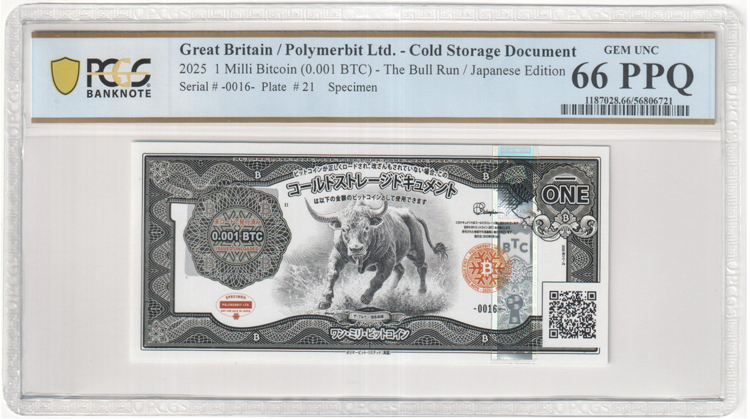
‘The Bull Run — Japanese Edition’ from Polymerbit, a bold note currently tied for the top-certified example with just one other piece, realized $1,830 in a June 2026 Heritage auction.
From Bitcointalk to the Bourse
Polymerbit founder Daniele Barbagallo readily credits predecessors, including Bitcoin Suisse, whose physical Bitcoin “crypto certificates” appeared in 2014. But cryptocurrency notes remained decidedly niche when Barbagallo began exploring his own approach the following year. Polymerbit grew from a university business-management paper into a physical product in 2016 and, for years, largely remained within the Bitcointalk community.
“This was not something that happened overnight,” Barbagallo says.
The first hint of greater potential came in early 2017, when considerably more of Polymerbit’s first issue sold than expected. The definitive change, however, arrived around 2023 as grading services and major auction houses brought physical cryptocurrency before traditional collectors.
“Numismatic dealers are known to be rather skeptical of any non-government issued note,” Barbagallo says. “Add Bitcoin to the mix and you’d lose their interest in the middle of the pitch.”
Then the reception changed.
“I can pinpoint when the tide shifted,” he says, “the minute I started to bring a Heritage Auctions catalog and PCGS graded notes to events such as the FUN show [in Orlando] or MIF [in Maastricht].”
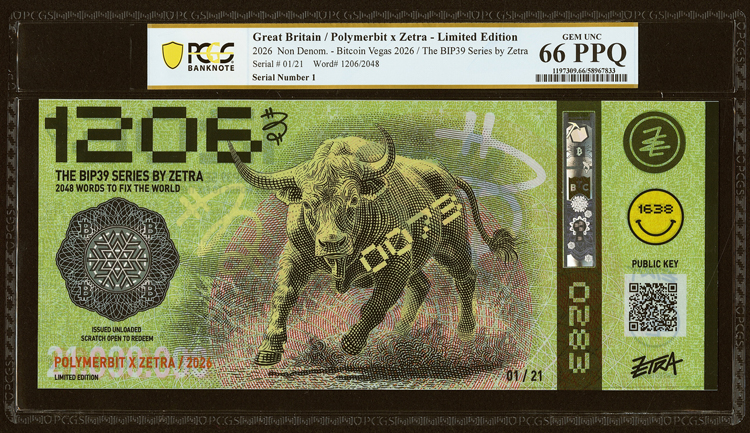
This Polymerbit x ZETRA limited-edition ‘1206/NOTE,’ available in Heritage’s September 3 ANA Physical Cryptocurrency auction, marks the inaugural collaboration between Polymerbit and the artist ZETRA.
Why a Note?
Barbagallo’s choice of format was partly artistic and partly pragmatic. “There were many more rounds than notes,” he says. Fresh from studying the “blue ocean” strategy of creating new markets rather than fighting for existing ones, he saw an opportunity.
Then there was the canvas. “I felt I could do a lot more with a bigger canvas and in color,” he adds.
Notes also made small production runs more practical than privately minted rounds, with their engraving and tooling costs.
That larger canvas eventually invited artistic collaboration. Polymerbit’s projects with artists such as Artikando and ZETRA push the cold-storage document into territory where wallet and artwork become increasingly difficult to separate.
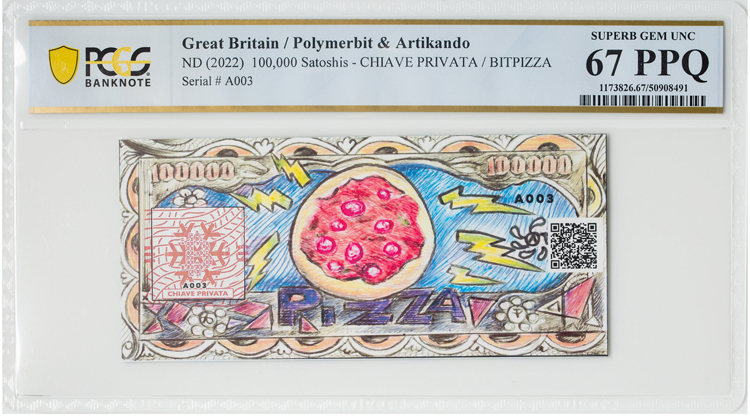
This rare note, a collaboration between Polymerbit and the Italian artist Artikando, commemorates Laszlo Hanyecz’s iconic purchase of two pizzas for 10,000 BTC on May 22, 2010. The note sold for $3,416 in a January 2026 Heritage auction.
Collectors have responded accordingly. In January, a Polymerbit x Artikando BitPizza note realized $3,416 at Heritage. The note contained only 0.001 BTC. With Bitcoin at $93,188 that day, the cryptocurrency itself was worth about $93.
Collectors were clearly buying something besides Bitcoin.
What’s Actually in the Note?
A loaded Polymerbit associates BTC with a public address printed on the note, allowing its balance to be verified on the blockchain. The corresponding private key — necessary to control those funds — remains concealed. Hand somebody an intact loaded note and possession of the cold-storage device can change without the BTC moving on the blockchain at all.
But attractive printing alone doesn’t make a serious cold-storage document.
Asked what separates a Bitcoin note from a piece of paper carrying Bitcoin artwork and a QR code, Barbagallo points to what happens before printing: “the efforts taken to mitigate the risk to the bearer,” including key-generation protocols, transparency when problems arise, and continuous improvement in security.
Physical security protects the note. Responsible key generation protects the Bitcoin. Both matter a great deal.
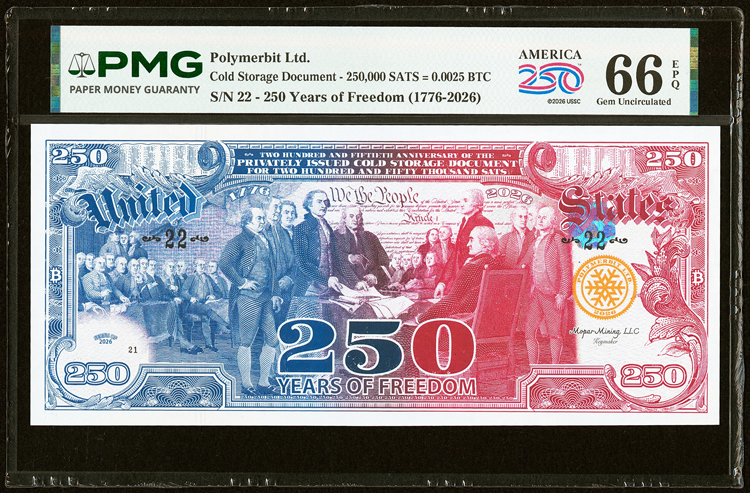
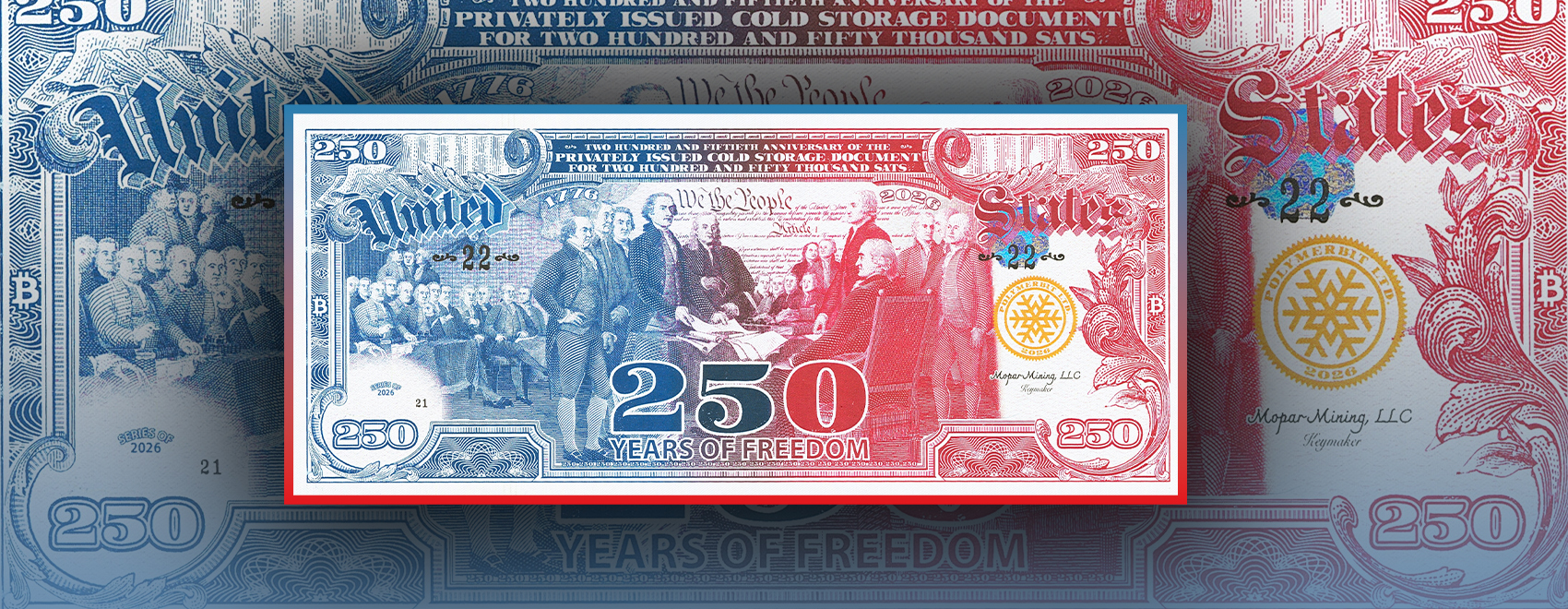
Polymerbit’s ‘250 Years of Freedom’ note, available in Heritage’s September 3 ANA Physical Cryptocurrency auction, commemorates the 250th anniversary of the United States’ Declaration of Independence.
An Object That Shouldn’t Need to Exist
There remains an obvious contradiction: Bitcoin was created so that value doesn’t require a physical token.
“There’s no hiding from the fact that these notes go against the grain of Bitcoin’s intent,” Barbagallo says. Polymerbit originally saw the note as a bridge between the physical and digital worlds — a way to introduce Bitcoin to newcomers. Instead, Barbagallo found established Bitcoiners using them to “orange pill” friends or wanting a physical representation of an asset important to them.
“People crave physical representations,” he says, “and this pull is stronger than the argument against these objects’ existence.”
Perhaps the strangest thing about a Bitcoin note isn’t that somebody gave physical form back to money designed not to need it. It’s that collectors understand exactly why they want one.