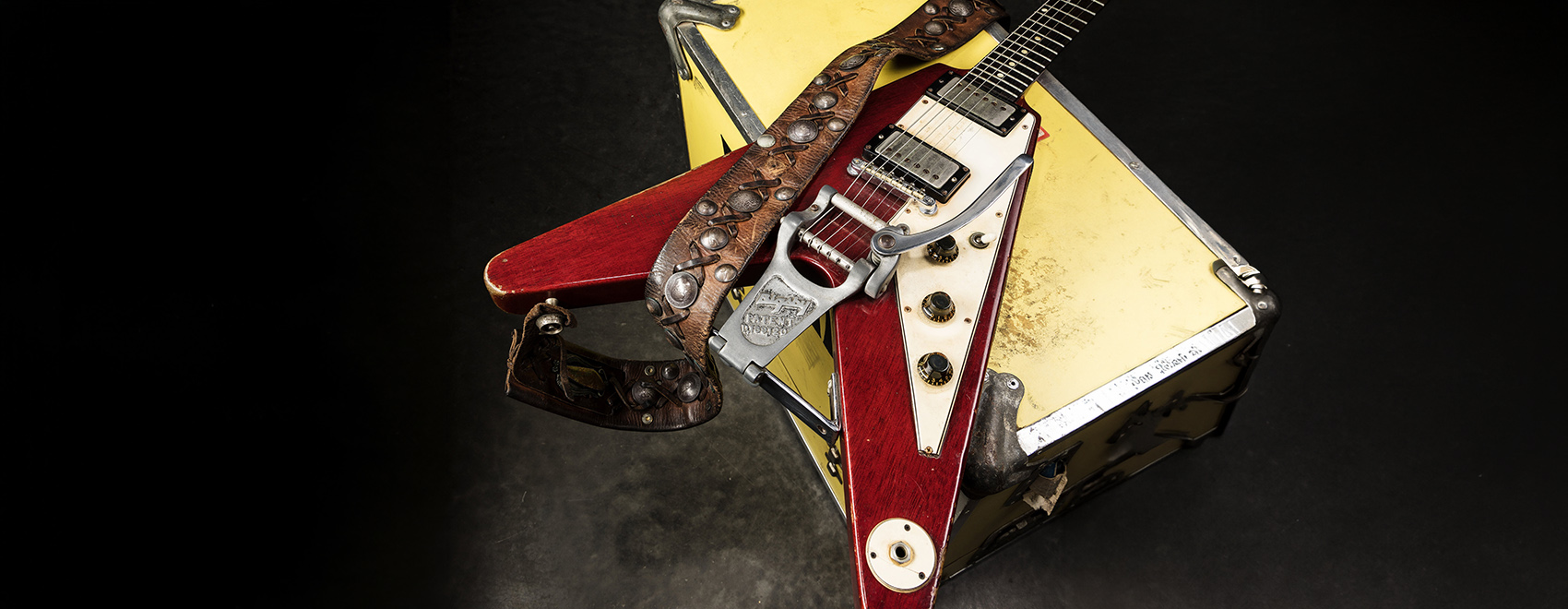
AN EARLY ROCKER FROM INDIANA MODIFIED THE INITIALLY UNLOVED, AHEAD-OF-ITS-TIME GIBSON FLYING V AND MADE ROCK HISTORY
By Jesse Hughey | September 17, 2026
“With the wiggle of a whammy bar and a blinding run of notes up and down the neck of his classic Gibson Flying V, Lonnie Mack launched the modern guitar era.” —Chicago Tribune
Prince and “Cloud.” B.B. King and “Lucille.” Willie Nelson and “Trigger.” Neil Young and “Old Black.” These massively talented musicians could without a doubt pick up any available guitar and make it sing, but each is tied to a specific model or even a single beloved guitar that over the years became so inextricable from the player that it is difficult to imagine them holding another axe.
But there might not be an icon of rock, country, and blues as inseparable from one particular guitar as Lonnie Mack and “Number 7,” the 1958 Gibson Flying V that was his primary instrument for almost the entirety of his influential yet underappreciated career. The guitar has its own section on Mack’s Wikipedia page, and Mack is mentioned in the second paragraph of the Flying V entry. Journalists seldom wrote about or photographed him without including the guitar in the story or picture.
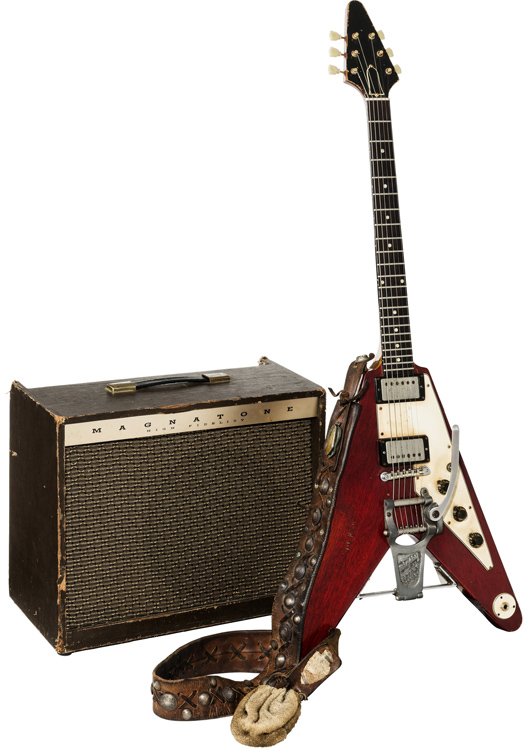
Lonnie Mack’s 1958 Gibson Flying V ‘Number 7’ Red Solid Body Electric Guitar and Magnatone Custom 440 Amplifier. Available in Heritage’s October 15 Vintage Guitars and Musical Instruments Signature® Auction.
“I’ve never seen him play any other guitar regularly, other than his acoustic,” says Lonnie’s son George Mack. George is not a musician himself, but he reminisces fondly about carrying the instrument into and out of late-night gigs as a kid.
After Lonnie Mack’s death in 2016, “Number 7” and Mack’s customary amplifier for it, a 1962 Magnatone 440, went to George’s sister Holly. But after her recent passing, George and the family decided they belong in the hands of someone who will appreciate these relics of early rock ’n’ roll.
“Once I got that thing after 10 years, I opened up the case,” George says. “It smelled like my dad, like a smoky bar. Just the power of it — I can understand why my sister didn’t want to part with it after all these years. It’s such a piece of rock history, those hits he cut on that guitar.”
It is no exaggeration to say the course of rock ’n’ roll was directed in part by Mack’s signature guitar, “Number 7” — so named, Mack said, because it was the seventh off the assembly line when Gibson introduced the forward-pointing electric guitar with the arrow-shaped body and head. Rolling Stone even included “Number 7” on its 2019 list of “20 Iconic Guitars.”
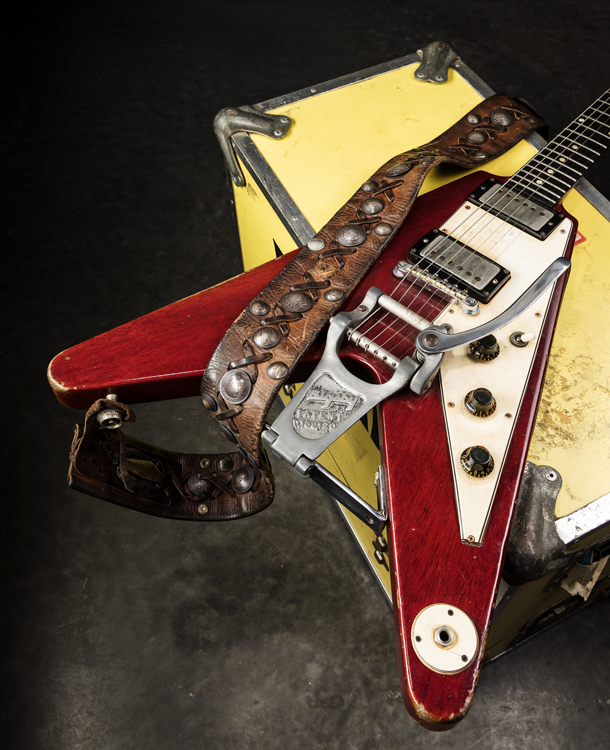
The guitar comes with Mack’s tooled leather stage strap.
Mack said in interviews it was the arrowlike profile that drew him to the guitar, that it struck a chord with his Native American heritage. Initially, he was in a small minority in his appreciation: The model was a commercial failure, with fewer than 100 sold its first two years of production. But after it was embraced by players like blues legend Albert King, the Kinks’ Dave Davies, and Mack, who loved the eye-catching shape and powerful sound, it eventually caught on despite a polarizing body style that makes it awkward at best to play sitting down.
Born Lonnie McIntosh in 1941 in West Harrison, Indiana, Mack first picked up a guitar at age 7, influenced by his Appalachian parents’ love of bluegrass and country as well as blues, R&B, pop, and country-gospel. He dropped out of school at 13 and was earning $300 a week by the time he was 14, playing local bars with a fake ID. Combining country- and blues-style fingerpicking and a voice that would later be described as “blue-eyed soul,” he developed a proto-rockabilly sound that would shape future generations of country-rock, blues-rock, and Southern rock stars. After some session work in the late 1950s and early ’60s, he recorded two blues-rock instrumental singles for Fraternity Records: a cover of Chuck Berry’s “Memphis” and “Wham!”, an original composition. They became hits and were central to his 1963 debut album, The Wham of That Memphis Man.
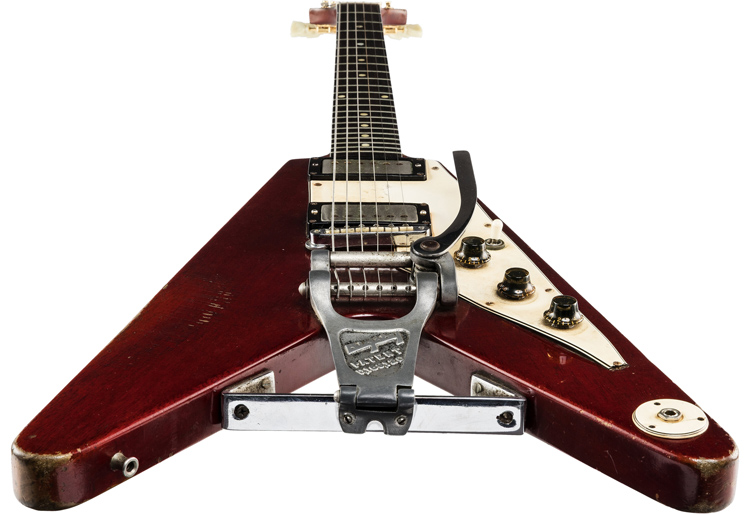
Later nicknamed a ‘whammy bar,’ the Bigsby tremolo arm Mack had added to the guitar required a steel bar to be fitted between the two wings of the Flying V.
Mack’s customizations to “Number 7” further molded the guitar to fit his trailblazing style, charting the course of rock guitar in the process. Mack had a guitar shop owner add a Bigsby tremolo arm to the guitar, which required a steel bar fitted between the two wings of the Flying V to brace the device. He made such extensive and creative use of it that guitarists began calling the accessory a “whammy bar,” referring to Mack’s debut single and album. More than 60 years later, it remains the tremolo bar’s most common nickname.
As it turned out, The Wham of That Memphis Man and its singles represented the peak of Mack’s career. Overlooked as the British Invasion took over pop music in the 1960s, he worked as a session player for years until a 1968 Rolling Stone story rekindled interest in his music for a while, and then it was back to playing bars and working as an axe for hire until re-emerging on the national scene in 1983. That year, a little-known guitarist named Stevie Ray Vaughan urged him to move to Texas.
Vaughan became a regular visitor to the school bus in which the family lived, George says, and organized a concert that raised a life-changing amount of money for the Macks. He even went as far as to secretly buy an air conditioner for the family and have it installed, to their surprise and delight.
George recalls hundreds of famous guitarists jamming with Mack at their home, and he has no doubt his father could play circles around every one of them. Frequently, they’d ask him how to play a certain lick or chord. But it wasn’t Mack’s style to show off.
“He was definitely under the radar,” George says. “He didn’t care about money or fame.”
That under-the-radar status continued to the day he left this world, April 21, 2016. Fans and journalists shared their memories and appreciation, but the bigger headlines went to another iconic, influential musician who died that day: Prince.
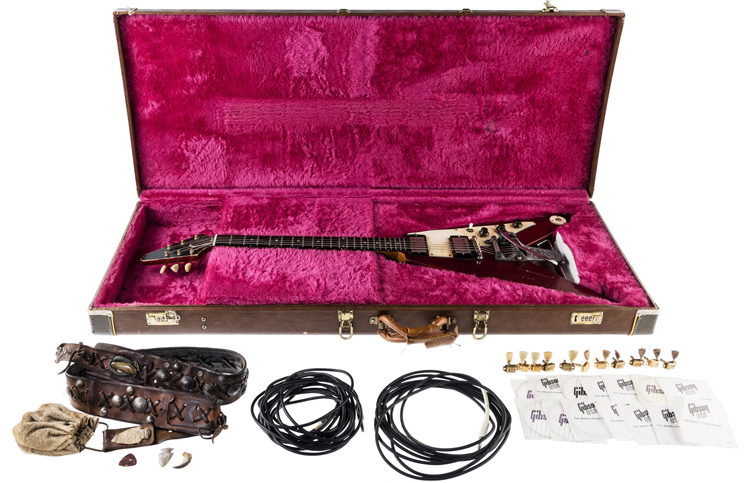
The lot includes the Flying V’s original tuners as well as another era-correct set in addition to the updated tuners Mack used.
“Number 7” is the headline lot at Heritage Auctions’ October 15 Vintage Guitars and Musical Instruments Signature® Auction. The lot includes the 1962 Magnatone Custom 440 amp, the other half of Mack’s signature sound, from which his Flying V is inseparable. Aaron Piscopo, Director of Vintage Guitars & Musical Instruments at Heritage, is ecstatic for the opportunity to sell such an important part of rock history.
“Lonnie Mack’s ‘Number 7’ is far more than a rare 1958 Gibson Flying V — it is one of the defining instruments of early blues-rock guitar,” Piscopo says. “Lonnie recognized the potential of Gibson’s radical new design before almost anyone else, then made it entirely his own.”
Dave Hinson, Managing Director of Music for Heritage, points out that “Number 7” has not had a single alteration since Mack died and includes the Flying V’s original tuners as well as another era-correct set in addition to the updated tuners Mack used. Altogether, it represents a once-in-a-generation opportunity for a serious guitar collector.
“A regular 1958 Flying V would be $600,000 or $700,000 even without any celebrity story attached to it,” he says.
Also included: Mack’s iconic tooled and accessorized leather stage strap, mojo bag and all. “I didn’t even look inside,” Hinson says with a laugh. “I don’t want to know what’s in there. I didn’t want to break the spell.”
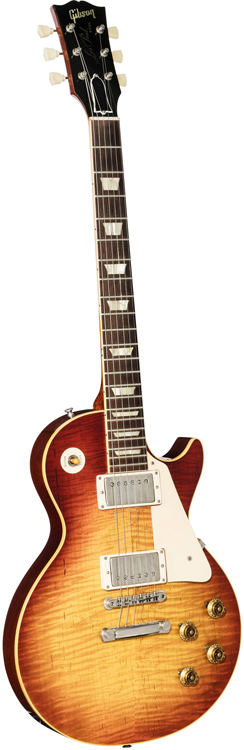
1959 Gibson Les Paul Standard Sunburst Solid Body Electric Guitar, Serial No. 9 0640. Available in Heritage’s October 15 Vintage Guitars and Musical Instruments Signature® Auction.
The Other Gibson Grail
Not all late-1950s Gibson guitars are as well-worn, repaired, modified, and customized as Mack’s “Number 7.” A gorgeous, incredibly preserved rare example from the other side of the spectrum is the other headline lot in Heritage’s October 15 Vintage Guitars and Musical Instruments Signature® Auction: this 1959 Gibson Les Paul Standard Sunburst Solid Body Electric Guitar, Serial No. 9 0640.
Hinson rates the guitar’s extraordinary state of preservation as a 9.6: “The guitar is all original, in very pristine condition,” he says.
It was part of the celebrated collection of Ichiro Kato, one of Japan’s most respected vintage Gibson collectors, whose name has become synonymous with originality, authenticity, and some of the finest surviving examples of Golden Era Gibson instruments. Its serial number has been extensively documented within the vintage guitar community and is recorded in the Burst Serial Registry, whose archival information is drawn from the foremost reference works on the subject, including The Beauty of the ’Burst, Burst Believers, Sunburst Alley, and Burst Gang.