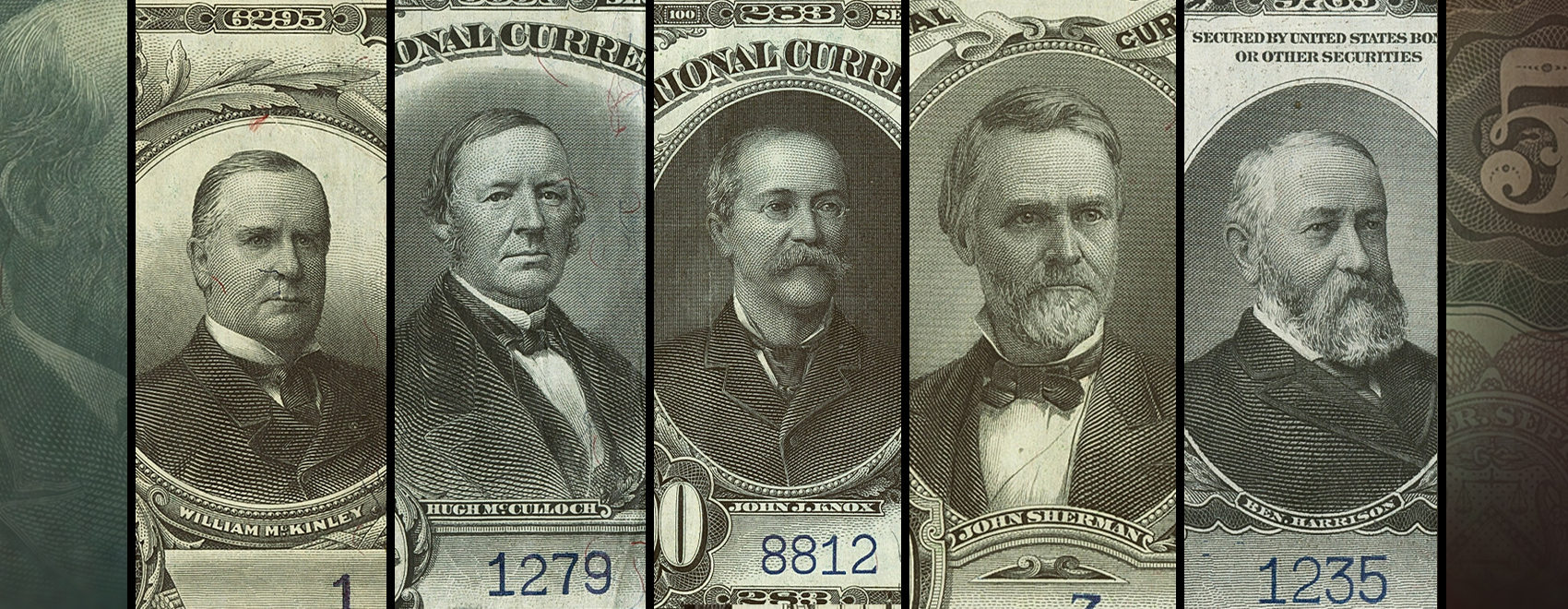
ISSUED BY BANKS ACROSS THE COUNTRY, LARGE SIZE NATIONAL BANK NOTES SHARE A PORTRAIT GALLERY OF THE PRESIDENTS AND POLICYMAKERS WHO SHAPED AMERICAN FINANCE
By Marilyn Pace | September 1, 2026
here are seemingly endless characteristics of Large Size National Bank Notes that continue to captivate collectors. Among the most popular are their beautiful vignettes, the fascinating stories of survival and discovery behind individual notes, and, perhaps most importantly, the towns, banks, and states from which they originated. Unlike many other types of U.S. currency, where the central portrait tends to command the spotlight, the portraits on Large Size National Bank Notes can sometimes be overlooked amid the wealth of other interesting details. Yet these familiar faces provide a unifying thread, linking notes issued by thousands of different banks across the country.
Notably, no individual portraits appear on the Original Series or Series of 1875 issues. Instead, these designs are dominated by elaborate vignettes that depict key moments from what was then a young nation’s brief history. Among the most notable are “The Baptism of Pocahontas” on the $20 notes, “Embarkation of the Pilgrims” on the $50, and “De Soto Discovering the Mississippi” on the $10.
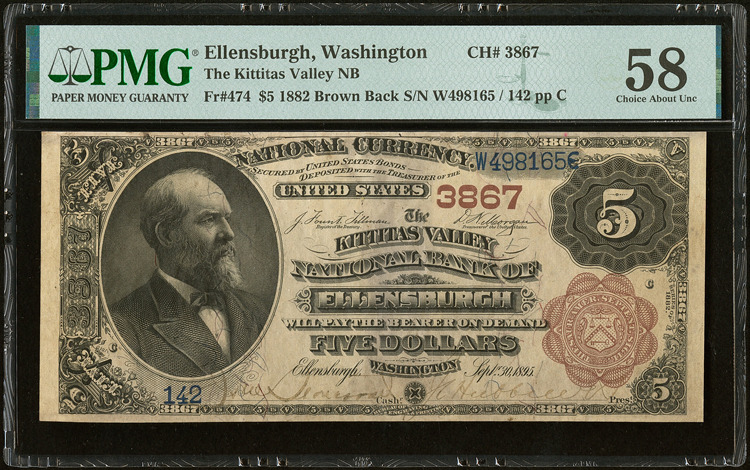
Ellensburg, Washington. $5 1882 Brown Back Fr. 474. The Kittitas Valley National Bank Ch. #3867. PMG Choice About Unc 58. Available in Heritage’s October 6-9 U.S. Currency Signature® Auction and featuring a portrait of President James A. Garfield.
The first individual portrait to appear on National Bank Notes emerged during the Second Charter Period, when President James A. Garfield was featured on the $5 denomination across all three issues. His likeness was selected for the Series of 1882 following his shocking assassination in 1881, making Garfield the only individual portrait used on that series and marking a significant shift in National Bank Note design while still maintaining continuity across the notes. Garfield’s death captivated the nation. He had been in office for only six months when he was shot by Charles J. Guiteau, a disgruntled and mentally unstable office seeker who believed he deserved a government appointment. Garfield survived for 80 days before ultimately succumbing to sepsis, and throughout his prolonged ordeal, Americans across the country anxiously awaited updates on the president’s condition. The nation’s mourning, coupled with the timing of the new note designs, made Garfield a fitting choice for the Series of 1882 $5 note.
Perhaps most intriguing about Garfield’s appearance on the note is the irony of his selection. Much like Andrew Jackson before him, Garfield was a staunch opponent of paper currency and a vocal advocate for the gold standard. He consistently emphasized the importance of sound money backed by specie and expressed deep skepticism toward the expansion of paper currency in the American economy beyond wartime necessity. Nevertheless, his portrait found a permanent home on the very medium he questioned, one of numismatics’ more delightful ironies.
The $5 denomination is the only one from the Series of 1882 to feature a focal portrait. The $10, $20, $50, and $100 denominations instead continued the tradition of featuring allegorical figures and scenes from American history, including Columbia on the $20 and a scene from the Battle of Lake Erie during the War of 1812 on the $100.
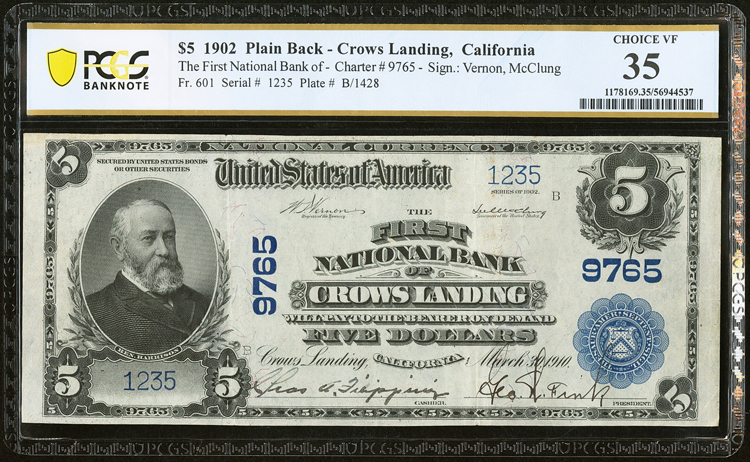
Crows Landing, California. $5 1902 Plain Back Fr. 601. The First National Bank Ch. #9765. PCGS Banknote Choice VF 35. Available in Heritage’s October 6-9 U.S. Currency Signature® Auction and featuring a portrait of President Benjamin Harrison.
Two decades later, the Series 1902 $5 note debuted with a portrait of President Benjamin Harrison, the 23rd president of the United States from 1889 to 1893. Although his presidency is often regarded as relatively unremarkable, his administration is best remembered for the passage of the Sherman Antitrust Act, a landmark law designed to curb monopolies. Harrison’s selection for the $5 denomination was largely aided by timing. He died in March 1901, just as the new Series 1902 notes were being designed, making him a natural choice as the nation commemorated his passing.
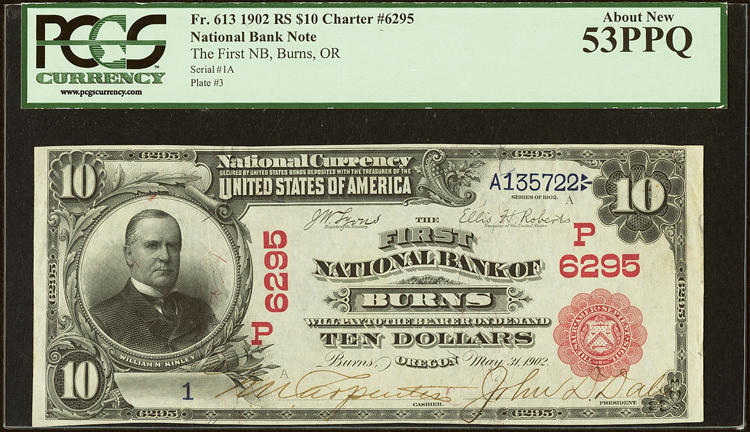
Serial Number 1 Burns, Oregon. $10 1902 Red Seal Fr. 613. The First National Bank Ch. #(P)6295. PCGS About New 53PPQ. Available in Heritage’s October 6-9 U.S. Currency Signature® Auction and featuring a portrait of President William McKinley.
The 1902 $10 note features a portrait of President William McKinley, who became the third U.S. president to be assassinated. He was fatally shot by anarchist Leon Czolgosz while greeting visitors at the Pan-American Exposition in Buffalo in September 1901. McKinley was a fitting choice for the note, as he was one of the nation’s most popular presidents at the time. He led the United States to victory in the Spanish-American War, helping establish the country as a major world power. He also signed the Gold Standard Act into law in 1900, firmly placing the nation’s monetary system on the gold standard.
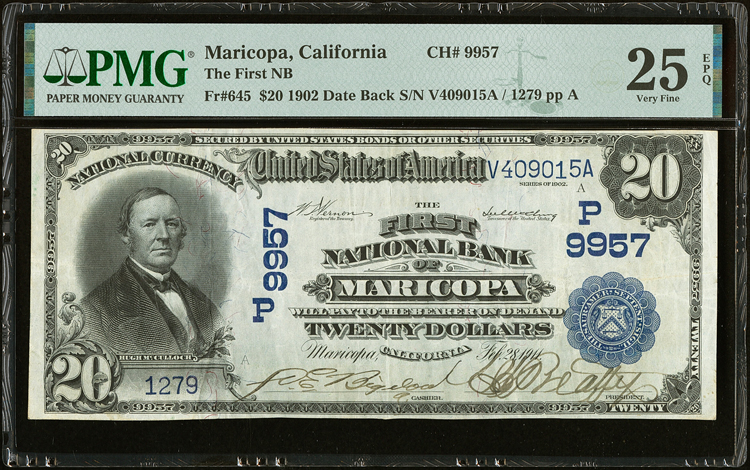
Maricopa, California. $20 1902 Date Back Fr. 645. The First National Bank Ch. #(P)9957. PMG Very Fine 25 EPQ. Available in Heritage’s October 6-9 U.S. Currency Signature® Auction and featuring a portrait of Hugh McCulloch, America’s first comptroller of the currency.
The Series 1902 $20 features Hugh McCulloch, who served as the nation’s first comptroller of the currency under President Abraham Lincoln from 1863 to 1865. McCulloch played a pivotal role in establishing the national banking system during the Civil War. During his tenure, 868 national banks were chartered without a single recorded bank failure. After just 22 months as comptroller, he left the office to become Lincoln’s secretary of the treasury, a position he would later hold again under President Chester A. Arthur.
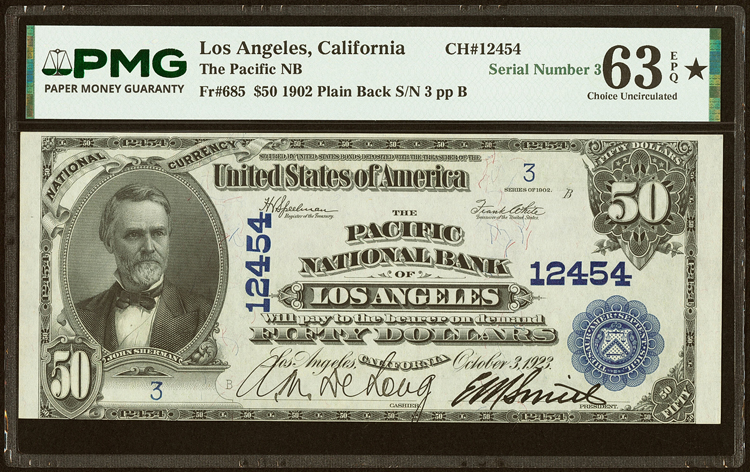
Los Angeles, California. $50 1902 Plain Back Fr. 685. The Pacific National Bank Ch. #12454. PMG Choice Uncirculated 63 EPQ. Available in Heritage’s October 6-9 U.S. Currency Signature® Auction and featuring a portrait of Senator John Sherman.
The 1902 $50 note features none other than Senator John Sherman, a career politician who still holds the record as Ohio’s longest-serving U.S. senator, with an impressive 32 years in office. Like many of the figures honored on National Bank Notes, Sherman is best remembered for his role in shaping the nation’s financial system during and after the Civil War, particularly his strong support of the gold standard. And, of course, his name lives on through the Sherman Antitrust Act of 1890, one of the most influential pieces of economic legislation in American history.
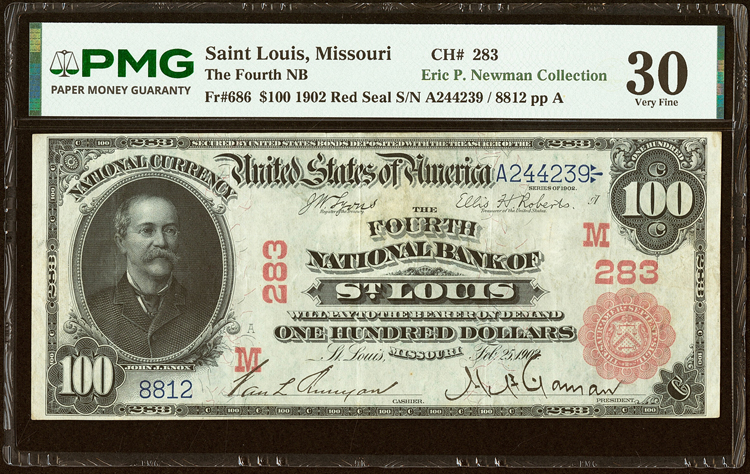
St. Louis, Missouri. $100 1902 Red Seal Fr. 686. The Fourth National Bank Ch. #(M)283. PMG Very Fine 30. Available in Heritage’s October 6-9 U.S. Currency Signature® Auction and featuring a portrait of John Jay Knox, the fourth comptroller of the currency.
Rounding out the series, the 1902 $100 note features John Jay Knox, who served as the fourth comptroller of the currency from 1872 to 1884. While he may not be as familiar a name today as McKinley or Sherman, Knox played an important role in strengthening the national banking system. During his 12 years in office, he helped secure legislation extending the charters of national banks by another 20 years and ensured that only federally chartered institutions could use the word “National” in their names — changes that helped shape the banking system for decades to come.
Taken together, these portraits do more than identify denominations; they trace a compact history of the nation’s political, financial, and institutional development. From martyred presidents to architects of the national banking system, the faces on Large Size National Bank Notes remind us that these issues are not merely products of thousands of individual banks, but part of a larger American story. For collectors, that is part of their enduring appeal: Each note carries the identity of a particular place while also reflecting the people and ideas that shaped the country’s currency, credit, and economic life.