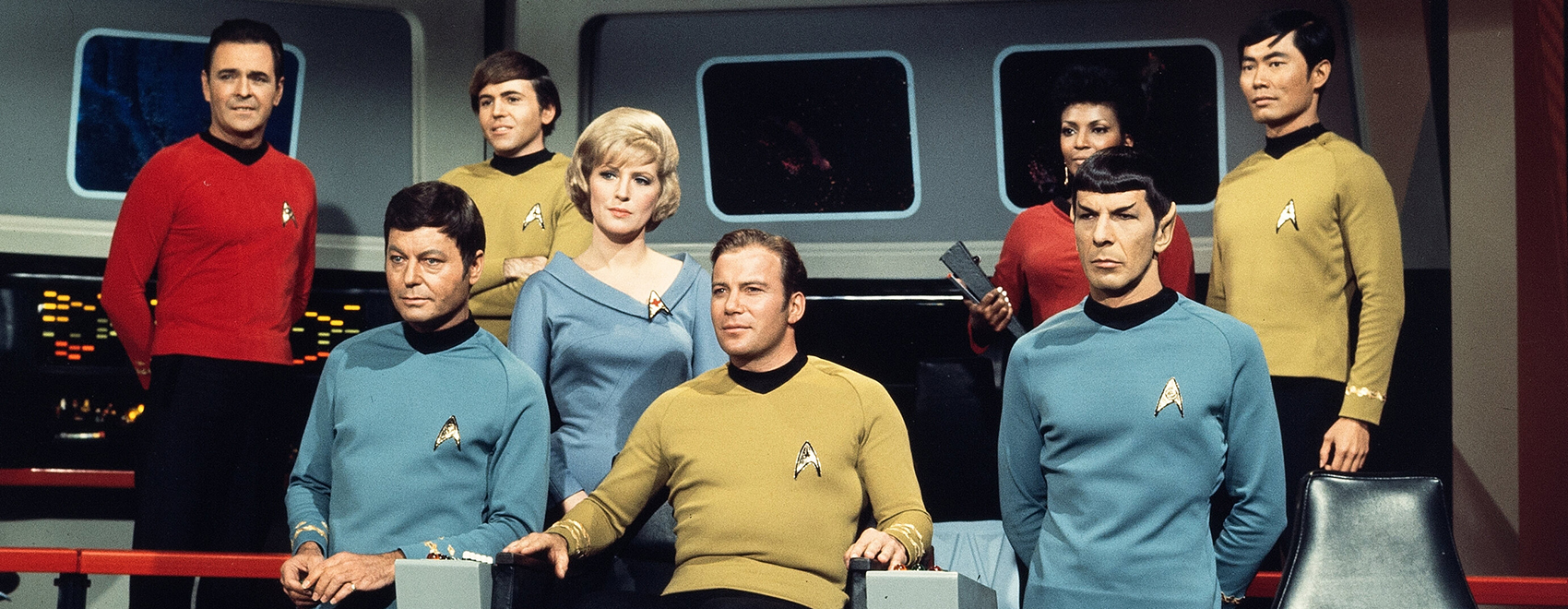
THE ORIGINAL TV SERIES MIGHT HAVE BEEN CANCELED AFTER ONLY THREE SEASONS, BUT THE FRANCHISE STILL THRIVES SIX BOLD DECADES LATER
By Robert Wilonsky | January 20, 2026
By most estimations, it would take more than 830 hours to watch the entirety of Star Trek, spanning The Original Series to the latest streaming spinoff – though one could easily eliminate, say, “Catspaw” or “Code of Honor” or “These Are the Voyages …” or Insurrection or the first two seasons of Picard or Section 31 or … This could take a while. Because, let’s be honest, the list of bad Trek is probably longer than the list of great Trek. And we haven’t even gotten into the endless run of comics (which included separate run-ins with Green Lantern and the X-Men) and novels that occasionally read like they’d been translated from the original Klingon.
And this comes from a 57-year-old man who still owns two – not ashamed – original-issue 1975 Mego-made U.S.S. Enterprise bridge playsets and all the action figures that go with it. And replica communicators and phasers that light up and make noises. And my first-edition Star Fleet Technical Manual and Star Trek Concordance, each bought with my allowance money. And a little Spock holding a lirpa next to a bigger Spock with a beard.
That’s the short list. The very short list. The shortest list.
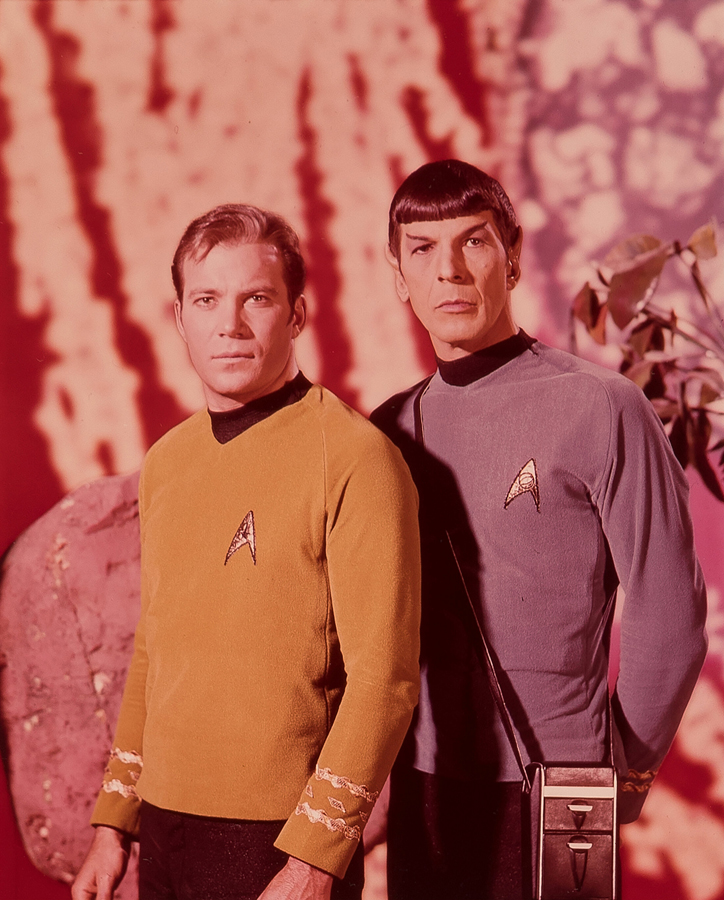
William Shatner as Captain Kirk and Leonard Nimoy as Spock in an early publicity photo for ‘Star Trek: The Original Series’
Sixty years of storytelling, mythmaking, rebooting, content-generating, and space-filling – every media company’s first and final frontier – inevitably leads to some underwhelming product. And it only took Trek six episodes into its third and final season to pull “Spock’s Brain” out of a dumpster fire. Any true Trek fetishist worth his or her weight in dilithium crystals can’t begin a proper appreciation without acknowledging the franchise got off course more often than the Kobayashi Maru.
Which doesn’t stop us (fine, me) from watching “Balance of Terror,” “Mirror, Mirror,” the two-part Next Generation farewell “All Good Things,” the director’s edition of The Motion Picture, any random episode of Lower Decks, the musical episode of Strange New Worlds, or Kirk’s resurrection in 2024’s short film Unification. Over and over. Unapologetically.
And that’s just the short list. The very short list. The shortest list.
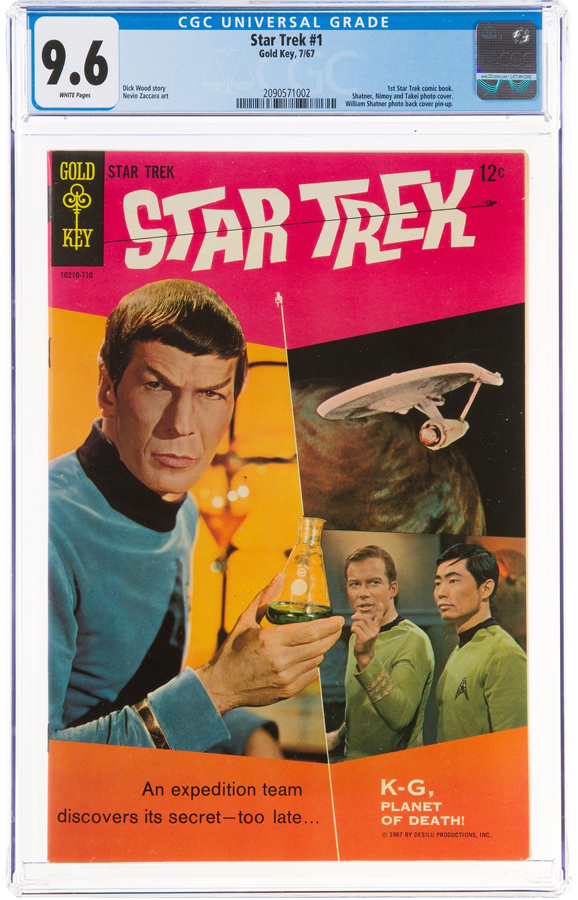
After the series’ 1966 TV debut came the first ‘Star Trek’ comic book. This copy of 1967’s ‘Star Trek’ No. 1, graded NM+ 9.6 by CGC, sold for $45,600 in a November 2022 Heritage auction.
The forever franchise, which premiered on NBC on September 8, 1966, survives its missteps because its template was powerful from the start: a diverse cast of endearing (and, ultimately, enduring) characters galloping around the cosmos guided by a strong moral compass. It might have begun as Wagon Train in space, per creator Gene Roddenberry’s initial pitch as he tried to score the screenwriter’s steady paycheck. But it didn’t take long for it to become what Seth MacFarlane called “a dream map.”
As the creator of Family Guy and The Orville wrote in the foreword of 2016’s history The Fifty-Year Mission, Star Trek offered a glimpse at “a world we’d all like to live in.”
Well, most people, anyway. OK, fine, some people. But, look, it’s a lot of people, OK?
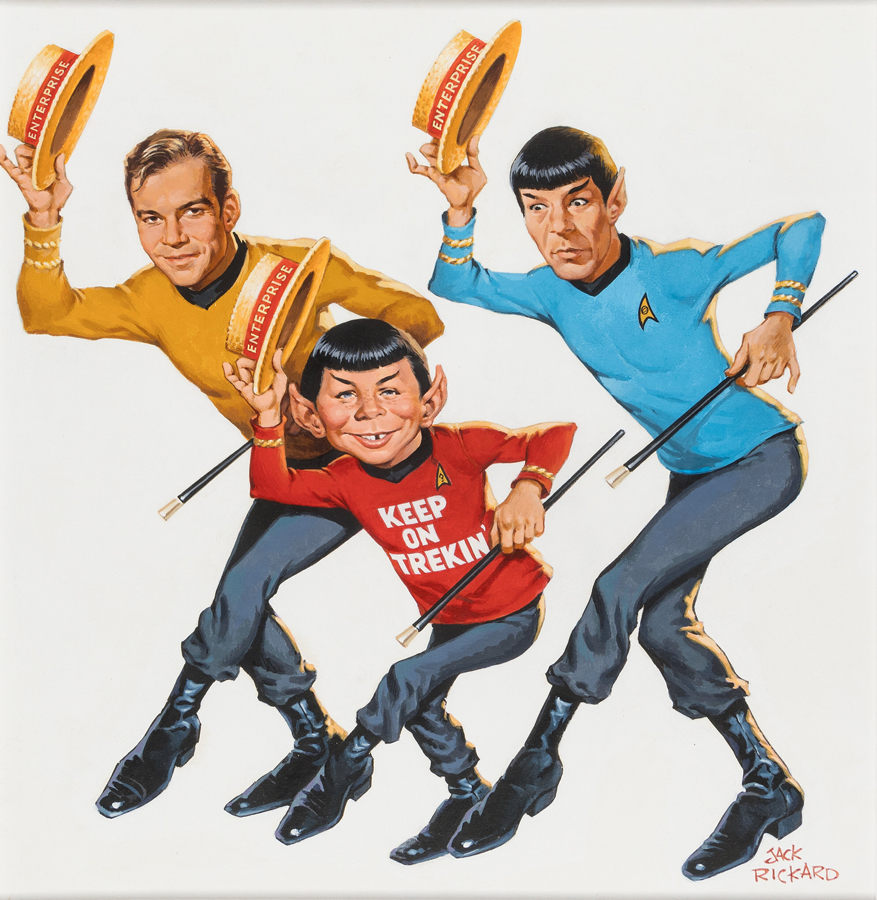
In 1976, Kirk and Spock made the cover of ‘Mad’ magazine, alongside a Vulcan-eared Alfred E. Neuman. Jack Rickard’s original art for the cover realized $50,400 in a January 2024 Heritage auction.
MacFarlane’s point was this: Where most science fiction presented a dystopian future, one in which humanity had wrecked this planet and spread its ruin across the universe, Trek guided us to better and brighter tomorrows of our own making. There would be hell to pay first – a third World War, because Roddenberry had flown 89 combat missions during World War II and knew well what horrors people were capable of committing. Yet he emerged hopeful nonetheless, believing we could overcome our worst instincts – our “superstitious, xenophobic adolescence,” as MacFarlane wrote – to do better, to be better.
“Star Trek was an attempt to say that humanity will reach maturity and wisdom on the day that it begins not just to tolerate, but take a special delight in differences in ideas and differences in life forms,” Roddenberry once said in an oft-repeated quote whose words hit harder with each passing year. “If we cannot learn to actually enjoy those small differences, to take a positive delight in those small differences between our own kind, here on this planet, then we do not deserve to go out into space and meet the diversity that is almost certainly out there.”
Whenever William Shatner, Leonard Nimoy, or any of the original cast were asked about why Trek endures, they would ultimately offer some variation on a theme of optimism, faith, the promise of a better tomorrow no matter how awful today might look.
“Star Trek says, ‘Hey! We exist 400 years from now … and there’s hope,’” Shatner once said. “I think that’s what the audience gets, the hope.”
Or, as one Redditor put it eight years ago, “In today’s f**ked up world, do you ever watch Star Trek to cheer you up, give you hope for a better future?” Over time, the answers would become … mixed.
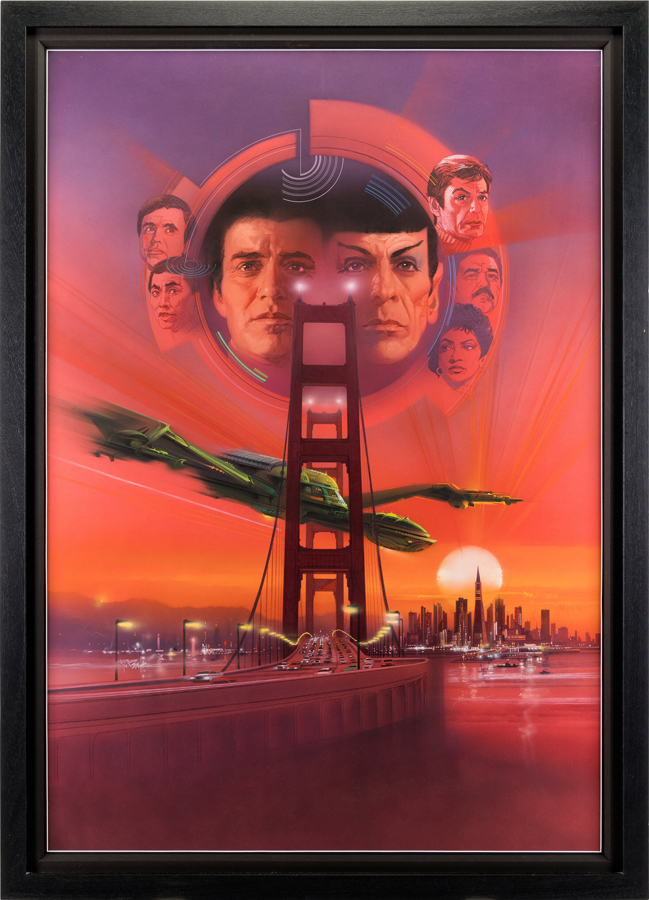
‘Star Trek’-related art remains popular with collectors. This mixed-media work by Bob Peak for the movie poster for 1987’s ‘Star Trek IV: The Voyage Home’ sold for $106,250 in a July 2024 Heritage auction.
That’s not the only reason it endures, of course. Each iteration has had a fantastic cast, no matter how much or little interest you might have had in the show itself. (I would only come ’round to Next Generation because of Patrick Stewart, who was Olivier to Shatner’s McQueen.) And it was as sexy as it was enlightened. And the uniforms were cool; the ships, even more so. And, all those toys!
That was the highlight of my Heritage Auctions tenure, spending time with all the props and models I’d seen only through a TV screen – and watching them sell for record amounts to collectors who revered and adored the series, usually the original iteration.
In September 2021, The Game of Life’s creator Reuben Klamer died at 99. Two months later, Heritage offered his most famous and coveted creation: the phaser rifle from the second pilot of Star Trek’s original series, September 1966’s “Where No Man Has Gone Before,” a stylish firearm holstered following the show’s filming. It arrived at the office housed in its original box, looking brand-new.

The phaser rifle from the second pilot of ‘Star Trek: The Original Series,’ titled ‘Where No Man Has Gone Before,’ realized $615,000 in a November 2021 Heritage auction.
The phaser appeared only in the episode about a man named Gary Mitchell, played by future 2001: A Space Odyssey star Gary Lockwood, who’d become a god thanks to the barrier at the galaxy’s edge. Spock secures the weapon to transport Mitchell to a planet where he’s to be left behind. But in the end, Mitchell’s best friend, Captain James T. Kirk (William Shatner), uses the phaser rifle to topple a mountain of rocks beneath which his unrecognizable buddy is buried.
Mitchell – and the phaser rifle – would never be seen on screen again, though the weapon accompanied Shatner, Nimoy, and others in early promotional photos for the nascent series. It sold for $615,000 – at the time, the most money ever paid for a Trek prop. Earlier in 2021, one of the few surviving handheld hero phasers used on screen realized $250,000; others, too, have sold at Heritage for close to that amount in recent years. They’re as much a part of Trek lore as Spock’s ears or Kirk’s one-night stands.
But nothing compared to the October 2023 event featuring the collection of Emmy- and Oscar-nominated miniature man Greg Jein, who collected, maintained, and repaired Trek models, costumes, and props, spanning numerous series and films, with the diligence of a man raised by Roddenberry’s creation. Indeed, Jein’s career began in childhood, when he and a friend would photograph or film Trek episodes so they could figure out how to make their own phasers, communicators, tricorders, and even models of the Enterprise itself. Jein’s friends would insist that he managed to get his hands on scripts even before Trek made its NBC debut.
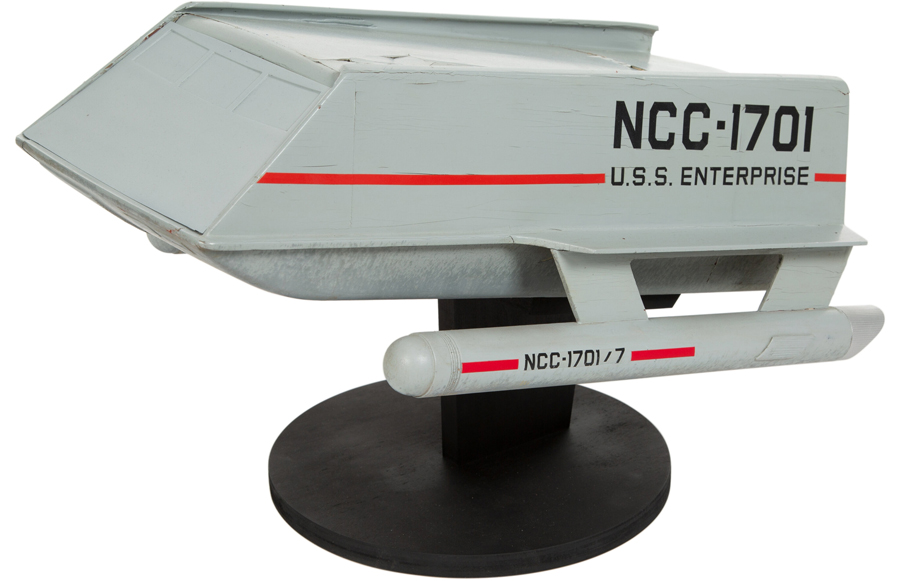
This filming miniature of the ‘Galileo’ shuttlecraft from ‘Star Trek: The Original Series’ sold for $225,000 in an October 2023 Heritage auction. The piece hailed from the collection of Hollywood model-maker Greg Jein.
Among the treasures offered from his collection in 2023 were two of the scant surviving models from The Original Series, including a 3.5-foot-long SS Botany Bay from “Space Seed” (featuring the debut of KHAAAAAAAAAAAAN) and the Galileo shuttlecraft that spawned an episode and a model kit my father had to finish when my tiny hands couldn’t in the mid-1970s. Jein, too, had an original tricorder and a communicator, without which there wouldn’t have been flip phones.
Star Trek’s past is in the hands of collectors; its present, in the hands of Holly Hunter, Paul Giamatti, and the unknowns attending Starfleet Academy and two bright young filmmakers promising another big-screen voyage; its future, in the hands of new Paramount leadership who likely would never have greenlit Roddenberry’s vision. As one Trek fan site notes, the franchise is at a crossroads. Of course, just as it celebrates its 60th birthday. What a perfect time for a midlife crisis.
Yet Trek may just live long enough to see the future it once imagined while winding up where it all began. After all, the Enterprise crew’s first five-year mission will extend into 2027, with the fifth and final season of Strange New Worlds, whose creators and fans pine for a spinoff that leads back to Captain Kirk soaring through a final frontier without end after all. The adventure is just beginning. Maybe?