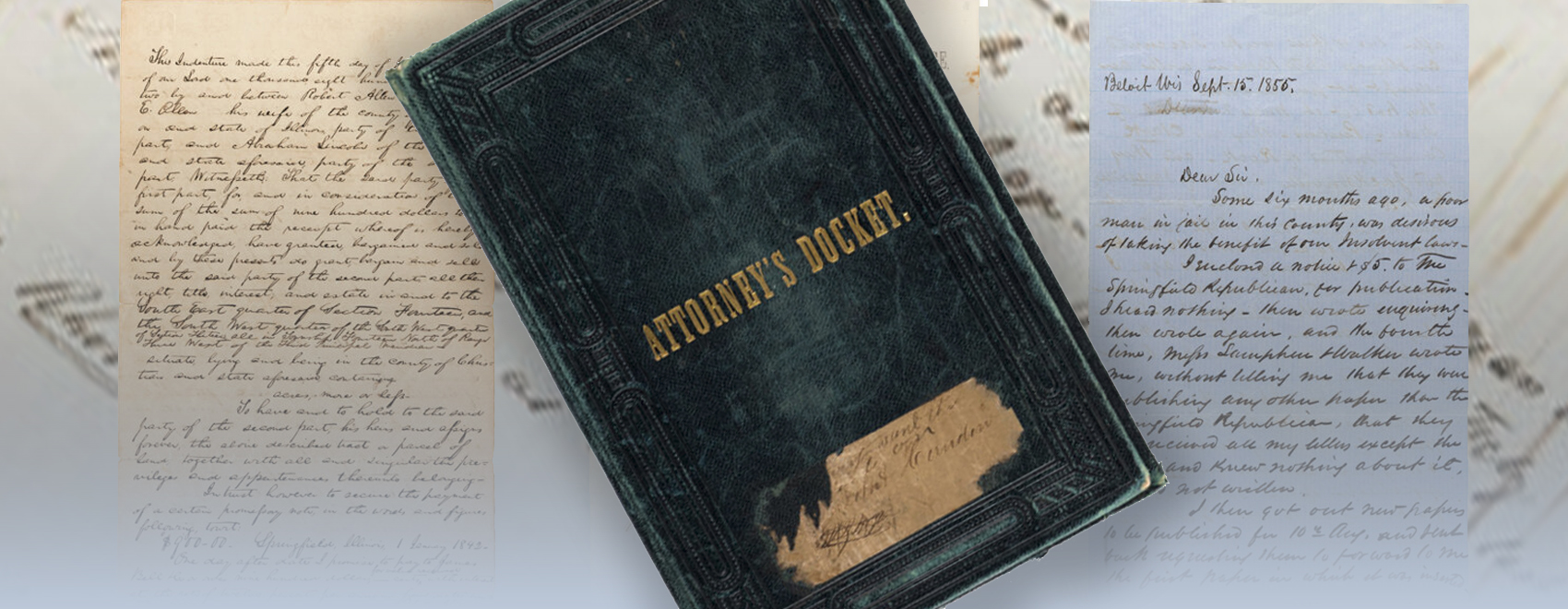
A REMARKABLE ARCHIVE PRESERVED FOR GENERATIONS BY A SINGLE FAMILY OFFERS AN INTIMATE LOOK AT THE LEGAL CAREER THAT FORGED ABRAHAM LINCOLN’S CHARACTER, INTELLECT, AND LEADERSHIP
By Caroline Tamposi | July 21, 2026
Few discoveries have the power to reshape our understanding of a familiar historical figure. The Alfred Orendorff Archive: Treasures from the Law Offices of Abraham Lincoln does exactly that, revealing the future president not as a towering statesman, but as a young attorney building a practice in Springfield, Illinois, decades before he entered the White House.
While every serious Lincoln collector is familiar with William H. Herndon, Lincoln’s longtime law partner and biographer, the name Alfred Orendorff — Herndon’s eventual law partner and heir to the firm Lincoln founded — has remained largely unknown outside specialist circles. The Illinois-born attorney and Civil War veteran preserved a remarkable collection of Lincoln material, including original documents, artifacts, and office furnishings that offer a window into Lincoln’s multifaceted professional life.
To better understand the significance of the Orendorff Archive, which Heritage Auctions will present on July 30, Intelligent Collector spoke with Harold Holzer, a renowned Lincoln and Civil War scholar, and David Webster, a direct descendant of Orendorff and one of the longtime stewards of his family’s archive. Together, they offer complementary perspectives: one placing the material in its broader historical context, the other reflecting on what it has meant to preserve these documents and artifacts for generations before sharing them with the public.

Heritage’s July 30 The Alfred Orendorff Archive: Treasures from the Law Offices of Abraham Lincoln Manuscripts Signature® Auction offers an extraordinary selection of Lincoln legal manuscripts, documents, and office furnishings preserved through the family of Alfred Orendorff, the law partner who succeeded Lincoln in practice.
Harold Holzer, Leading Lincoln Scholar
INTELLIGENT COLLECTOR: Many people know Abraham Lincoln as president and emancipator, but far fewer appreciate the nearly 25 years he spent practicing law. How did Lincoln’s legal career shape the leadership, reasoning, and temperament that ultimately defined his presidency?
HAROLD HOLZER: “Reverence for the laws” — as Lincoln described his philosophy in his 1838 Lyceum Address — influenced and animated every aspect of his enormously consequential, nation-saving presidency. His legal training compelled him to seek justification in the law for nearly every daring, historic initiative he took to save democracy: opposing secession, calling for volunteers, imposing a blockade, justifying the suspension of habeas corpus, freedom of speech and freedom of the press, legislating the first military draft and first federal income tax, authorizing emancipation — even encouraging western Virginia “secession” and statehood. For everything there was a season and political and military reason — but also very careful legal research, consultation with and advice from the brilliant lawyers in his Cabinet, and justification to the people in the manner of the best jury summations. Other scholars have said, and I endorse the idea: Lincoln was the quintessential lawyer-president.
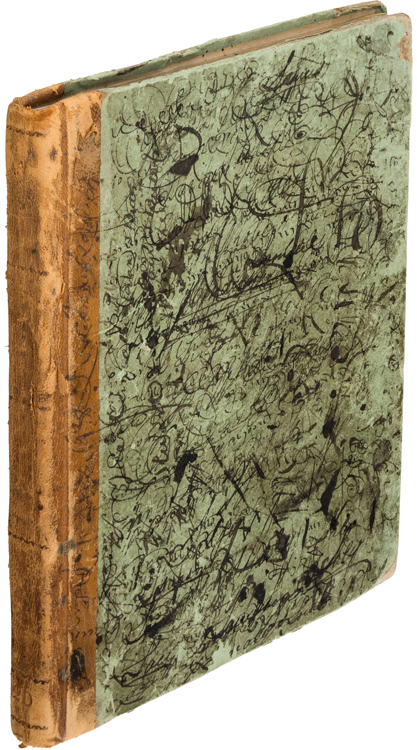
Lincoln’s office fee book from his law partnership with John Todd Stuart. Stuart & Lincoln lasted from 1837 until its amicable dissolution in 1841.
IC: Lincoln spent thousands of miles riding the Illinois Eighth Judicial Circuit, representing everyone from railroads to ordinary farmers. Which aspects of his legal practice do you think most challenged or refined his character, and can those experiences be traced in the documents that survive today?
HH: Circuit-riding not only gave Lincoln experience in every aspect of common law — from murder to divorce to wills and estates to bankruptcy to Black rights to corporate law — it exposed him to a wide array of personalities and characters of all political persuasions, helping him to situate himself in politics and government, and introducing him to clients, judges, and newspapermen in the many county seats where he practiced. The law was not all flash and fire, however. The surviving documents from Lincoln’s legal practice, including the relics preserved in the Orendorff Archive, show that the Lincoln-Herndon firm crossed the t’s and dotted the i’s where state law is concerned, leaving no stone unturned, leaving no precedent unresearched, to achieve the best understanding of the law and the best results for their clients.
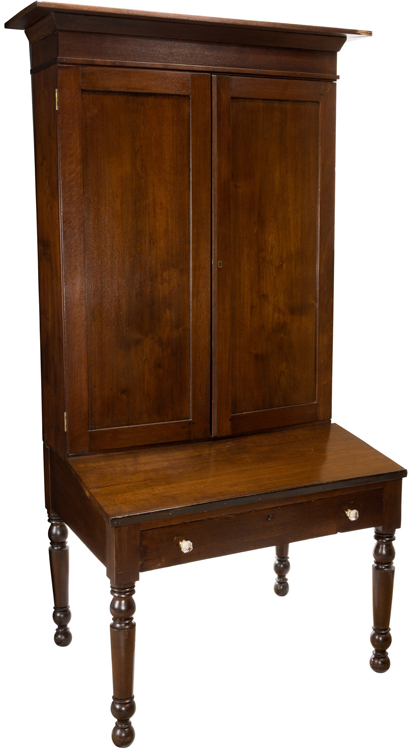
This circa-1845 Empire mahogany secretary desk is among the principal surviving furnishings from the Lincoln & Herndon law office. Preserved in the homes of Orendorff and his descendants for more than a century, it has remained largely unknown to Lincoln scholars and has been rarely exhibited publicly.
IC: What was Lincoln’s relationship with his law partners like? How did his practice evolve or change under Stuart, Logan, and Herndon?
HH: On the most obvious level, Lincoln progressed over time from a kind of legal intern to junior partner to equal partner to senior partner during his three decades in legal practice. His first partner, John Todd Stuart, was a source of inspiration and encouragement, a mentor, a good example of how to combine the law and politics in a single career, not to mention a member of the family into which Lincoln would later marry. I think perhaps Stephen Trigg Logan was his least copacetic partner — a good Whig, to be sure, but a rather brittle fellow, really not Lincoln’s type at all. Both men — and Lincoln, too — ran for Congress as Whigs, which shows you what a springboard the practice could be. Herndon, of course, did not follow in their footsteps, though he did serve for a time as Springfield mayor and remained active in local politics and abolitionist philosophy. Lincoln shared all his fees 50-50 with Herndon, but there was never any doubt that Lincoln was the senior, and Herndon the junior, partner. Yet Herndon’s attention to research detail was foundational to their work. Herndon always believed that Lincoln would return to the practice one day, but it is instructive to note that Lincoln would not even give his partner a patronage job when Herndon asked for one. What else could Herndon do but take on a partner of his own and become a biographer?
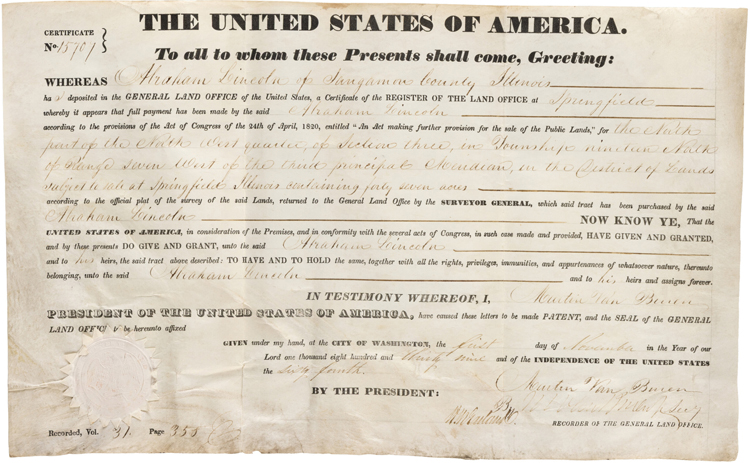
Lincoln’s federal land grant for his earliest known land purchase on the Illinois frontier. Issued under Martin Van Buren, the grant is dated November 1, 1839.
IC: What is the biggest misconception people have about Lincoln as a lawyer?
HH: In history and the arts alike, both books and movies, the biggest misconception has been that Lincoln was a homespun prairie lawyer who kind of sleepwalked through his legal career on the strength of a winning personality, a reputation for absolute honesty, and a terrific sense of humor. Those aspects of his personality are indisputable, but the surviving records demonstrate that he was a very sharp lawyer indeed, fully capable of arguing a panoply of cases and even establishing case law that stood for generations as precedent-making. On the other hand, a counter-misinterpretation, which arose late in the 20th century, is that Lincoln was a sharp, sometimes even an unscrupulous attorney comfortably in the thrall of railroad interests at the expense of his neighbors’ best interests. Both of these reputational extremes do a disservice to the real attorney, who was skilled, much in-demand, well-respected by judges, and responsible for a great deal of appeals work in Springfield. In short, he was a lawyer’s lawyer.
IC: Was there anything in this archive that genuinely surprised you, despite years of studying Lincoln?
HH: Well, I had no idea that these law office furnishings had survived, and I am absolutely overwhelmed that they have been so beautifully preserved and protected by the Orendorff family. The pieces are sturdy and functional, as well as pleasing to the eye — metaphors, in a way, for the Lincoln-Herndon law practice itself. Where the documents are concerned, I would have to say the big eye-opener for me was the Lincoln-Stuart casebook, with all its detail about how fees were calculated and divided, and the record of Lincoln’s first real estate purchase at the tender age of 27, signed by President Martin Van Buren, no less, whom Lincoln would meet one day in Illinois. What a complex, endlessly fascinating professional life Lincoln led outside of politics, and here is the living evidence of that formative career. Without his experience as a fine lawyer, Lincoln could never have been a great president, and without the Orendorff material at his disposal, he never could have been a successful, well-organized lawyer.
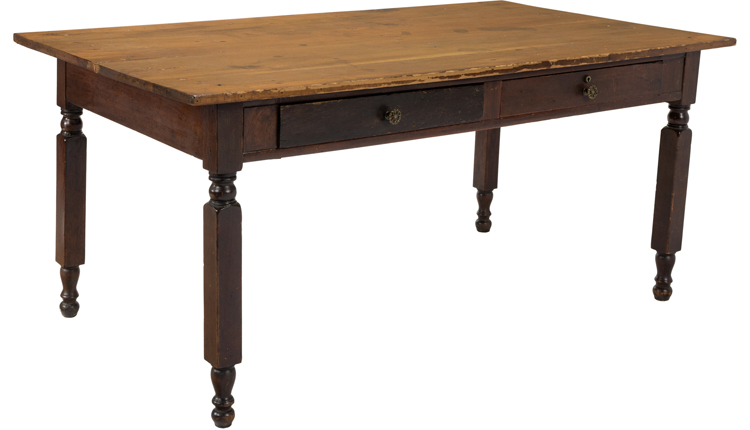
This unassuming table with mismatched wood types, ink stains, scratches and nicks, reinforcement nails, and reglued dovetails is exactly the type of furniture one would expect to see in the Lincoln & Herndon law office — symbolic of hard work and dependability and void of vanity.
David Webster, Alfred Orendorff’s Great-Grandson and Part Owner of the Orendorff Archive
INTELLIGENT COLLECTOR: Your family has preserved this archive for generations, tracing back to Alfred Orendorff and the succession of Lincoln’s law office. Growing up, when did you first realize that these weren’t simply family heirlooms, but pieces of American history?
DAVID WEBSTER: When I was very young, my extraordinary grandmother, who was Alfred Orendorff’s younger daughter, Lydia Edna Orendorff Macpherson, told me stories of her parents, of long-ago Springfield, and of Abraham Lincoln. She regarded her parents and grandparents as significant witnesses to Springfield’s relationship with Lincoln; in fact, as a young girl, my grandmother’s mother (and Alfred Orendorff’s wife), Julia Jayne Williams, had known Lincoln and his family. I took great delight in shaking my grandmother’s hand and observing that I had just shaken a hand that had itself shaken the hand (of her mother), who had shaken the hand of Mr. Lincoln.
My grandmother spoke to me as an adult and took very seriously my own early fascination with history, much of it because of her. We had fascinating conversations about the relationship her own grandparents (John and Lydia Porter Williams) had with the Lincoln family. (John Williams was one of the few people who served as an honorary pallbearer at the funerals of both Abraham and Mary Todd Lincoln.) Both the Lincoln table and desk were kept in her home, and her stories about them made us appreciate them as a part of American history.
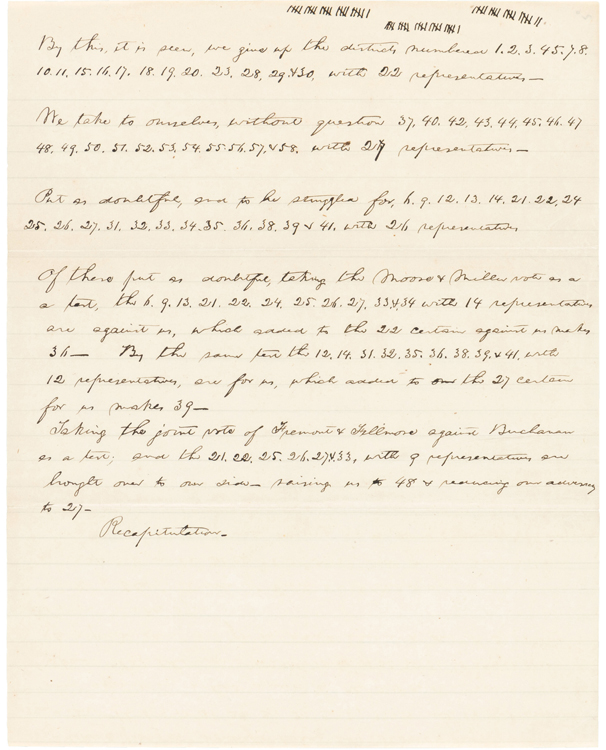
Lincoln’s handwritten strategy blueprint for his 1858 Senate race against Stephen A. Douglas
IC: For many years, your family chose to share portions of the archive with historians and institutions while continuing to preserve it privately. Why was it important to you to make these materials available for scholarship, and what has it been like seeing researchers uncover new insights from documents your family safeguarded for generations?
DW: The Orendorff Archive has correspondence between General Orendorff (Orendorff had served as Illinois state adjutant general in the 1890s under Governor John Peter Altgeld, hence his military title) and Frederick Trevor Hill. Hill requested that certain items in the Orendorff Archive be made available to him for his book, Lincoln the Lawyer, published in 1906. In the decades following this, similar items were made available to other Lincoln biographers, notably to Harry E. Pratt, the author, among other works, of the 1943 foundational book The Personal Finances of Abraham Lincoln.
I never asked my grandmother why the family had made the archive available to historians. I think she would have pointed to the role her parents and grandparents had played in the development of Springfield. They believed Springfield was special (all of them rest at Oak Ridge Cemetery there), and one way of making it so was to help tell the complete story of its greatest son. The Orendorff Archive has helped make that possible.
What fascinates me about your question is that during part of my lifetime relatively few books or articles were published that directly used or cited the items in the archive. Then, in the early 2000s, the masterful Law Practice of Abraham Lincoln went online. This, for the first time, enabled researchers to learn the details of some of the less well-known items in the archive. This has been greatly illuminating, and it has heightened interest in the archive. From time to time, new works on Lincoln contain full reproductions of items contained in the archive, e.g., Ronald White’s use of Lot 43024, showing Lincoln’s campaign strategy in the 1858 Senate race against Stephen A. Douglas, in his work Lincoln in Private.

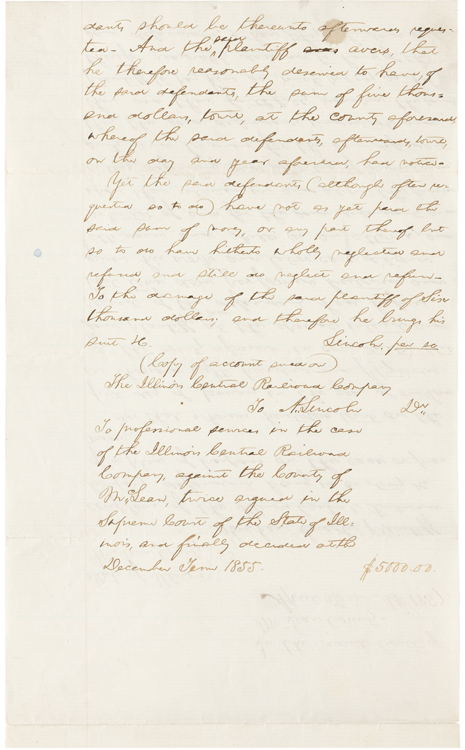
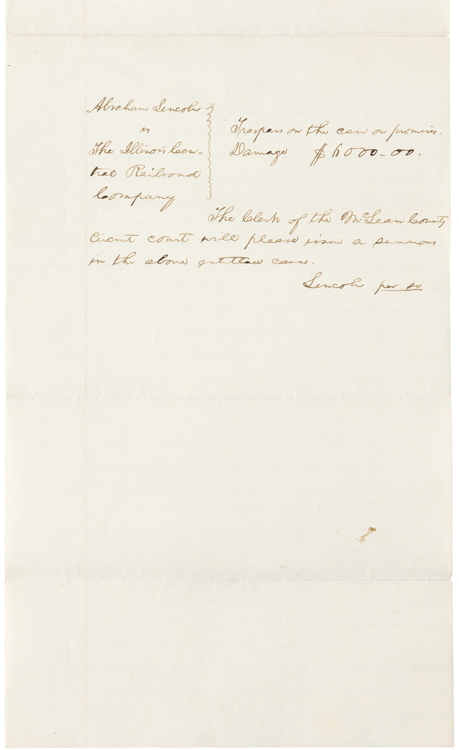
Lincoln’s representation of the Illinois Central Railroad in the McLean County tax litigation stands among the most significant, lucrative, and frequently discussed cases of his legal career. These autograph documents offer a rare firsthand view of his effort to secure payment after his celebrated victories on behalf of the railroad before the Illinois Supreme Court.
IC: As you’ve researched your family’s connection to William Herndon, Alfred Orendorff, and the Lincoln law office, what discoveries have surprised or moved you the most? Have you learned anything about your ancestors that you never expected?
DW: I had not known of the Lincoln Family Album (which is not part of the archive), the photographs set aside by the Lincolns and their descendants in a family photo album. (Mark Neely and Harold Holzer have written about it in The Lincoln Family Album.) I came across the album while working on the archive, and to my delight I found in it photographs not only of a youthful Alfred Orendorff, but also of his wife, Julia Jayne Williams, and her parents, John and Lydia Porter Williams. I do not know how these photographs came to be part of the Lincoln Family Album, but the confirmation of a relationship between the Orendorffs/Williamses and the Lincolns was uplifting. It was the direct result of working on the archive.
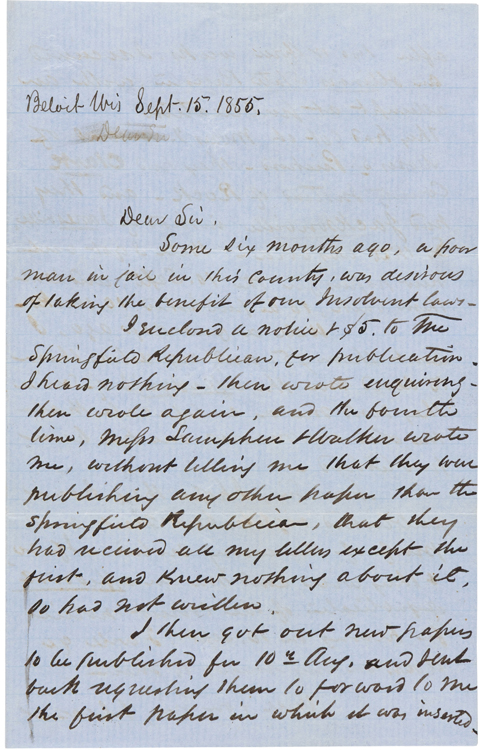
An 1855 letter Lincoln inadvertently received from Wisconsin attorney Matthew Hale Carpenter, who included these postmaster instructions: ‘please hand this to a good lawyer, in Springfield.’
IC: After spending so many years living with these documents and objects, what do you think people will better understand about Lincoln — not as a president, but as a lawyer, colleague, and everyday person — when they encounter this archive?
DW: I think people will better understand that Lincoln was not only a Springfield prairie lawyer, but also one of the leading lawyers in the entire state. Many of his cases — both for and against — involved railroads, which are often considered to be the premier mid-19th century legal client. The archive shows, in the Illinois Central Railroad case, Lot 43021, that Lincoln was not afraid of losing a big client for a righteous reason when he personally sued the railroad for his unpaid legal fees. It similarly shows his closeness to the cream of the legal profession in Illinois, when he asked several of these lawyers to testify to the reasonableness of his legal fees in the Illinois Central litigation. In several of the documents a clear sense of his analytical abilities emerges, which is one way of looking at the workings of a person’s mind.
Another is Lot 43016, “Matthew Carpenter Autograph Letter Signed with Postmaster Instructions.” The sender, a Wisconsin lawyer, needed Illinois legal advice and wrote on the address panel “Mr PM, please hand this to a good lawyer, in Springfield.” The letter went to Abraham Lincoln, which of course shows that Lincoln’s reputation among his townsmen was of the highest.
Lot 43011, “William H. Herndon Autograph Document Signed: Accounting of Office Furniture and Supplies for the Lincoln & Herndon Law Firm,” evinces aspects of the business relationship between Lincoln and his final law partner, William H. Herndon, one of the most famous law partnerships in American history. It demonstrates that they divided law firm expenses evenly, gives examples of early firm purchases, and reflects attentiveness to the keeping of basic business records. It may even be a simple form of a partnership agreement, no other examples of which are known to exist.
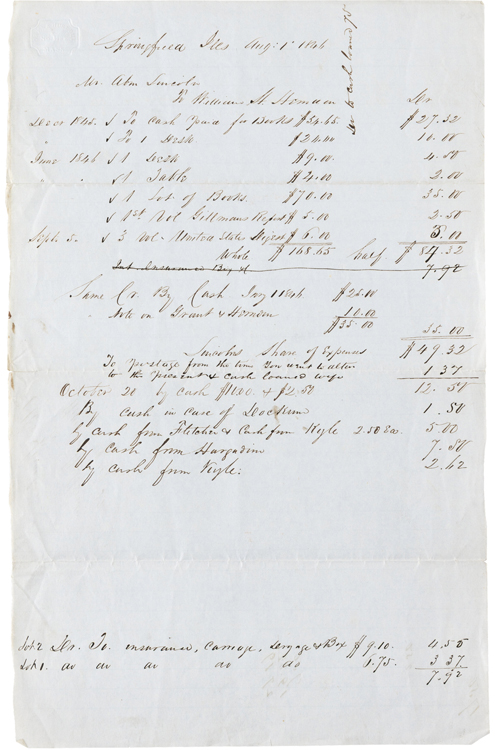
This 1846 shopping list records expenses incurred in the operation of the Lincoln & Herndon law office. Among the listed purchases are books, furniture, legal reference works, postage, insurance, and other office necessities.
IC: Every family has stories that are passed down from one generation to the next. Has caring for this archive changed the way you think about your family’s place in history, and what does it mean to you to be the final family steward of this remarkable archive?
DW: Saying goodbye to the Orendorff Archive will be difficult. Most of the items have been in the extended Orendorff family for close to 150 years. But the creative and talented professionals at Heritage are making it possible for the items in the archive to find new and far larger audiences, perhaps newfound scholarly relevance, and helping, even indirectly, to focus a praiseful spotlight on Alfred Oredorff and his work in preserving the Lincoln record. That is a considerable reward in and of itself.