
FOR TWO BROTHERS HANDLING THEIR PARENTS’ ESTATE, LETTING GO OF THE FAMILY HEIRLOOMS WAS AN EMOTIONAL JOURNEY
By Barbara Tunick | January 6, 2026
The paintings hung in their dad’s home office since Adam and Jon Turteltaub were young boys. They were part of the fabric of their home, of their family, of their lives. They were always there, even after the boys grew up and moved away. They were there when they came home to visit from college, then with their own families, and after their dad passed away. They were and continue to be a reminder of the friendship between their dad, Saul Turteltaub – the Emmy-nominated writer and producer for such shows as Sanford and Son, The Carol Burnett Show, and That Girl – and the artist Ernie Barnes.
Barnes, who was born in segregated Durham, North Carolina, and raised during the height of the Jim Crow era, played professional football throughout the early 1960s and was the first American professional athlete to become an acclaimed painter. His most famous work, The Sugar Shack, a 1976 painting depicting dancing figures in a crowded Black music hall in North Carolina, rose to prominence when it was added to the end credits of the groundbreaking 1970s sitcom Good Times. An earlier version of the painting also appeared on the cover of a 1976 Marvin Gaye album.
But before music and television fame, Barnes created two pieces for Saul and Shirley Turteltaub, both paintings excellent examples of the artist’s neo-Mannerist style of elongated figures, exaggerated musculature, dynamic movement, and energy depicting scenes of Southern Black life and athleticism. “My parents weren’t art collectors or people who commissioned art, and Ernie wasn’t churning out pieces of art that were very valuable at the time or that people bought knowing they were going to make money,” Adam recalls. “I think it says a lot that they were struck by his work and wanted to support him.”
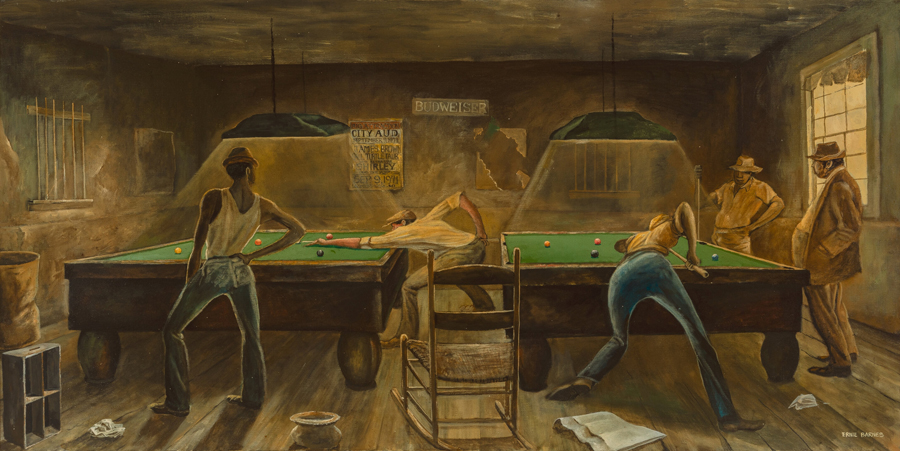
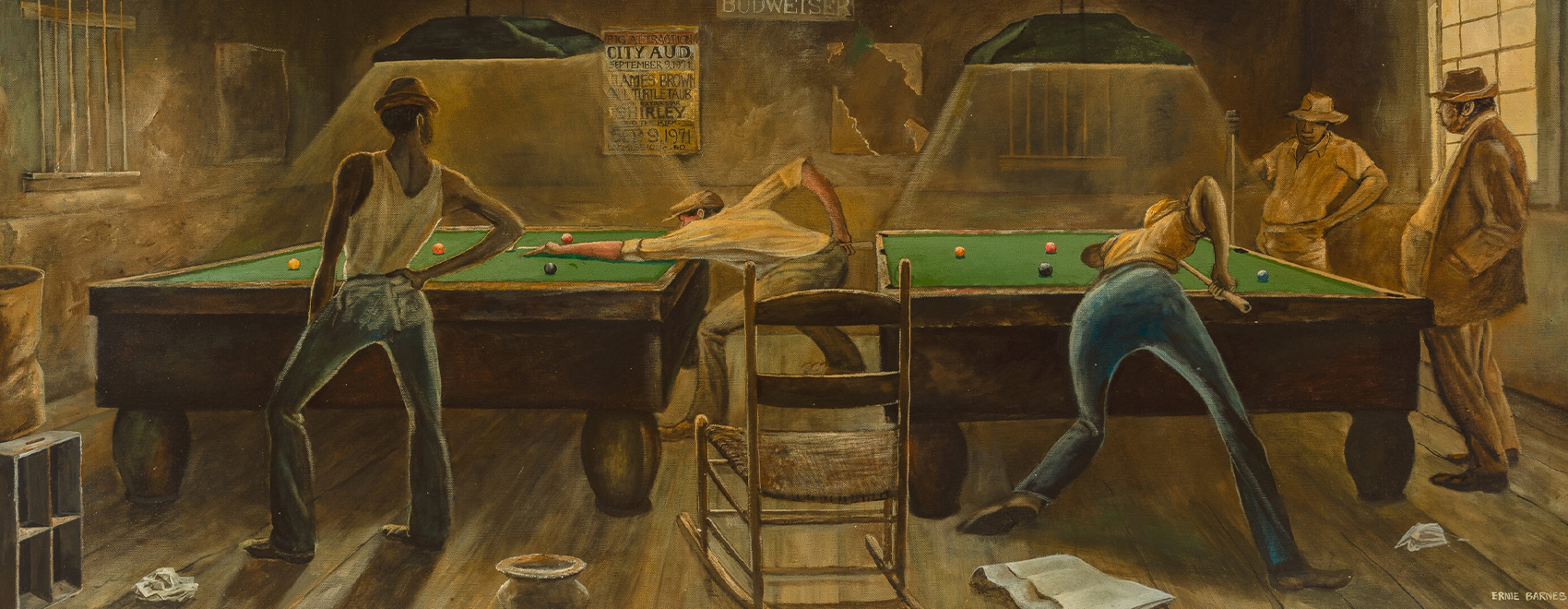
Ernie Barnes ‘Easy Shot,’ 1971. Oil on canvas. 24 x 48 inches (61.0 x 121.9 cm). Property from the Estate of Saul and Shirley Turteltaub, Beverly Hills, California. Sold for $225,000 on November 14, 2025, in Heritage’s American Art Signature® Auction.
Easy Shot, painted for Saul and Shirley in 1971, is set in a 1970s Southern pool hall and has been described as a masterful meditation on movement, community, and the visual rhythm of everyday life. A misspelling of “Turteltaub” even appears in the composition, on a poster affixed to the pool-hall wall. The second painting Barnes created for the Turteltaubs, 1-2 Finish from 1973, depicts two hurdlers with elongated limbs suspended in perfect harmony, their torsos twisting with rhythm, energy, and precision.
“I remember being a kid and seeing Ernie’s work was now on the TV show Good Times. And then when I looked at our painting with our name on it, it was the greatest thing ever,” Jon says with a laugh. “Ernie didn’t want people to simply look at his paintings as objects; he wanted viewers to appreciate the subject of the painting. It was as if he was saying, ‘Look at this piece of life. And I’m going to exaggerate it a bit, so you really see what’s great about it.’ Ernie also had a cultural understanding of sports and its importance. I think he felt that sports was part of the sinew of the Black community. He saw it in a different, intimate way. He focused on bodies rather than faces, on movement rather than on stillness.”
Both paintings remained a cherished part of the Turteltaub estate for more than 50 years, but things changed in 2022, when Barnes’ iconic painting The Sugar Shack sold at auction for more than $15 million. “That’s when we realized our paintings were much more valuable than we ever imagined,” Adam says. “It would have been very expensive to insure and protect them in our parents’ house. We eventually moved them to an art warehouse where they would be safe.”
“While it didn’t make sense to leave them hanging on a wall in our parents’ house, once we moved them to the warehouse, it felt like we had them locked in a closet. We still owned them, but no one was enjoying them,” Jon adds. “Then there were the LA fires and the fact that we’re all getting older, and possessions began to feel less and less important. You realize your kids aren’t going to cherish the same things you do, and there was the burden of caring for and insuring them, while knowing that at some point we were going to have to let them go since neither Adam nor I had a place in our homes for them.”
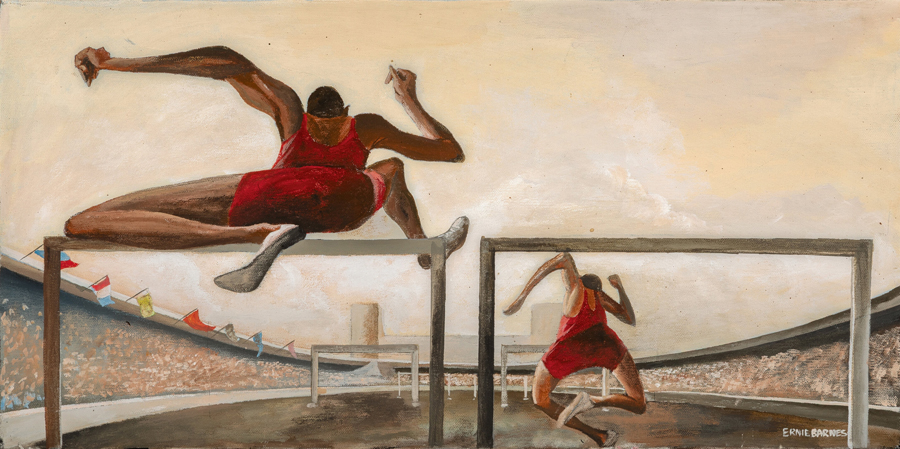
Ernie Barnes ‘1-2 Finish,’ 1973. Oil on canvas. 12 x 24 inches (30.5 x 61.0 cm). Property from the Estate of Saul and Shirley Turteltaub, Beverly Hills, California. Sold for $137,500 on November 14, 2025, in Heritage’s American Art Signature® Auction.
After considering their options for how to best sell their beloved paintings, the Turteltaubs chose to consign the pieces with Heritage Auctions. “The external process was easy. We felt like Heritage did the best job for us. They never pushed, they communicated frequently, advertised the auction well, and made everything easy,” Jon says. “The struggle was internal. You feel like you’re losing control of something very important, almost like we were sending a child off to live with another family.”
“It’s a very emotional experience for many people once they decide to sell their collections or their family heirlooms,” says Carolyn Mani, Heritage Auctions’ West Coast Director of Trust & Estates and curator for the Turteltaub estate. “I’ve been doing this for 26 years and will tell you that once clients make the decision to sell their possessions, there’s a release. People don’t realize the monumental responsibility that goes along with caring for valuable family heirlooms. Once the decision is made to let them go, there’s a sense of freedom, but getting to that feeling is a journey.”
Part of the process, she notes, is assuring clients that they have chosen the best place for their collections. “For the Turteltaubs, it helped to know that I personally started selling Ernie Barnes paintings 16 years ago and that Heritage Auctions has offered some of his best pieces to come to auction,” she says. “Couple that with the fact that we have seen prices raise exponentially on his work.”
It’s also important to understand and have access to the appropriate audience. “In this case, we knew who was interested in Ernie Barnes’ work, so we reached out to a very strong base of collectors,” Mani says. “When you work with people who are really passionate about what they are buying, when there is more competitive bidding and buying, there’s a better result for the client. And that was, thankfully, the case for the Turteltaubs.”
Easy Shot sold for $225,000 in a November 2025 Heritage auction, and 1-2 Finish realized $137,500.
“For many collectors, it’s not only about the monetary benefit of selling their collections, but it’s releasing something important in their lives that they can’t keep, yet feel a sense of responsibility to, especially when it comes to honoring their decedent’s wishes,” Mani says. “It’s a great feeling to help them realize that they don’t have to carry that burden any longer.”
“It’s kind of strange thinking about our paintings belonging to someone else, especially the one with our name on it,” Adam says. “But it’s nice knowing they’re going to be in a place where there’s space for them and they’ll be treasured and appreciated.”
“I still feel a connection to the paintings,” Jon adds, “but I know we did what was best. If we had someone who wanted them, who would love them, we would have given them away. The truth is when you start to think about your mortality, you realize the best things in life aren’t your possessions.”