
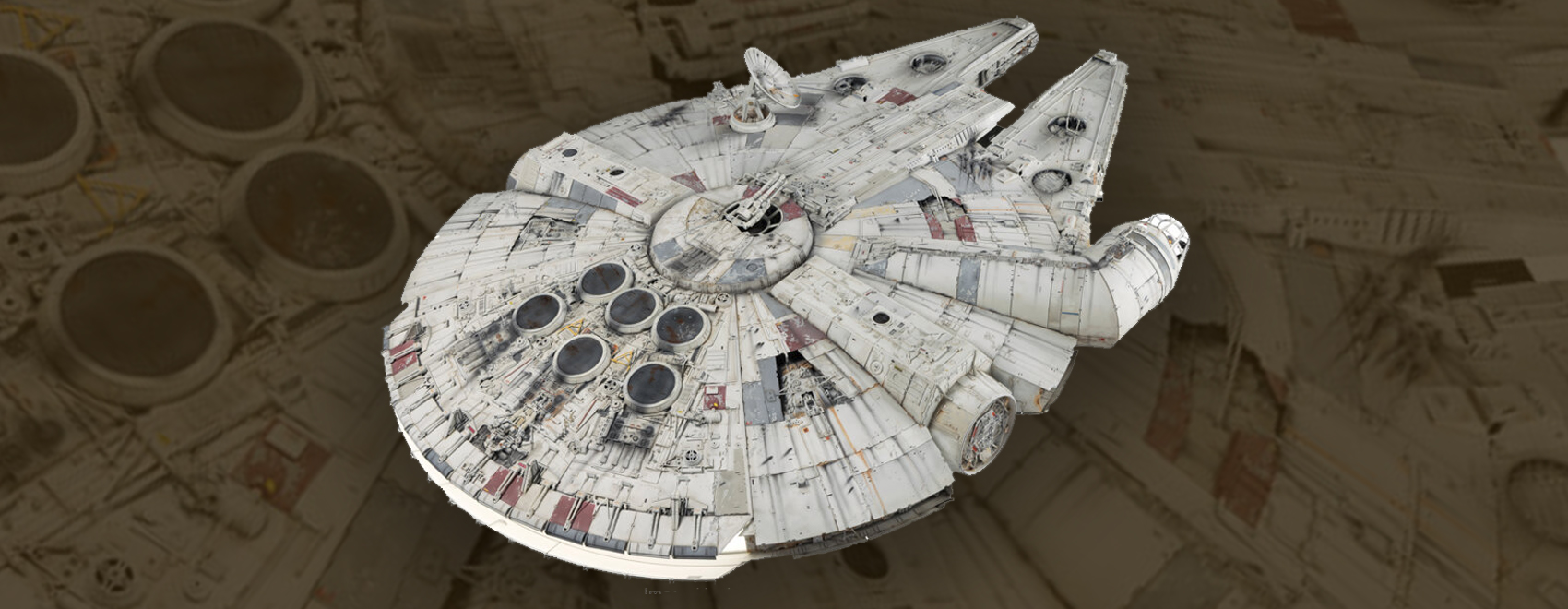
CREATED WITH ORIGINAL TECHNIQUES AND THOUSANDS OF VINTAGE PARTS, CRAFTSMAN SEAN SIDES’ VERSION OF THE STAR WARS ICON BLURS THE LINE BETWEEN REPLICA AND ARTIFACT
By Colin Tait | April 7, 2026
What do you call something that is more than 5 feet long, never appeared on screen, and took nearly four years to build by hand? It’s not quite a filming miniature. But calling it a replica doesn’t quite fit either. In fact, Sean Sides’ Millennium Falcon occupies a category of its own.
In certain respects, it is even truer to the original 1977 filming miniature than the version audiences remember — that screen-used model, after all, was modified for The Empire Strikes Back. And crucially, that version — the Falcon as it now exists — will almost certainly never be offered for sale, remaining permanently housed within the Lucasfilm archives and effectively removed from the marketplace altogether.
In that context, Sides’ work, which is now available in Heritage’s May 4 Star Wars Day Hollywood/Entertainment Signature® Auction, takes on a different significance: not simply as a replica, but as the closest attainable version of the original artifact. And yet, none of that fully prepares you for the experience of encountering it in person.
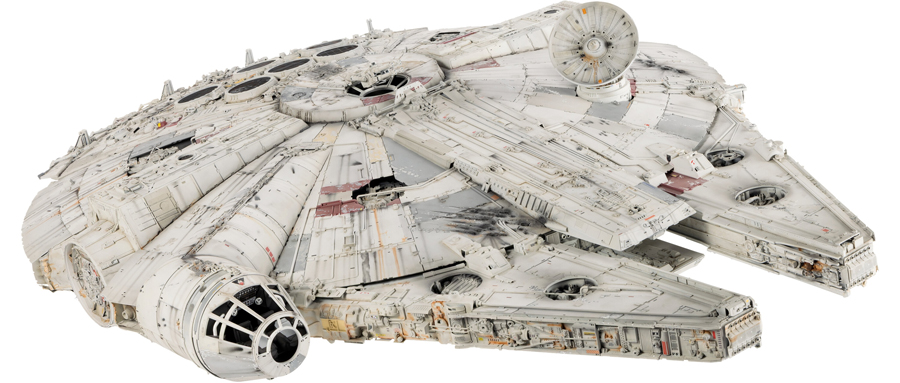
Sean Sides’ hand-built replica of the Millennium Falcon filming miniature from 1977’s ‘Star Wars: Episode IV – A New Hope’ is available in Heritage’s May 4 Star Wars Day Hollywood/Entertainment Signature® Auction.
Standing before Sides’ Falcon is, quite simply, overwhelming. Your eye drifts across its surface, catching on every “greeblie” — the dense constellation of kitbashed parts that give the ship its texture and believability — along with every scar, decal, and weathered panel. What becomes clear, slowly and then all at once, is that this is not merely a feat of scale, but of fidelity.
Sides has not only re-created the Falcon’s iconic silhouette but also traced the lineage of its construction — sourcing the exact model kit components used by the original Industrial Light & Magic craftsmen in service of George Lucas’ vision for the ship.
That commitment to detail has not gone unnoticed.
Sides’ Falcon was selected for display at the Academy Museum of Motion Pictures, where it served as a centerpiece in demonstrations of John Dykstra’s revolutionary Dykstraflex camera — the system that first gave these models convincing motion and weight on screen. That placement does more than validate the work; it situates the model within the very history it seeks to recover.
For Sides, the story begins in 1977.
“Star Wars comes out. I’m 10 years old,” he says. “I was exactly the target audience.” What he wanted, even then, was not just to watch these ships, but to build them.
“What I wanted was model kits,” he says. “And there weren’t any Star Wars kits yet.” So he built what he could — Battlestar Galactica models, early science fiction kits, whatever approximations were available. At the time, the work was simple. But something deeper lingered. “I remember seeing model magazines — jets, armor — with panel lines and weathering,” he says. “And thinking: How do you even get to that level?”
He wouldn’t answer that question until much later.
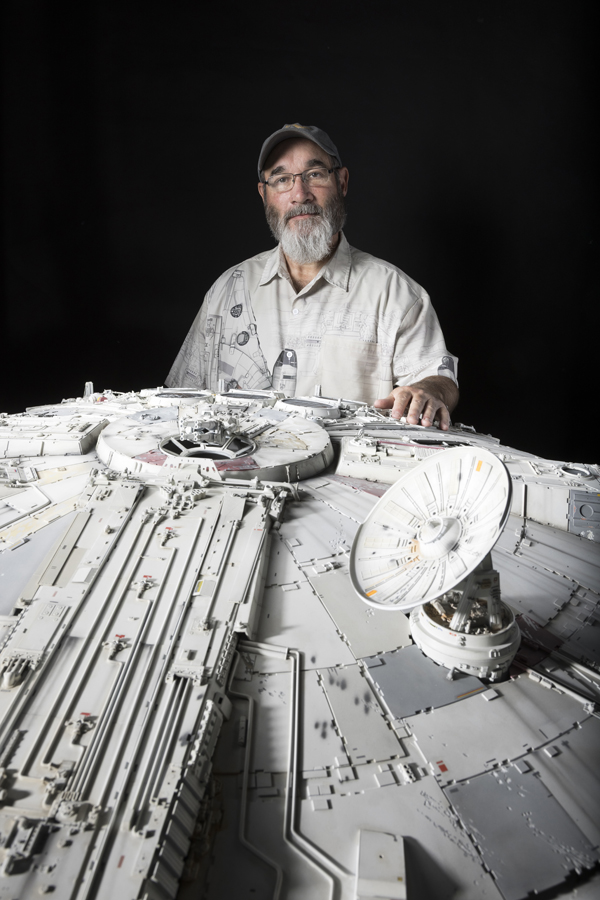
Sides with his museum-worthy re-creation of the Millennium Falcon
By the late 1990s, Sides returned to model building with a new seriousness — learning advanced techniques, joining the International Plastic Modelers’ Society, and competing at a high level. Then came the internet, and with it, a transformation. “You start seeing scratch-building, garage kits,” he says. “Things I’d never even heard of.”
Online communities began doing something unprecedented: collectively reverse-engineering filming miniatures. Builders compared photographs, identified parts, measured proportions, and refined each other’s findings.
“It was crowdsourcing,” Sides says. “Before we even had a word for it.”
That process reached a turning point when Sides undertook to create a screen-accurate, fully scratch-built 1978 Battlestar Galactica Colonial Class spacecraft filming miniature, a project that took three years and fundamentally changed his approach. “This is when the light bulb came on,” he says. “I realized I was done with commercial kits.”
What followed was not simply modeling, but reconstruction.
At the heart of that reconstruction is kitbashing, the process ILM pioneered in the 1970s, in which commercial model kit parts — tank treads, aircraft components, naval details, decals — were repurposed and layered onto original forms to transform familiar elements into entirely new spacecraft. From a distance, these additions read simply as surface detail; up close, they reveal themselves as something else entirely — “greeblies,” as the artists called them — individual parts drawn from disparate kits, combined to add texture, dimension, and a sense of functional complexity. Until Star Wars, spacecraft were typically sleek and pristine. But inspired by his background in hot rod culture, Lucas insisted these ships should appear used, modified, and lived-in — and the model builders made them look the part.
This philosophy would guide Sides’ Falcon — and, more importantly, his reconstruction of it.
But Sides’ ambition went further. He was not trying to re-create the Falcon as it exists today. He was trying to recover something more specific: the original 1976–77 version.
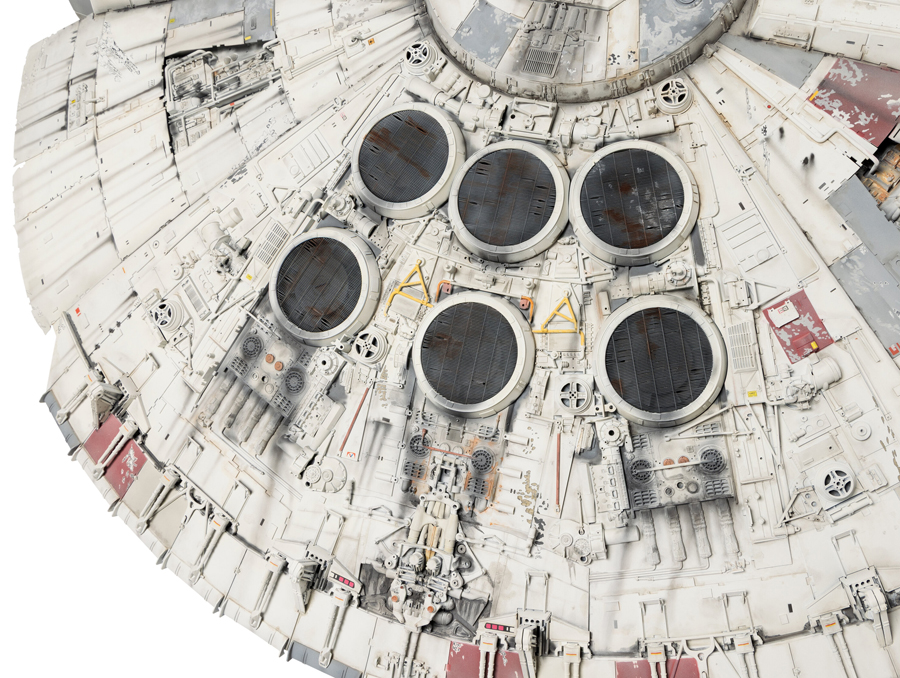
A detail view of Sides’ Falcon
“What I wanted to re-create,” he says, “was the magic of the model they built for the first film.”
That version no longer exists as a singular, intact object. The original filming miniature was modified extensively for The Empire Strikes Back, most visibly through the addition of the multi-point landing gear system that altered the underside of the ship. It was then further revised during Return of the Jedi, accumulating additional structural and surface changes that moved it even further from its original 1976 configuration. What survives today is not the Falcon as first built, but an evolved production artifact — layered, altered, and historically transformed.
Compounding this, the original miniature is permanently housed within the Lucasfilm archives, where it remains preserved under strict institutional control. It is not available for acquisition, and even access by original filmmakers is limited. In practical terms, the Falcon as it appeared in 1977 — the object audiences first encountered — can no longer be experienced as a complete, standalone artifact.
Which makes what Sides has built something else entirely.
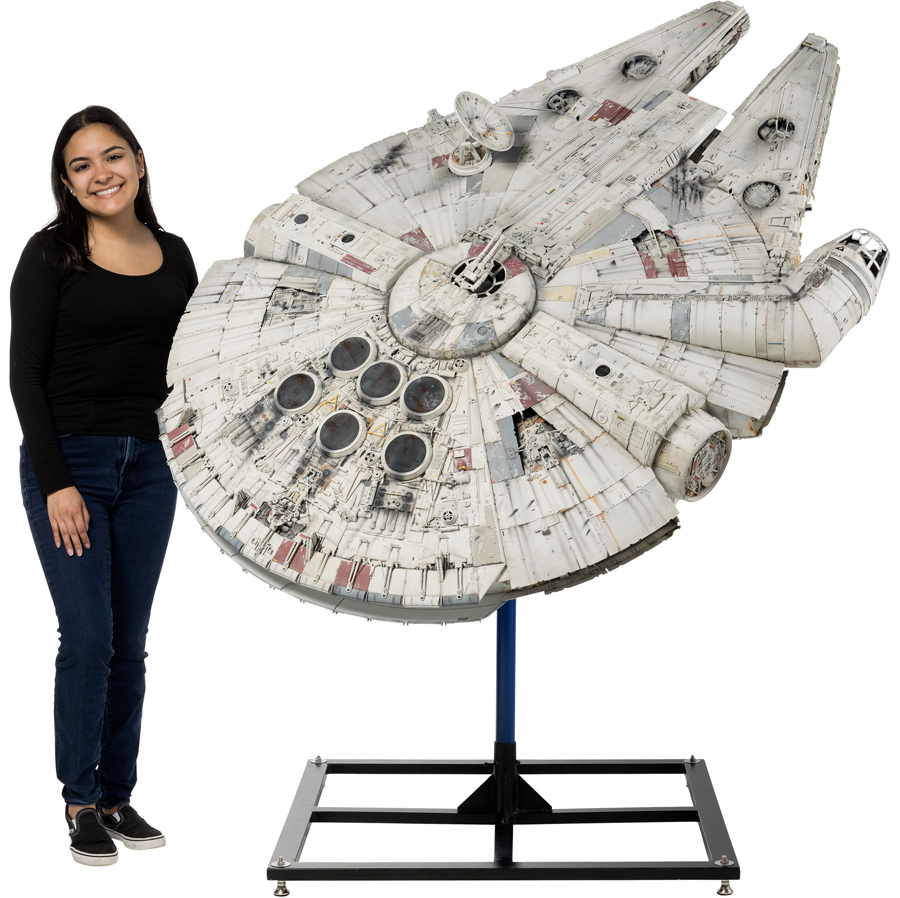
Meticulously constructed using more than 3,000 vintage model kit components, Sides’ Millennium Falcon stretches more than 5 feet across.
The build itself required not just skill, but methods that are also increasingly rare. To replicate the Falcon’s domed hull, Sides contracted a skylight manufacturer to blow-mold acrylic forms to exact specifications. The company produced 12 attempts. Only three worked.
“They told me, ‘Don’t ever send another Millennium Falcon builder here again,’” he says.
From there, the process followed ILM’s original techniques: steel pipe armature, acrylic structure, styrene skinning, layered detailing, and extensive kitbashing.
Over time, Sides and fellow researchers identified approximately 170 unique model kits used in the original Falcon — everything from tanks and aircraft to ships and trains. Many of these kits have since become extraordinarily scarce and, in some cases, nearly impossible to source. The kits themselves have evolved into collector’s items, driven not only by their identification as source material for the Falcon, but by a growing community of builders attempting to replicate the ship using those same original parts. As a result, what were once inexpensive commercial kits have become highly sought-after artifacts, valued as much for their connection to Star Wars as for their role in reconstructing it.
In some cases, only a decal from a kit was used, requiring Sides to track down fragile, decades-old materials and restore them by hand. Even damage had to be reconstructed physically, not cosmetically. “If it didn’t match,” he says, “I had to tear it off and do it again.”
What ultimately separates Sides’ Falcon from all others is not just execution — it is access and the methods that access makes possible. At a moment when many collectors and model makers have turned to 3D printing — prioritizing efficiency, replication, and digital precision — Sides’ approach moves in the opposite direction, returning to the physical processes, materials, and constraints that defined the original builds.
Over years, he assembled what he calls “deep reference material”: unpublished photographs, archival measurements, and direct observations tied to the original model. That level of access is rare and, in some cases, impossible to replicate. To my knowledge, no Millennium Falcon combining this level of craftsmanship, documentary precision, and direct lineage to the original ILM construction methods has ever been offered publicly.
Others have tried. Some have come close. None have pursued the same fidelity to both form and process.
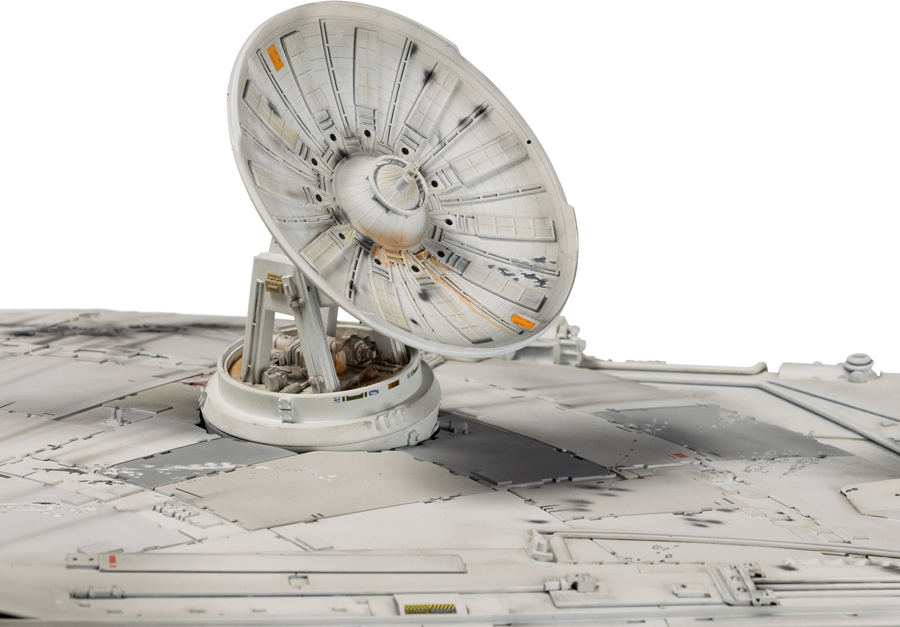
Another detail view of Sides’ reconstructed Falcon
In 2019, that work found its first major public stage. The Academy Museum invited Sides to display his Falcon alongside the restored Dykstraflex camera. Visitors exited screenings to find both objects together — camera and Sides’ impressive model. The camera tracked over the Falcon, using the same angles seen in the original movie and producing the same magical effect.
“People just went nuts,” he says.
More meaningful still was the response from the original filmmakers themselves. At one point, model maker Jonathan Erland remarked that the replica lacked one thing: The builders had signed the original, using small Letraset decals applied directly to the surface of the model.
Afterward, Sides quietly showed him otherwise. He had done the same — tracking down the exact style of decals used by the ILM crew and placing them in the same locations — but instead of reproducing their names, he added his own, along with his wife’s, as a deliberate homage to the original builders and the collaborative spirit of their work.
Erland’s reaction, Sides recalls, was immediate. He recognized it not as imitation, but as the ultimate gesture of respect.
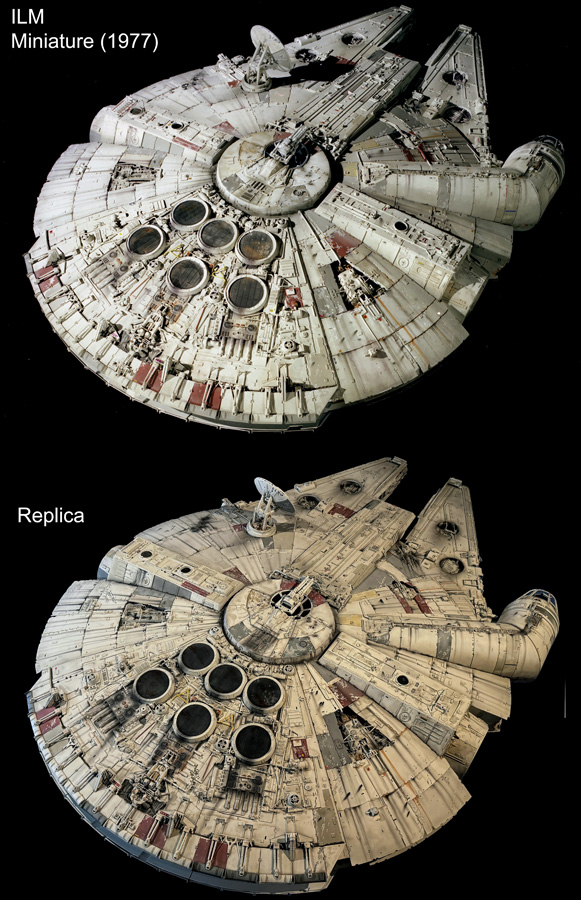
This side-by-side comparison shows why Sides’ version of the Millennium Falcon is widely regarded as the most faithful re-creation of the iconic model ever produced.
In 2024, the Falcon returned to the Academy Museum, this time for an extended exhibition where the Dykstraflex physically moved over the model.
More recently, it traveled even farther.
As he had with the Falcon’s journey to Hollywood, Sides traveled alongside it — this time to Tokyo’s famed Ginza shopping district — as part of Heritage’s May 4 Star Wars Day auction. There, the Falcon was exhibited alongside iconic franchise artifacts, including Han Solo’s DL-44 heavy blaster pistol from The Force Awakens, Chewbacca’s bowcaster, Rey’s staff, and a First Order stormtrooper helmet.
Presented together, these objects charted the tactile history of Star Wars — weapons, costumes, and tools that defined the saga’s physical world. But Sides’ Falcon operated on a different scale.
At more than 5 feet across, it did not simply sit among them. It commanded the space. It flew over them, its sheer size and density of detail drawing the eye from across the display. Where the other objects invite close inspection, the Falcon first overwhelms, then rewards sustained looking, its surface unfolding into hundreds of layered decisions, each one contributing to the illusion of a working machine.
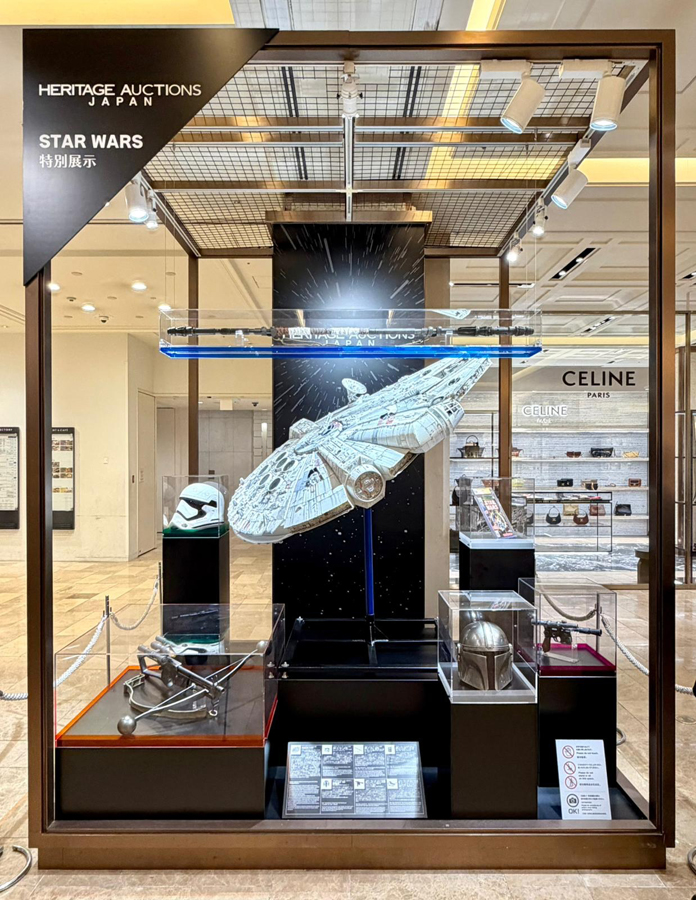
Sides’ Falcon on display in Tokyo during a preview of Heritage’s May 4 Star Wars Day Hollywood/Entertainment Signature® Auction.
For Sides, the experience was not abstract. Having traveled with the model, he was able to witness firsthand the reaction it elicited — the recognition, the surprise, and, most of all, the joy. It was, in a sense, the completion of a long arc: from a 10-year-old encountering the Falcon for the first time to standing beside his own reconstruction as others encountered it anew.
It was not a prop. It was a reconstruction of a lost state, an object that no longer exists in its original form and cannot be directly accessed even by those who first brought it to life. A nostalgic object, in one sense — but more precisely, a reconstruction of memory itself, willed into being by the hands that set out to remake the Falcon as it was.
For Sides, the journey still feels difficult to fully grasp.
“What kid,” he says, “at 10 years old, seeing those ships on screen… would ever imagine this?”
He pauses.
“It took me to another place. It kept me young. It still keeps me young.”
Now, after more than a decade, he is ready to let it go. “I’ve had this model for years,” he says, “and it’s just time to share it.”
He hopes it finds a home where it will be seen and understood — ideally a museum, but at the very least in the hands of someone who recognizes what it represents. Because what Sides has built is not simply an object, nor even a feat of technical precision. At a time when many re-creations rely on digital tools and 3D printing to approximate the surface of the Falcon, his work returns to something more fundamental: the physical logic, material constraints, and accumulated decisions that defined the original.
It is, in that sense, not just a model of the Millennium Falcon, but a reconstruction of how the Millennium Falcon was made and, more subtly, a reconstruction of memory itself.
Because that is ultimately what makes Sides’ Millennium Falcon so arresting. It does not merely resemble the original. It remembers how the original was dreamed into being.