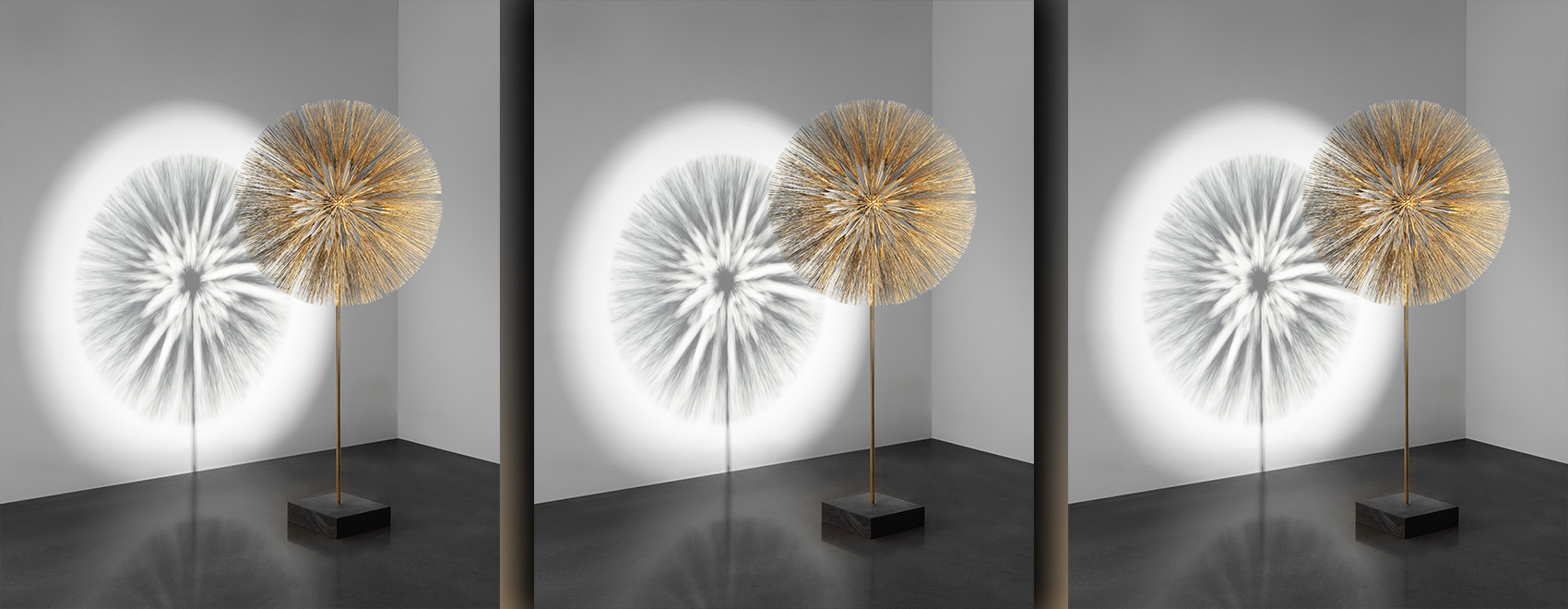
THE LONGTIME FRIENDSHIP BETWEEN HARRY BERTOIA AND KNOLL’S JOHN L. HELM REVEALS THE PERSONAL RELATIONSHIPS THAT HELPED SHAPE A MID-CENTURY MODERN MASTER’S CAREER
By Marin R. Sullivan, PhD | November 3, 2026
In 1950, Harry Bertoia accepted a position with Knoll, relocating from Southern California to Pennsylvania’s Lehigh Valley. Though his formal employment lasted only three years, during which he designed his now iconic suite of seating, the company functioned as one of the most stabilizing forces in his career until his death in 1978. Bertoia’s relationship with Knoll was not an impersonal corporate alliance but rather a sustained effort advanced, over decades, by individuals across the company who became close colleagues, crucial interlocutors, and, in many cases, friends. Though no formal contracts were ever signed, these supporters essentially worked as Bertoia’s art agents and dealers, pursuing potential commissions within the company’s architecture and design networks as well as fostering and forging important relationships with private clients and collectors.
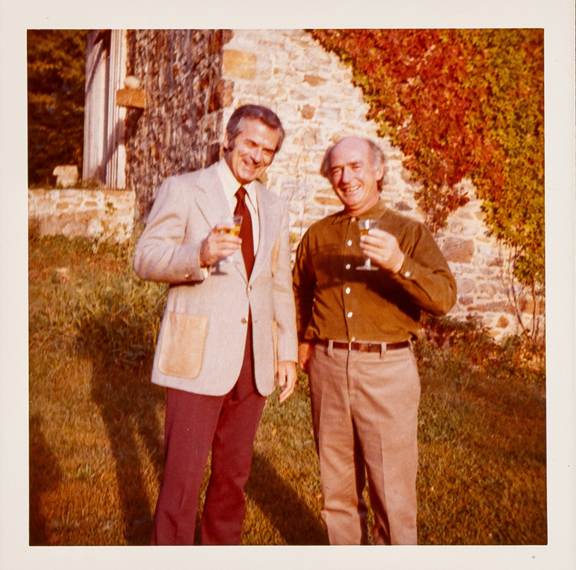
Harry Bertoia (right) with Knoll executive John L. Helm, 1973
Bertoia and Knoll proved crucial to the other as each established their reputations during the 1950s, and one would be hard-pressed to find another example of a mid-century modern artist whose interests and career development were so deeply intertwined with a single commercial entity or design concern.
One of Bertoia’s biggest supporters at Knoll was John L. Helm, who founder Hans Knoll tapped in 1950 to lead the new Dallas showroom. Helm spent the next 25 years working his way up through the company, eventually serving as Vice President of Operations and then International Global Licensees until his retirement in 1974. He was an important, steadfast advocate of Bertoia and helped facilitate the placement and sales of sculptures in every subsequent showroom the company opened. In a letter dated April 23, 1968, Helm expressed to Bertoia that even though the artist-designer’s official employment with the company had been short-lived, those within Knoll still felt like he was a “vital part of the family,” and they possessed “great love and affection” for him.
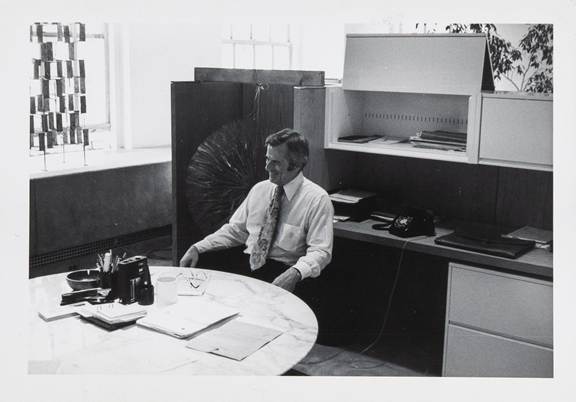
Helm in his office at Knoll International surrounded by Bertoia’s works, late 1970s
Over three decades, Helm and Bertoia were in steady contact and regularly visited each other. Though Bertoia’s archives are relatively sparse for such a prolific artist, there are proportionally copious amounts of correspondence between the two men — inventory lists of works sent and sold, news about potential commissions and exhibition opportunities, and personal updates on family and friends. Helm also often paid far more attention to the pricing and overall career strategy than Bertoia himself ever did. As Helm wrote to Bertoia in the 1960s, “I am vitally interested in you and your work and would like for you to get more exposure. I think you price some of your items too low, therefore, I have taken the liberty of marking them up and whatever proceeds we receive from them is sent to you. I do not want a commission and will not consider such from you. I am pleased we can be of some help.”
Now, one of the tangible results of this mutually beneficial partnership and long friendship is the top lot in Heritage’s November 12 Modern Design Signature® Auction: Untitled (Dandelion), 1971.
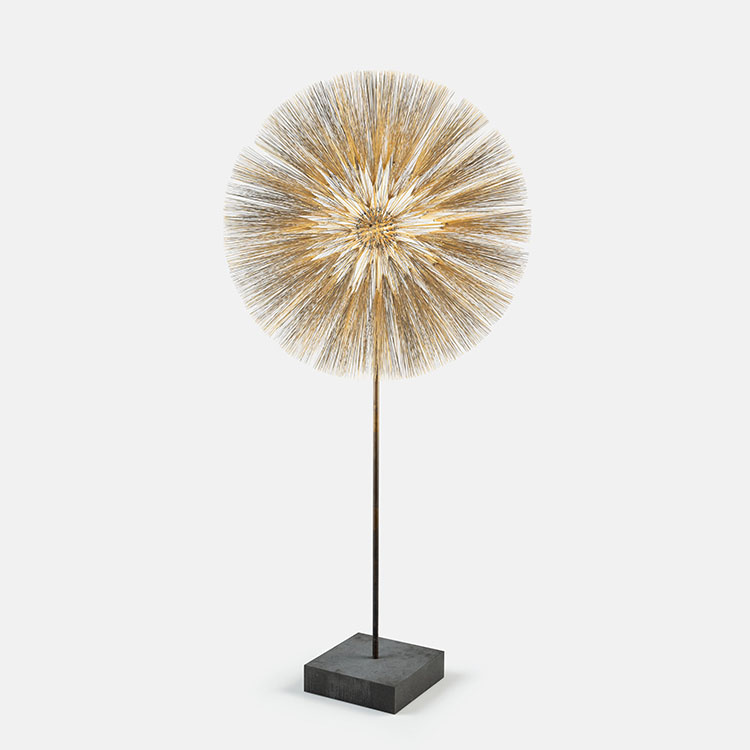
The 1971 copper ‘Dandelion’ sculpture now open for bidding in Heritage’s November 12 Modern Design Signature® Auction
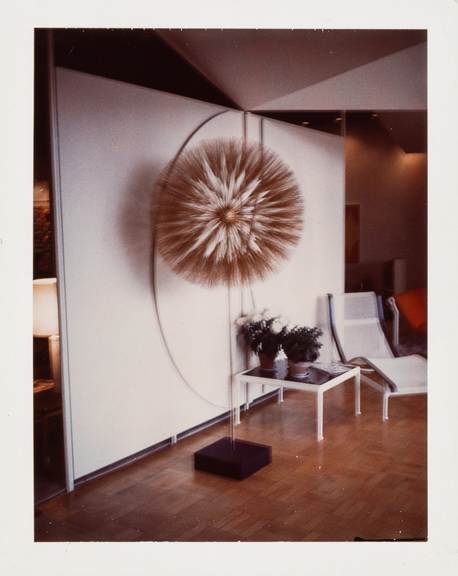
The present ‘Dandelion’ example pictured in Knoll International’s Houston showroom, 1971-1973. Referred to colloquially as ‘Dandelions’ due to their light orb shapes made from hundreds of individually welded wires placed on posts or suspended from ceilings, this lot is part of a body of work classified as ‘wire form’ sculptures.
In early 1970, Helm wrote to Bertoia about the possibility of making one of his wire form “Dandelion” sculptures for a client of Evans Monical, an interior design firm in Houston. Over the next year, Bertoia found himself busy with other projects, including a large-scale commission for the Victor Gruen-designed Genesee Valley Center Mall in Flint, Michigan, and a solo exhibition at Staempfli Gallery in New York. By February 1971, however, Bertoia was finally able to turn his attention to Helm’s request. His original intent was to use fine stainless steel wire, but in the early 1970s the cost of that material had not only increased by 35% but was also hard to procure. He decided instead to “resort to beryllium copper wire,” which was more expensive than even the stainless steel but would hold gold plating better and, perhaps more importantly, could be more easily obtained.
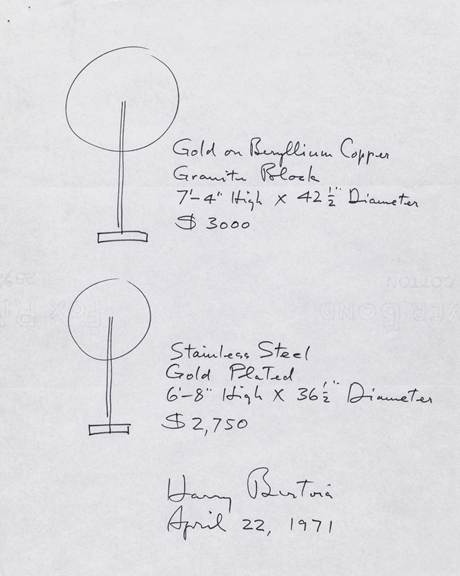
Drawings of the two ‘Dandelions’ included with a letter Bertoia sent to Helm in April 1971. The present example is pictured and described at top.
By the end of April 1971, Bertoia had completed three “Dandelions,” which he described to his friend “Johnny” as his “nicest yet.” Bertoia shipped all of the works to Dallas, with one going directly to a private collector he met through Knoll and the other two to Helm at the showroom — one in stainless steel and the other in beryllium copper, both plated in glistening gold. Too much time had passed and the Evans Monical client was no longer interested, but Helm quickly got to work trying to find buyers for the sculptures. In June 1973, he sold the smaller stainless steel “Dandelion” for so much that it covered the price Bertoia had placed on both pieces. In Bertoia’s typically generous manner and only wanting to recoup his costs, he suggested that Helm keep the other one as a gift, writing, “This means that I have received payment for both. I hope you decide to keep the other one or dispose of it at your own discretion.”