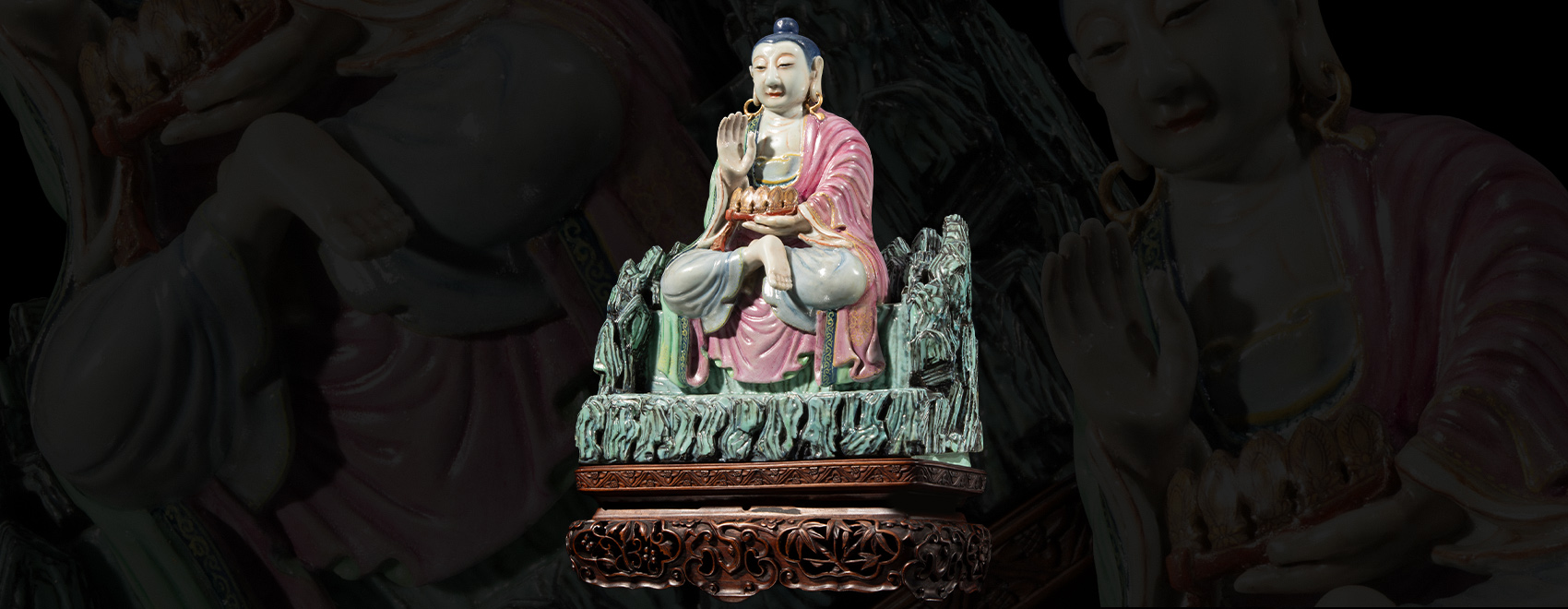
THE DISCOVERY OF RAHULA IN A TEXAS LIVING ROOM HELPS SOLVE A CENTURIES-OLD PUZZLE SURROUNDING AN IMPERIAL PORCELAIN ENSEMBLE CREATED FOR THE QIANLONG EMPEROR
By Charlene Wang | September 1, 2026
One day, a colleague I had assigned to help with the research on a curious porcelain figure that had been consigned through Heritage’s Dallas office came running toward me.
“I know who he is!” she said. “He’s the son of the Buddha!”
The son of the Buddha? Not to introduce scandal into the life of one of history’s great spiritual teachers, but I had grown up surrounded by Buddhist culture and somehow missed the fact that the Buddha had a son.
He did. His name was Rahula.
According to Buddhist tradition, Rahula was conceived shortly before Siddhartha Gautama abandoned his privileged life as a prince in search of enlightenment. Rahula later entered the Buddhist order, studied under his father, and became an arhat — or, in Chinese, a luohan — one who has attained liberation.
That also explained something that had puzzled us from the beginning: Our figure looked remarkably like the Buddha. Unlike the other luohans in the group, he has an ushnisha, the distinctive domed protuberance on his head.
But that raised another question: What was the Buddha’s son doing in Dallas?
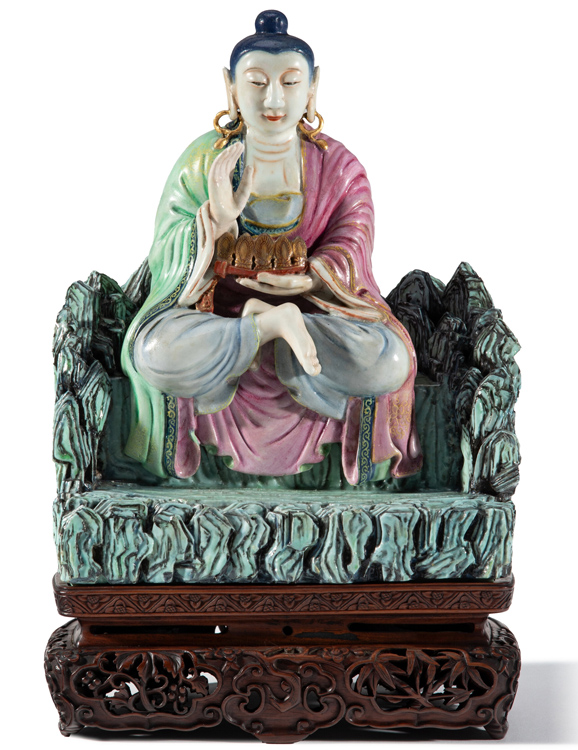
This rare and exceptional Chinese molded famille rose figure of the arhat Rahula dates to the 18th century and is now the centerpiece lot in Heritage’s September 16 Asian Art Signature® Auction.
A Discovery in the Living Room
The story had begun earlier that summer, when I visited a client’s home in Dallas for an unrelated project. There, sitting rather casually on a chest in the living room, was a beautiful Chinese famille rose porcelain figure. I recognized it almost immediately as something extraordinary: one of a mysterious group of imperial porcelain luohans, seated on elaborate rockwork pedestals, associated with the private Buddhist spaces of the Qianlong Emperor. The pedestal was unmistakable — jagged porcelain “rockeries” covered in brilliant turquoise and blue enamels, their edges dramatically picked out in black.
I told the family that the figure sitting in their living room appeared to have belonged to an imperial ensemble made for the court of the Qianlong Emperor nearly three centuries ago. They were, understandably, surprised. The figure had been in their late mother’s collection for decades. None of her children knew what it was.
Once the family agreed to consign it, the easy part was over. The questions began.
Only eight other figures from the group were known to us. Information about the original ensemble was remarkably limited. How many figures had there been? Who did each one represent? Where were they displayed? How were they arranged?
And then there was our figure.
The other known luohans looked like extraordinary versions of ordinary men: monks and sages with individualized faces. This one looked like a Buddha, with blue hair and an ushnisha. At first, I wondered whether he actually was a Buddha — perhaps Shakyamuni, Bhaisajyaguru, or Amitabha. But the iconography did not quite work. He was holding a Buddhist crown. None of those Buddhas is conventionally represented that way.
Then there was another clue. Hidden underneath the figure were two incised Chinese characters: 東五 — “East Five.”
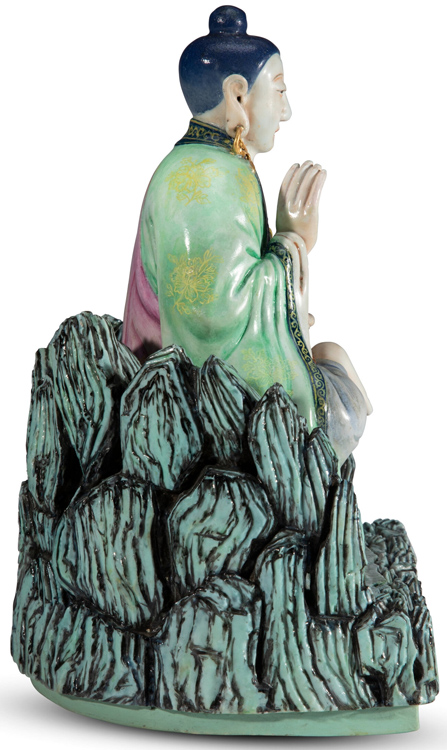
The figure sits on an elaborate turquoise rockwork pedestal.
Cracking the Code
“East Five” sounds more like a subway exit than an imperial inventory system. But when we compared the inscription with those on the other surviving figures, a pattern began to emerge. Another figure that had previously appeared at auction was marked “West Nine.” If there was a West Nine, presumably there had been at least nine positions on the western side. And if our figure was East Five, perhaps there were nine on the eastern side as well.
Nine plus nine: 18.
That number made sense. Luohans are traditionally represented in groups, most famously as the Sixteen Arhats, the Eighteen Luohans, and, on a much larger scale, the Five Hundred Luohans.
At that point, however, I was still entertaining another possibility. If our mysterious East Five was actually a Buddha, could the missing West Five also have been a Buddha? Perhaps 16 luohans were arranged around two Buddhas. Or perhaps there was even a third Buddha in the center, since Buddhist triads are common.
It was an intriguing theory. There was just one problem: I had never encountered an arrangement like it. So I did what researchers often do when the evidence refuses to cooperate. I went back to my regular work and kept digging, hoping that eventually something would give.
Then my colleague came running over. “He’s the son of the Buddha.” And suddenly the puzzle began to solve itself.
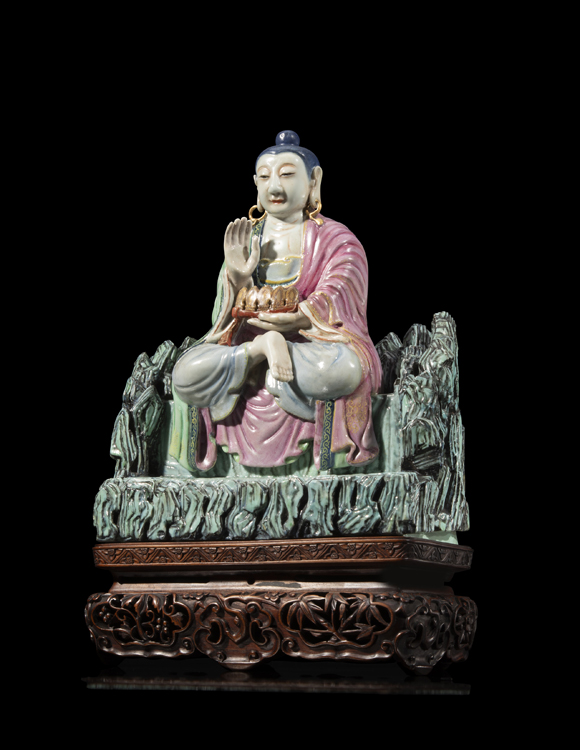
Unlike some examples of the Eighteen Luohans, the figure available at Heritage retains its original fitted wooden stand.
Eighteen Luohans, Nine to a Side
The figure was Rahula — not a Buddha inserted among the luohans, but one of the luohans himself. With that identification, the structure of the ensemble became much clearer.
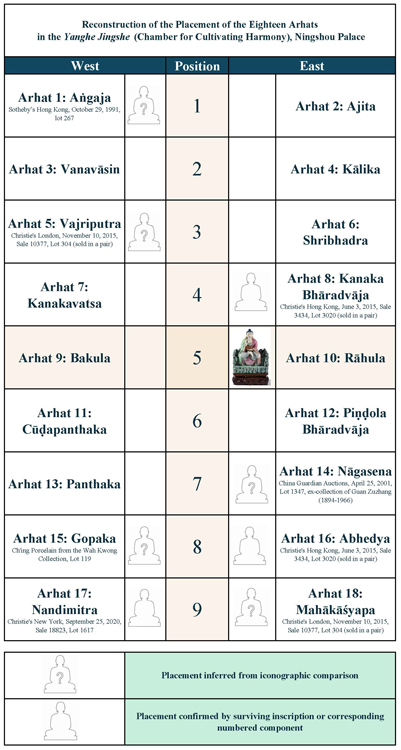
There were 18 figures arranged in two groups of nine. The sequence alternated from west to east: The first arhat, Aṅgaja, occupied West One; the second, Ajita, East One; the third, Vanavāsin, West Two; the fourth, Kālika, East Two; and so on, until the 18th figure occupied East Nine.
Our Rahula, the 10th arhat in the sequence, therefore belonged exactly where his inscription said he did: East Five — the central position among the nine figures on the eastern side.
I made a chart (pictured below) to visualize the reconstruction. The answer to one question, however, produced several more.
An Imperial Puzzle With Missing Pieces
Each luohan originally appears to have carried a ritual implement identifying him: a staff, a Buddhist scripture, a miniature tower, or another attribute. Many of these objects have disappeared over the centuries, making identification considerably harder.
The numbering system presents another complication. Ideally, each figure should carry an incised position mark such as “East Five,” with a corresponding mark on its rockwork pedestal. But not every surviving example does. The figure identified as East Seven, which first appeared at auction in 2001, for example, bears its designation in ink rather than incised into the porcelain. Whether that inscription is original or was added later remains uncertain.
Then there are the pedestals. The figures and their elaborate porcelain rockwork bases were made separately, and several surviving examples now sit on pedestals bearing numbers that do not match those on the figures themselves. This was almost certainly not an imperial workshop error. At some point after the ensemble was dismantled, figures and pedestals appear to have been separated and incorrectly reunited.
The figures have suffered in other ways as well. Ritual implements have disappeared. Hands have been replaced. Original wooden stands have been lost. Our Rahula was unusually fortunate. It retains its original fitted wooden stand, made for the ensemble.
All of this damage is frustrating to a researcher, but it is also evidence. The mismatched bases, missing attributes, and scattered figures tell us something about what happened to the group after it left its original setting.
What We Think Happened
The evidence points to an imperial ensemble of 18 porcelain luohans made during the Qianlong period, most likely in the later 18th century. Dating the group more precisely is complicated. In the 1750s, the Qianlong Emperor himself was actively investigating the identities and number of the arhats, and at that stage his understanding centered on a group of 16. His thinking continued to evolve, and the 18-luohan system became important later in his reign.
The figures themselves would also have been exceptionally demanding to produce. These are not simple porcelain statuettes. Each combines complex modeling, enameling, separately constructed rockwork, and numerous fragile details. Producing an entire ensemble at this level would have required considerable time and some of the finest technical skills available to the imperial workshops and kilns.
The group appears to have remained together in the imperial collection into the late Qing period, possibly as late as the era of Empress Dowager Cixi. After that, the trail becomes murky.
At some point, the ensemble was removed from its original setting without documentation known to us today. The figures were separated. Some were damaged. Pedestals were mixed up. Eventually they dispersed.
Over the last half-century, they have begun, one by one, to reappear. With the Dallas discovery, nine figures are now known to us. Nine remain unaccounted for.
Are they still sitting in private homes? Were some destroyed? Will another emerge at auction next year? Is one sitting unnoticed on another family’s chest somewhere?
We simply do not know.
But that uncertainty is part of what makes discoveries like this so exciting. An object can sit quietly in a living room for decades, its history forgotten, a silent witness to an emperor’s rise and an empire’s fall.
So, a word of advice: If you happen to have a brightly enameled 18th-century Chinese porcelain luohan sitting on turquoise rockwork somewhere in your house, stop what you are doing. Put it somewhere safe. Then give us a call.
The newly discovered figure of Rahula, Son of the Buddha, will be offered in Heritage Auctions’ Asian Art Signature® Auction on September 16.