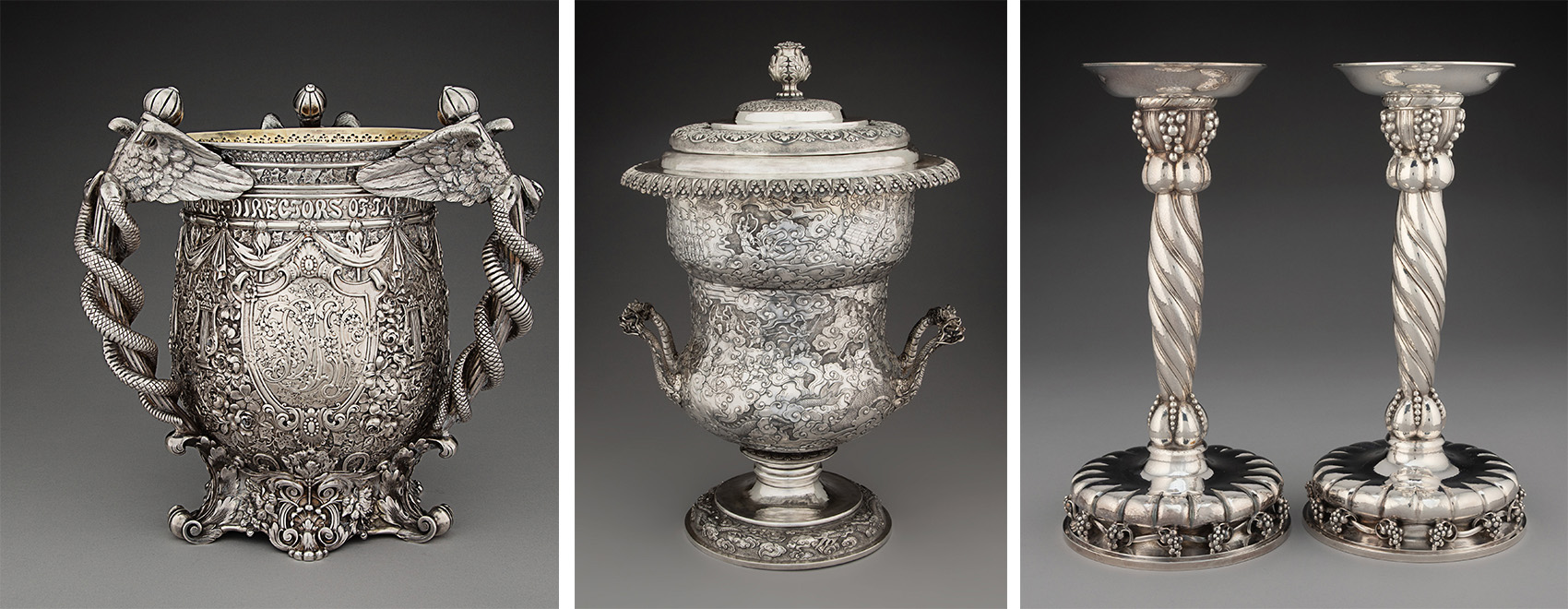
HERITAGE SPECIALIST KAREN RIGDON EXAMINES THE EVOLVING SILVER MARKET AND THE ENDURING ROLE OF TRUE COLLECTORS
By Karen Rigdon | May 5, 2026
Lately, my phone has been ringing with a familiar question: Should I melt it? Closely followed by another: No one collects silver anymore … do they? We hear this often — that silver collecting is in decline, that the market is shrinking, that “people don’t buy sterling anymore.” But that assumption rests on a misunderstanding. The 20th century did not create more collectors. It created more owners. And ownership is not the same as collecting.
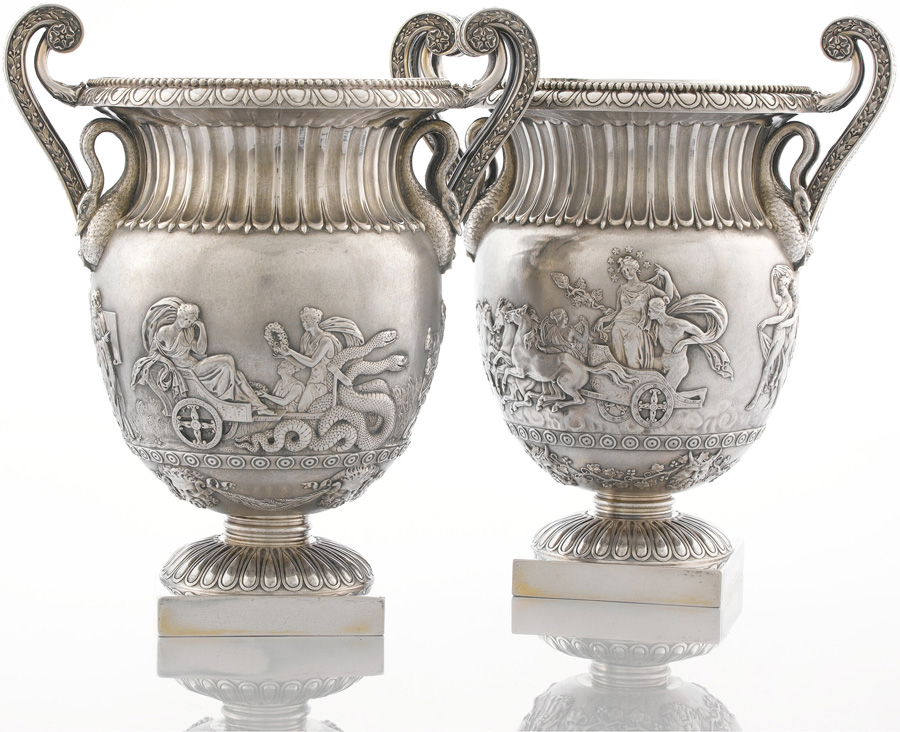
A pair of English silver wine coolers. Paul Storr, London, England, 1827-1828; second of pair by John Samuel Hunt, London, England, 1845-46. Sold for $101,575 in a November 2009 Heritage auction.
The Illusion of Expansion
In the 18th century, silver was wealth made visible. It was expensive, labor-intensive, and inherently unstable — an object that could be melted tomorrow if circumstances required. Very few people owned it, and fewer still collected it with intention. By the late 19th and early 20th centuries, that changed dramatically. American industry transformed silver production. Factories scaled. Patterns were standardized. National catalogs circulated widely. Advertising reshaped silver into an aspirational commodity. At the same time, the discovery of abundant silver deposits in the American West drove down the cost of raw material.
Sterling became accessible. Then came a quieter but equally powerful innovation: the bridal registry.
Instead of a single patron commissioning a service, an entire community assembled one: a teaspoon from one guest, a ladle from another. Over time, a complete service emerged. Ownership expanded rapidly, not through connoisseurship, but through participation in a social ritual. It looked like collecting. But much of it was acquisition as social ritual.
The Cloak of Ownership
The 20th century created a kind of shimmering illusion — a cloak of silver ownership. Department stores built entire silver departments. Replacement services flourished. Millions of households owned sterling flatware and hollowware. From a distance, it appeared that collecting had become widespread. In reality, it was distribution that had expanded.
Silver was often chosen because it was expected. It marked milestones, fulfilled social obligations, and signaled participation in a shared cultural script. When that script changed — when entertaining became informal, when registries shifted toward experiences rather than objects, when traditions loosened — the cloak fell away. And we began to ask: Where did all the collectors go?
But perhaps they never left.
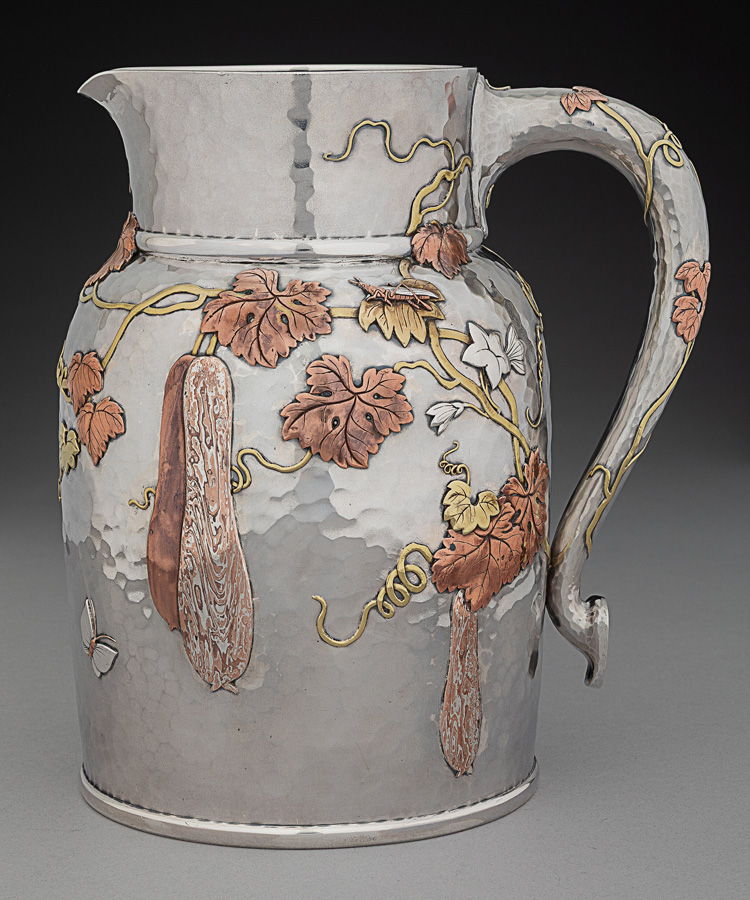
A Tiffany & Co. silver, mixed metal, and mokume water pitcher. New York, circa 1875. Sold for $87,500 in a May 2025 Heritage auction.
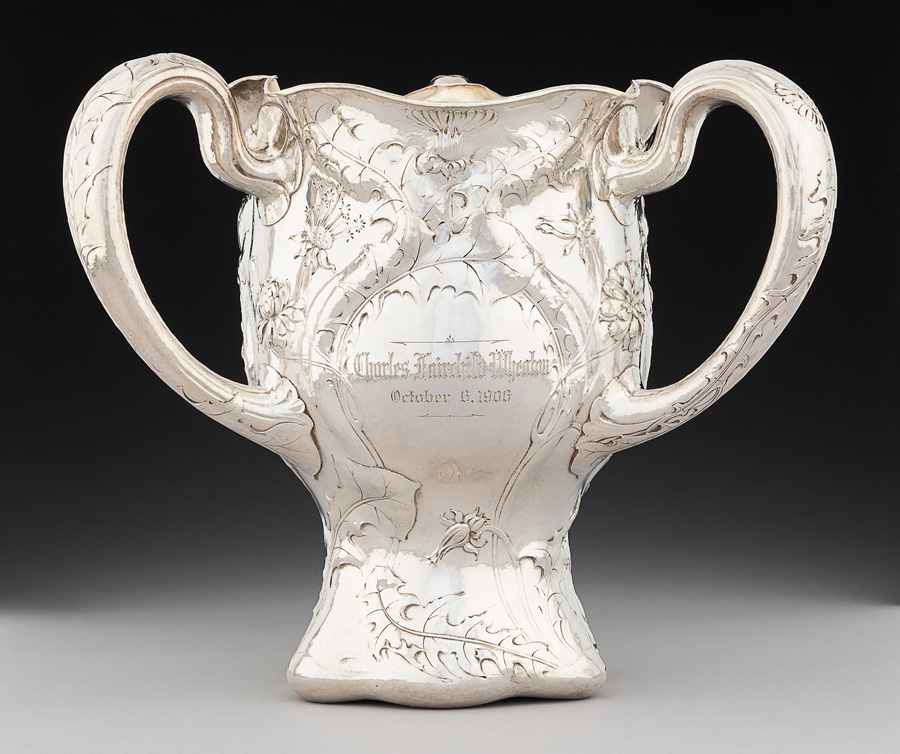
A Gorham Mfg. Co. Martelé partial gilt silver three-handle trophy cup. Providence, Rhode Island, 1905. Available in Heritage’s May 22 Silver & Vertu Signature® Auction.
What Remains
What has disappeared is not collecting, but what might be called inherited ownership — silver acquired through tradition rather than intention. What remains is what has always existed: a small group of individuals who care deeply. The person who understands why Japanese aesthetics transformed Tiffany’s work in the late 19th century. The person who knows the difference between Minerva 1 and Minerva 2. The person who sees Paul Storr not simply as antique hollowware, but as sculptural force. The person who can distinguish between die-struck abundance and the mastery needed to execute the chased repoussé surfaces of Gorham’s Martelé line.
That group has always been small.
In 1890, it was small.
In 1955, it was small.
In 2026, it is still small.
The 20th century did not create millions of collectors. It created millions of households with silver. The distinction matters. Because if we interpret this moment as a collapse, we chase nostalgia. We try to re-create a world of bridal registries and formal dining that no longer exists. We mourn the loss of something that was never truly collecting to begin with. But if we understand this as a correction — a return to historical scale — then the picture becomes clearer.
Silver has always belonged to the few.
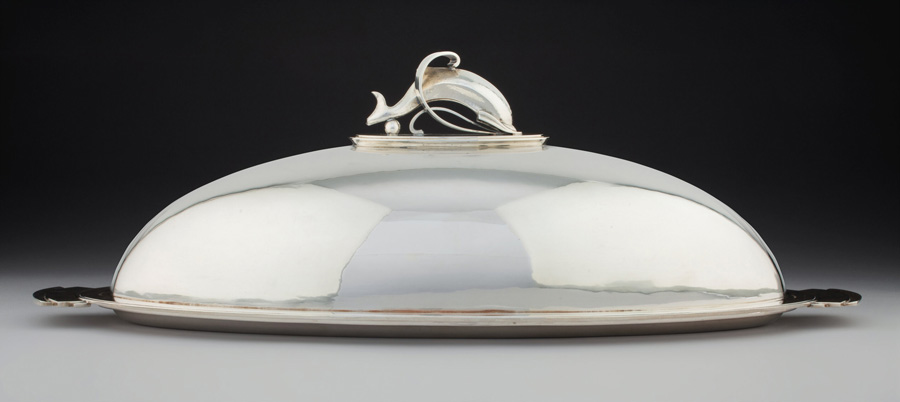
A Georg Jensen No. 600B Pyramid silver fish platter, cover, and mazarine. Copenhagen, Denmark, 1933-1944. Available in Heritage’s May 22 Silver & Vertu Signature® Auction.
When a Buyer Becomes a Collector
Collectors do not simply accumulate objects. They change the outcome of objects. This season, Heritage Auctions is presenting Georg Jensen silver from the Collection of Yousif & Myrna Hamati. There are over 100 lots. However, it did not begin as a collection. It began with curiosity. A piece here. A bowl. A cup. Something beautiful. Then Joe started to study the marks. Next, the designers. The realization that Georg Jensen was not a single hand, but a community — Harald Nielsen, Johan Rohde, and others — each shaping the evolution of form.
Knowledge changed the scale of ambition.
At a certain point, he acquired Harald Nielsen’s fish platter with dome — not as decoration, but as a masterpiece. That is the moment a buyer becomes a collector: not when he purchases silver, but when he understands it.
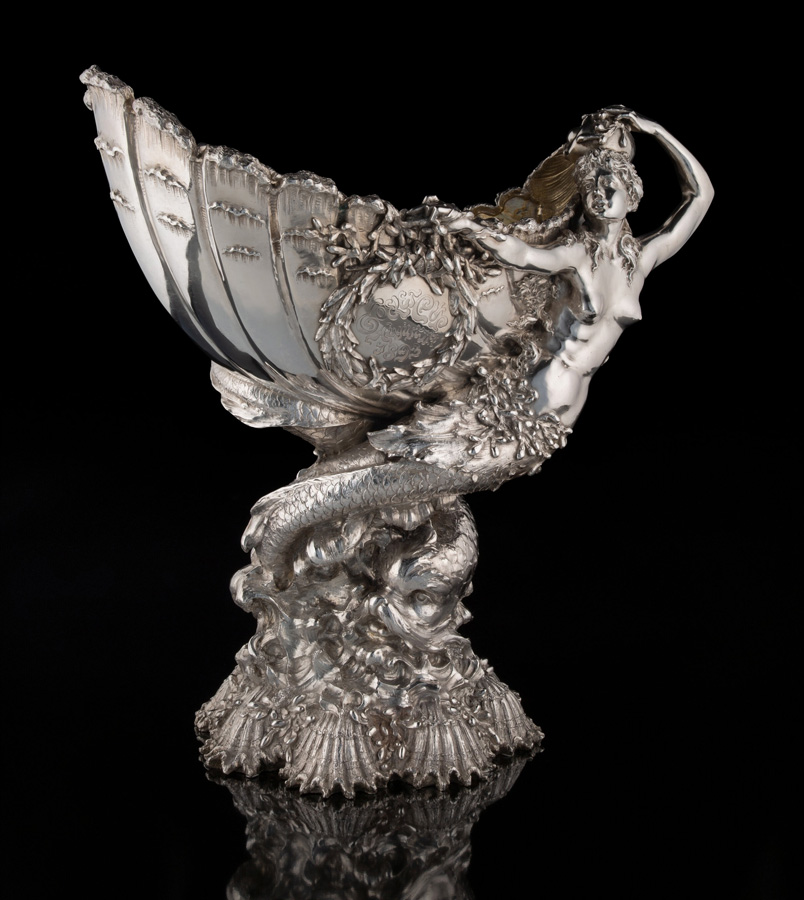
A Tiffany & Co. silver yachting trophy: Goelet Cup. New York, 1893. Sold for $300,000 in a November 2020 Heritage auction.
A different transformation occurred with collector J.D. Parks. His entry point was not design, but history. He began with a trophy cup, then another, then another — drawn not to form alone, but to narrative: regattas, competitions, civic accomplishments preserved in metal. When the Niederhoffer Collection of Trophy and Presentation Silver came to auction — museum-level material — he recognized that he did not have to admire great works from a distance or behind glass. He could own such works personally.
The collection ultimately included the 1893 Goelet Cup for schooners, which realized $300,000 in a November 2020 Heritage auction. But the price is not the point. The point is that a private collector stepped into the role of steward.
This is what collectors do. They intervene.
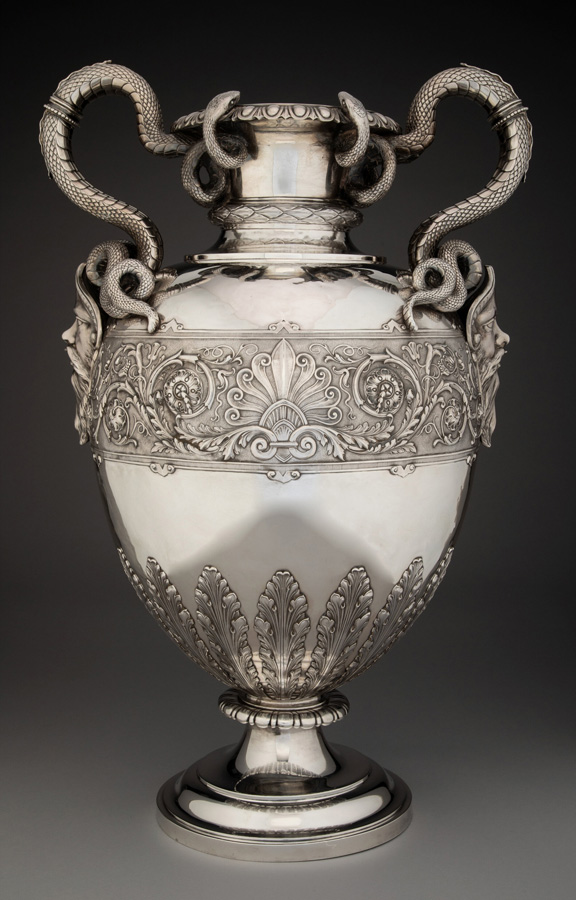
A Robert Garrard silver two-handled urn. London, 1885. Sold for $31,250 in a May 2024 Heritage auction.
The Collector as Intervenor
Sometimes that intervention happens at the last possible moment. A monumental Garrard urn — dented, dismissed, and sitting in a smelter’s bin — was recognized for what it was. It was restored and returned to the market, eventually displayed not as scrap, but as sculpture.
In another instance, a young man in Minnesota purchased a modest box lot, largely for a single Irish ladle he believed would cover his cost. At home, he examined each piece more closely. On the underside of a small bowl was a mark: P. Bentzon. Peter Bentzon is the only known African American silversmith of the 18th century working under his own mark, active between Philadelphia and the Danish West Indies. The bowl, initially overlooked, is now part of the Yale University Art Gallery. This was not luck. It was attention. Most people would have seen scrap. A few saw history. And because of that, the historical record is richer, more complete, and more accurate.
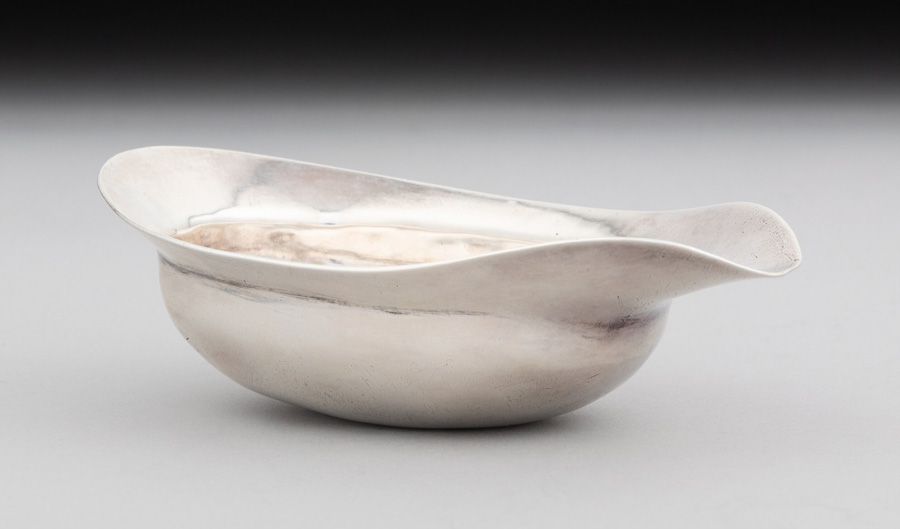
A rare Peter Bentzon silver pap bowl. St. Croix and Philadelphia, circa 1810-20. Sold for $30,000 in a November 2025 Heritage auction.
From Private Passion to Public Legacy
Among collectors, there is an even smaller subset: those who build not only private collections, but public ones. The Dallas Museum of Art offers a clear example of how individual collectors shape institutional narratives across generations.
The Hoblitzelle Collection reflects the dominant model of early 20th-century American collecting — strong English and Continental works, authoritative, canonical, and exclusively pre-1840. Silver was understood as aristocratic monument, exemplified by masterworks such as a 1742 cup and cover by Paul de Lamerie, arguably the greatest silversmith of his time.
In the mid-1980s, curator Charles Venable expanded that framework. Through scholarship and acquisition, he reframed post-1840 American silver as innovative and worthy of serious institutional attention, broadening the canon. By 2002, collector and scholarJewel Stern further transformed the field with a gift of more than 400 examples of modernist American silver. Through exhibition and publication, she established 20th-century design as central — not peripheral — to the story of silver.
Today, that legacy continues through ongoing stewardship and scholarship. At every stage, the pattern is the same: a small number of individuals reshaping what matters.
The Measure of the Market
When you step back, the pattern becomes clear. A collector studies deeply and acquires a masterpiece. Another follows history into stewardship. A careful eye rescues an object from the smelter. An institution evolves because individuals expand its vision. The number of collectors has never been large, but their impact has always been disproportionate.
They rescue.
They study.
They elevate.
They give.
Most silver moves through time anonymously. A few people interrupt that anonymity. And because they do, a damaged object becomes sculpture again. A misidentified piece becomes a cornerstone of scholarship. A functional object becomes cultural history.
This is why the size of the market has never been the real measure. The real measure is whether there are still individuals willing to look closely. Because silver has never depended on the many. It has always depended on the few.
And as long as the few remain — collectors, scholars, curators — the story continues. Silver has always survived for the same reason: Someone cared enough to recognize it before it disappeared.
And it has always taken only a few.