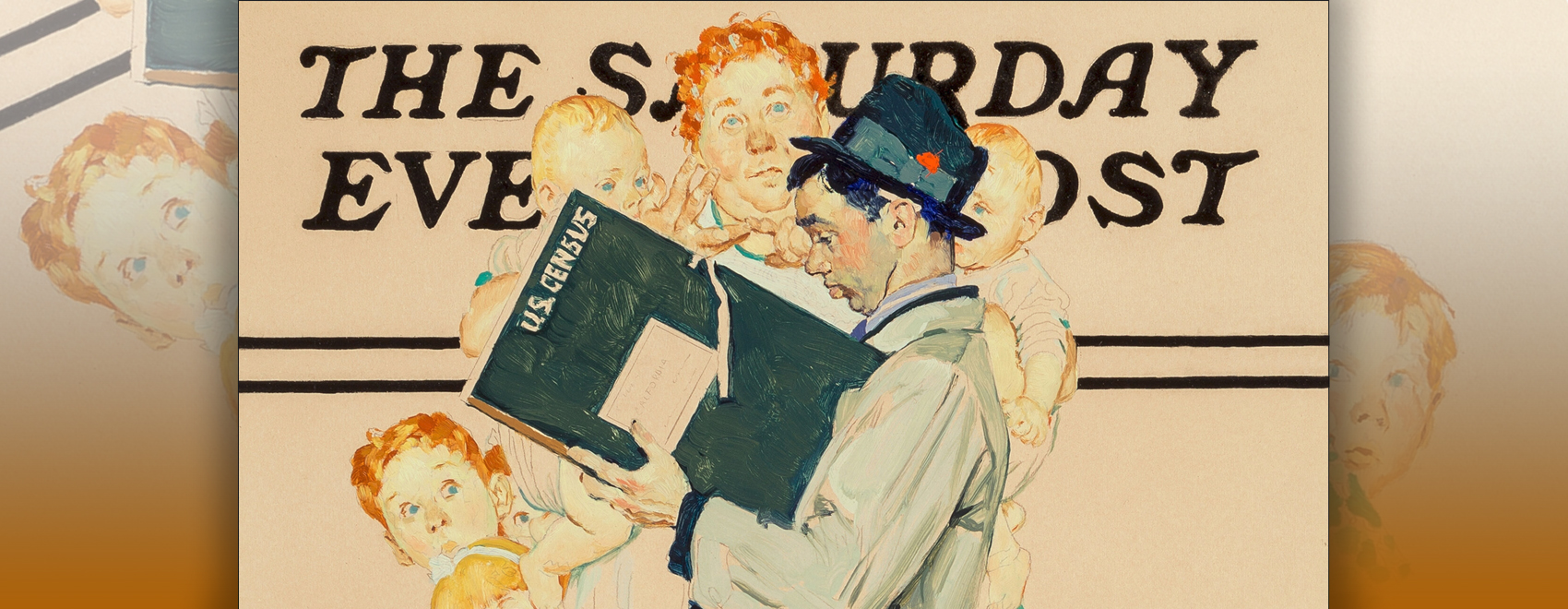
HERITAGE’S DEPUTY CHAIRMAN OF FINE ART EXPLAINS THE MARKET FORCES, ICONIC IMAGERY, AND LASTING APPEAL BEHIND ONE OF AMERICA’S MOST BELOVED ARTISTS
Interview by Jordan Clark | August 18, 2026
Whether depicting a family gathered around the Thanksgiving table or a child heading off to school, Norman Rockwell possessed an extraordinary gift for turning everyday moments into timeless images. Almost half a century after his death, his paintings remain among the most beloved — and most fiercely collected — in American Art. In this Collector’s Guide, Aviva Lehmann, Heritage’s Deputy Chairman of Fine Art, answers some of the most important questions about collecting Rockwell, from market trends to the artist’s enduring appeal across generations.

Norman Rockwell ‘Study for Triple Self Portrait,’ 1960. Oil on photographic paper laid on panel. 11-1/2 x 9-1/4 inches (29.2 x 23.5 cm) (sheet). Sold for $1,332,500 in a May 2017 Heritage auction.
INTELLIGENT COLLECTOR: Norman Rockwell’s imagery is tied to a specific vision of American life. Why do you think his work continues to resonate with collectors today?
AVIVA LEHMANN: I think Rockwell continues to resonate because, regardless of our backgrounds, we’ve all been children. And when life becomes complicated, which it inevitably does, we often find ourselves longing for simpler moments and a sense of connection. Rockwell’s paintings remind us of those moments. They’re not simplistic, but they are uncomplicated. They celebrate family, community, kindness, humor, and the everyday experiences that unite us. Even when he’s depicting something deeply emotional, there’s an optimism and humanity that people instinctively respond to.
At the same time, contemporary audiences also view Rockwell through a more nuanced lens. They recognize that he painted an idealized vision of America, but they also appreciate how his work evolved. Some of his later paintings, particularly those addressing civil rights and social justice, demonstrate an artist who wasn’t simply documenting American life — he was engaging with it and helping shape the national conversation.
Ultimately, I think collectors today appreciate both aspects of Rockwell: the timeless nostalgia that reminds us of who we were and the deeper humanity that reminds us of who we aspire to be.
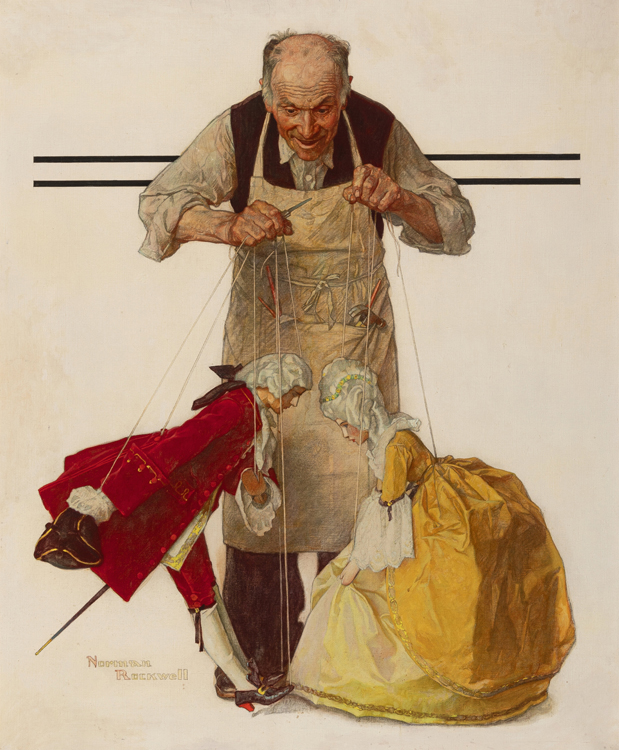
Norman Rockwell ‘Marionettes, The Saturday Evening Post cover,’ October 22, 1932. Oil on canvas. 34 x 28 inches (86.4 x 71.1 cm). Sold for $906,250 in a May 2025 Heritage auction.
IC: Rockwell’s Saturday Evening Post covers are among his most iconic achievements. How does a painting’s publication history influence collector interest and value?
AL: When it comes to Norman Rockwell, who was an extraordinarily prolific artist and worked for countless publishers, advertisers, and corporations throughout his career, his Saturday Evening Post covers sit at the very top of the hierarchy. Not surprisingly, they’re also generally his most sought-after and valuable works.
It’s important to remember the role the Post played in American life. Before television — and certainly before the internet — The Saturday Evening Post was a national cultural event. Families across the country eagerly awaited each new issue, and Rockwell’s cover was the first thing they saw. His images became woven into the fabric of American life and created a shared visual language that generations of people recognized instantly.
That publication history is incredibly important to collectors. A painting reproduced as a Saturday Evening Post cover wasn’t just seen by a few gallery visitors — it was seen by millions of Americans. Many collectors can still remember the first time they encountered a particular image on the cover of the magazine, and that emotional connection becomes part of the work’s provenance. The publication transforms the painting from an exceptional work of art into a cultural icon.
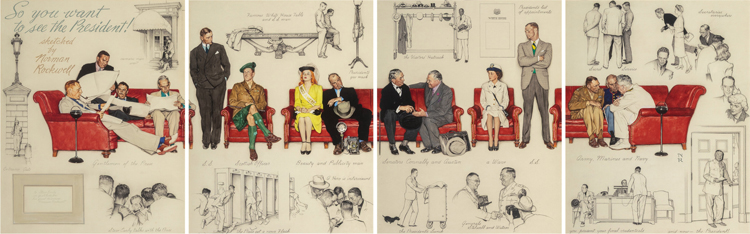
Norman Rockwell ‘So You Want to See the President!, The Saturday Evening Post interior (complete series; 19 vignettes, 4 sheets),’ November 13, 1943. Mixed media on paper, each. 28 x 21-3/4 inches (71.1 x 55.2 cm) (Panel One). 28-3/8 x 21-7/8 inches (72.1 x 55.6 cm) (Panels Two, Three, Four). Sold for $7,250,000 in a November 2025 Heritage auction.
IC: What elements of Rockwell’s work consistently drive the strongest auction results?
AL: The works that achieve the strongest prices are typically the iconic images that are fresh to the market, have exceptional provenance or a compelling story, remain in original condition, and represent Rockwell at the height of his artistic powers. Subject matter also plays an enormous role. Collectors gravitate toward the images that have become part of America’s shared consciousness — the works that evoke an immediate emotional response because they’ve been loved for generations.
When all of those qualities align, you’ve found the holy grail. Those are the paintings that inspire fierce competition, command eight-figure prices, and redefine the market. I wouldn’t be surprised if one day we see the finest examples push even beyond that. After all, there are only so many truly iconic Rockwell masterpieces, and every time one disappears into a private collection, the opportunity to acquire another becomes that much rarer.

Norman Rockwell ‘Study for Cheerleaders,’ 1952. Mixed media on paper. 40-1/8 x 38-1/2 inches (101.9 x 97.8 cm) (sheet). Sold for $600,000 in a May 2026 Heritage auction.
IC: Rockwell’s body of work spans paintings, studies, preparatory drawings, published illustrations, and prints. Where do you see the greatest opportunities or demand within the market today?
AL: One of the wonderful things about collecting Norman Rockwell is that there is something for everyone. Rockwell was meticulous in his creative process. Before completing a finished painting or Saturday Evening Post cover, he produced numerous sketches and studies, worked extensively with live models, and staged elaborate photographic reference sessions in his studio. As a result, his body of work encompasses not only the finished masterworks, but also the preparatory drawings, oil studies, photographs, and related material that reveal how those iconic images came to life.
Collectors appreciate each category for different reasons. The finished paintings represent the pinnacle of his achievement, while the studies and drawings offer an intimate glimpse into Rockwell’s creative mind. There’s something incredibly compelling about seeing an idea evolve from a simple sketch into one of the most recognizable images in American Art.
The market also offers an unusually broad range of entry points. A collector might begin with a wonderful drawing in the neighborhood of $10,000, while the most iconic published paintings have achieved prices exceeding $46 million. Few artists offer that kind of accessibility alongside such extraordinary top-end value. I think that’s one of the great strengths of the Rockwell market. Whether you’re an emerging collector purchasing your first drawing or a museum competing for a masterpiece, you’re participating in the legacy of one of America’s greatest storytellers.
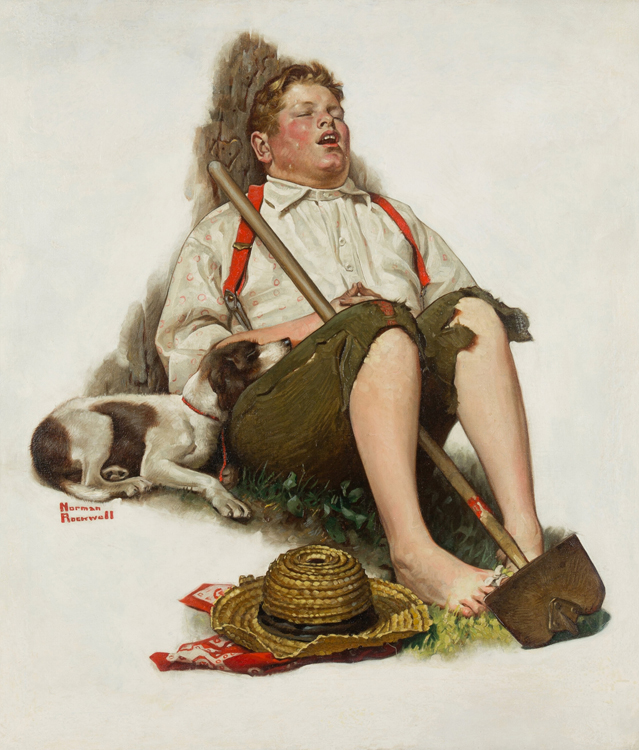
Norman Rockwell ‘Lazybones, The Saturday Evening Post cover,’ September 6, 1919. Oil on canvas. 26 x 24 inches (66.0 x 61.0 cm). Sold for $912,500 in a November 2017 Heritage auction.
IC: Are there any themes, periods, or other aspects of Rockwell’s career that collectors are paying closer attention to now than they were a decade ago?
AL: There is very little about Norman Rockwell’s career that could be considered “undiscovered” or undocumented. Few American artists have been studied as extensively. That said, I do believe his earliest work — particularly paintings and illustrations from the 1910s and early 1920s — still has meaningful room for appreciation. Those works capture Rockwell before he became the iconic storyteller we all recognize, and they offer collectors a fascinating glimpse into the development of his artistic voice. They also come to market far less frequently than his classic Saturday Evening Post covers. If I were advising a collector looking for long-term growth within the Rockwell market, I would focus on those early works. I think that period still has untapped potential compared to some of his more familiar and widely celebrated later masterpieces.
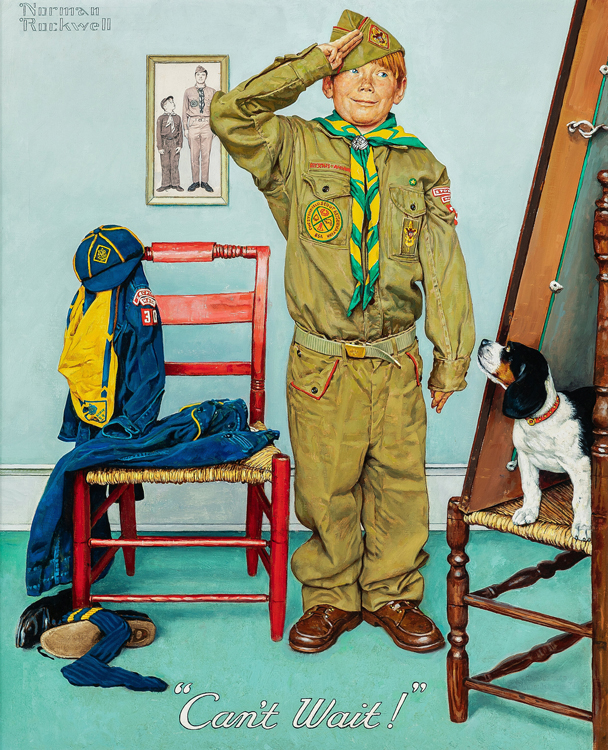
Norman Rockwell ‘Can’t Wait,’ 1972. Oil on canvas with applied photo collage. 36 x 29 inches (91.4 x 73.7 cm). Sold for $1,310,000 in a May 2025 Heritage auction.
IC: How has the art world’s perception of Rockwell evolved over the years, and has that affected collecting trends?
AL: Many people have heard me tell the story of auction catalog layouts when I first began specializing in American Art in 2002. At that time, Rockwell and the other great Golden Age illustrators were typically relegated to a separate section at the back of the catalog, while the “fine artists” — Hassam, Hopper, Sargent, O’Keeffe, and others — received center stage.
That perception began to change in a very meaningful way when Rosie the Riveter sold at auction for approximately $5 million. It established a new benchmark and demonstrated that Rockwell was competing not with other illustrators, but with the very best American artists. From there, the shift accelerated. Major institutional collectors such as George Lucas and Alice Walton began actively acquiring important illustration works for the Lucas Museum of Narrative Art and Crystal Bridges Museum of American Art. Once museums of that caliber started pursuing Rockwell and his contemporaries alongside Hopper, Wyeth, and O’Keeffe, it became abundantly clear that illustration had earned its place as museum-quality American Art.
Perhaps the clearest example came in 2013, when Rockwell’s Saying Grace sold for $46 million. The next-highest American painting sold that season was an Edward Hopper at roughly $35 million. That comparison tells you almost everything you need to know about how the market now views Rockwell.
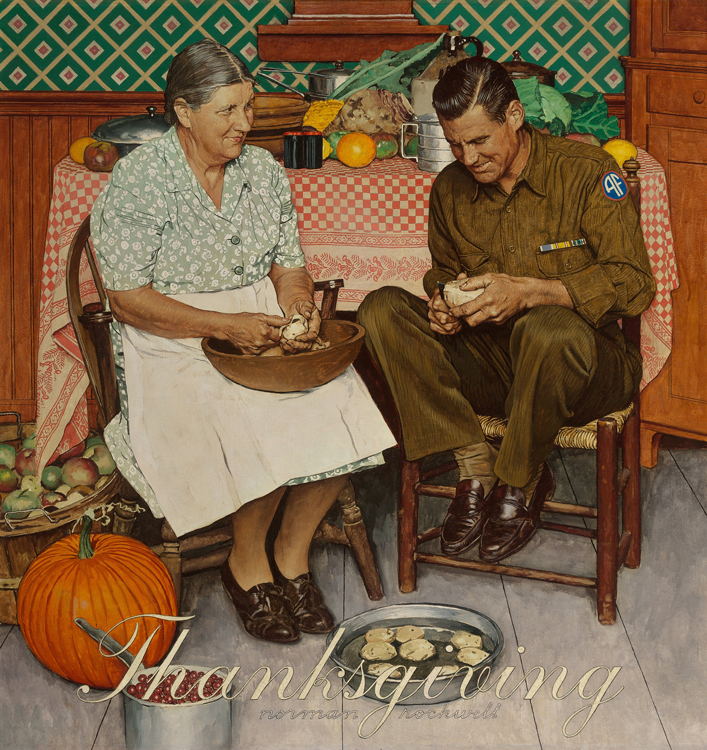
Norman Rockwell ‘Home for Thanksgiving, The Saturday Evening Post cover,’ November 24, 1945. Oil on canvas. 35 x 33 inches (88.9 x 83.8 cm). Sold for $4,305,000 in a November 2021 Heritage auction.
IC: When it comes to subject matter, what Rockwell scenes tend to be most popular with collectors?
AL: Holiday scenes are perennial favorites because they appeal to both serious collectors and institutions. Wartime paintings — particularly those tied to World War II and the American home front — have become increasingly important as collectors recognize their historical significance in addition to their artistic merit. Rockwell’s later socially conscious works, such as The Problem We All Live With and Murder in Mississippi, occupy a different space. They are extraordinary paintings and are among his most important artistic achievements, but they rarely come to market. If one of those were ever offered publicly, I suspect the competition would be extraordinary because they transcend illustration and have become defining images of American history.

Norman Rockwell ‘Boy and Dogs, New Puppies,’ 1958. Oil on canvas. 27 x 25 inches (68.6 x 63.5 cm). Sold for $781,250 in a November 2024 Heritage auction.
IC: How has Rockwell’s collector base evolved in recent decades?
AL: One of the most exciting changes we’ve seen in recent years is the evolution of the buyer base. Traditionally, Rockwell collectors were primarily established fine art buyers. Today, we’re welcoming a younger generation of collectors who are entering the category through adjacent passions — comics, comic art, sports, Americana, and pop culture. They grew up recognizing Rockwell’s imagery, and they’re drawn to the narrative quality of his work. They’re collecting not just because it’s a masterpiece, but because it resonates with them personally. That crossover has expanded the market in a meaningful way and has introduced an entirely new generation to Rockwell.