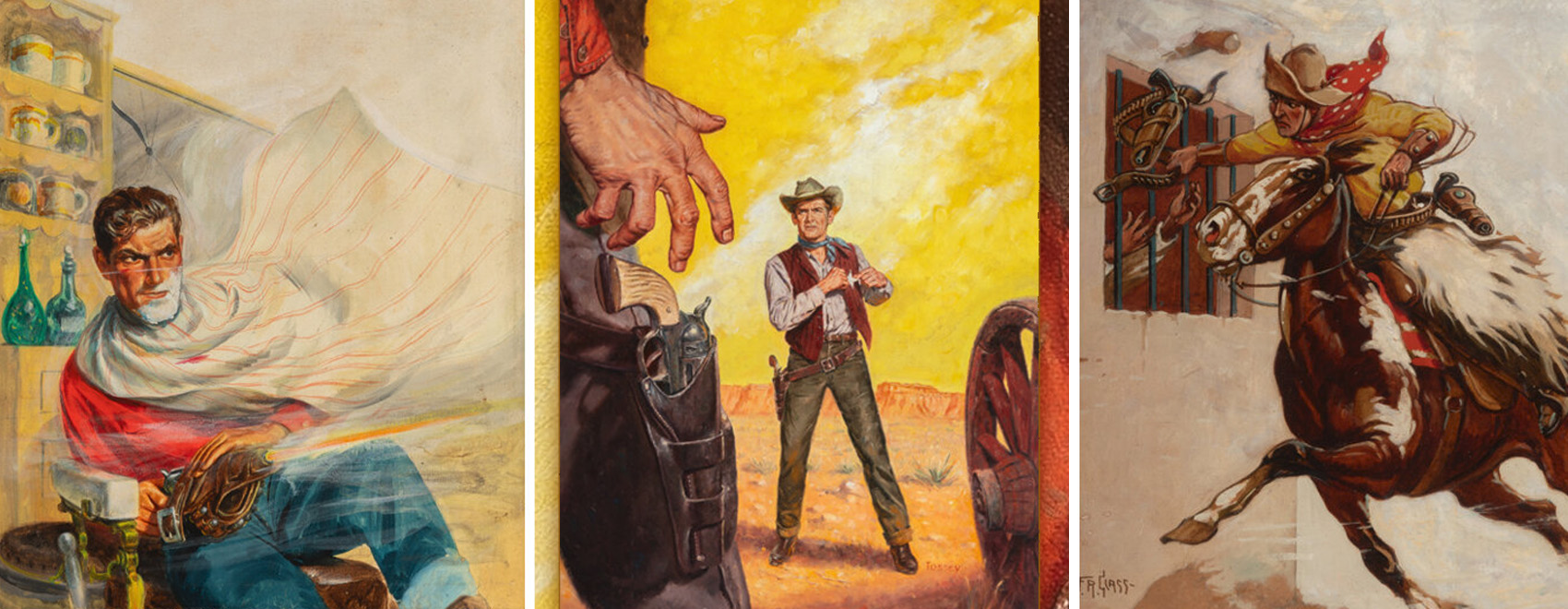
AN UPCOMING AUCTION OF ILLUSTRATION ART BY THE ARTISTS WHO SHAPED AMERICA’S VISION OF THE WEST CAPTURES THE LAND’S PROMISE, PERIL, AND POWER TO REINVENT
By Rainey Knudson | July 16, 2025
In the 1929 novel Sand, by Will James, a dissipated, morally and physically depleted East Coaster wakes up from a bender with nothing but the dirty, rumpled tuxedo on his back. He is stuck at a railroad terminus deep in the American West. The story of his unlikely redemption in the rugged terrain is a classic frontier narrative, where the landscape serves as a mythic backdrop for heroic journeys of self-reliance and moral clarity.
Indeed, there was probably never in recorded history so vast a stage for personal transformation as the American West. A desire to know that we can change and start anew seems hardwired into our species; every human mythology and religion has at least one central story of rebirth. And at one time, the expanses of the American continent offered the ideal blank slate for individuals seeking to reinvent themselves.

The American West has inspired generations of artists, including the unknown illustrator who created this cowboy scene for a 1914 cover of ‘Top-Notch Magazine.’ The painting is one of the many highlights in Heritage’s July 29 Western Stories: Illustration Art Showcase Auction.
By the early 20th century, however, the open range had closed, and the cattle drives passed into memory. It was then that the visual mythmaking about the Western terrain began in earnest. A cohort of artists born in the late 19th and early 20th centuries helped shape not only Western iconography but the broader landscape of American visual culture. They came of age when illustrated magazines like The Saturday Evening Post and Collier’s were booming, as were pocket-size paperback books and pulp magazines devoted to genre storytelling like Westerns, detective fiction, and sci-fi.
Many of these illustrators were part of the atelier-based training pipeline centered around the Art Students League and Grand Central School of Art in New York. They studied under earlier artists like N.C. Wyeth and Harvey Dunn, learning a visual language of narrative clarity, anatomy, and compositional drama – all essential tools for telling a story in a single frame.
On July 29, during its Western Stories auction – a 72-lot sale of pulp and mainstream illustration art – Heritage will celebrate the seemingly limitless possibility of the American frontier and the 20th-century illustrators who kept its spirit alive through their work. “What we’re really offering is the art of nostalgia,” says Meagen McMillan, Heritage’s Senior Specialist of Illustration and American Art. “These images preserve the enduring myth of the West as Americans have long imagined it. Whether they were commissioned illustrations or ‘fine’ art – and the distinction between the two is arguably muddy – they form a visual iconography of the West that still resonates today.”

John Philip Falter ‘New School Marm,’ 1975. Oil on canvas. 22 x 28 inches (55.9 x 71.1 cm). Available in Heritage’s July 29 Western Stories: Illustration Art Showcase Auction.

Herbert Morton Stoops ‘Lady Bluebeard, Cosmopolitan magazine interior,’ August 1924. Oil on canvas. 36 x 28 inches (91.4 x 71.1 cm). Available in Heritage’s July 29 Western Stories: Illustration Art Showcase Auction.
Western illustrators weren’t just telling stories. They were constructing archetypes of people starting their lives over – outlaws who became lawmen (or vice versa), drifters who became ranchers, lost urbanites who became adept cowboys. In the case of John Philip Falter’s riveting painting New School Marm (1975), one of the highlights of the Heritage auction, the central figure making a fresh start is a woman, newly arrived in town with no known name or past. She has just alighted from her stagecoach to a dubious welcome from a few townsfolk, and she stands, unmistakably out of place as the lone sunlit figure, at the center of a composition that revolves around her. We know her life will never be the same again.
By contrast, Herbert Morton Stoops’ Lady Bluebeard depicts a seductive temptress – a fictitious manslayer based on real-life serial killers like Belle Gunness and Lyda Southard – placed to the side in the shadows as she surveys her next victim, a hapless man on horseback. Painted for Cosmopolitan in 1924, the image illustrates the dark side of anonymity and freedom, a reminder that the West was ultimately neutral in terms of the quality of reinvention that occurred there. In a place with little accountability, where the truth could be whatever the teller needed it to be, a descent into depravity was every bit as possible as wholesome redemption.

Harold von Schmidt ‘Heritage of Hate, American magazine interior,’ October 1941. Gouache on board. 20-3/8 x 34 inches (51.6 x 86.4 cm). Available in Heritage’s July 29 Western Stories: Illustration Art Showcase Auction.

Carl E. Hantman ‘Hangrope Town paperback cover,’ 1964. Acrylic on board. 16-1/4 x 10-1/4 inches (41.3 x 26.0 cm). Available in Heritage’s July 29 Western Stories: Illustration Art Showcase Auction.
Two handsome landscapes by Harold von Schmidt also featured in the auction illuminate this tension between light and darkness. Heritage of Hate is a stunning, graphic, monochromatic nocturne that von Schmidt produced for American magazine in 1941. Detached from the story it once accompanied, the “hatred” of the title, and the question of who inherits it, becomes ambiguous. The central figure in his cuffed jeans, surrounded by affectionate dogs, might have stepped from the pages of Boys’ Life if it weren’t for the eerie palette and unsettling title. The painting The Wastes of Fear, made as an interior spread for The Saturday Evening Post eight years later, sees von Schmidt working in a more painterly mode that is nonetheless still fraught with tension. Here, the image is as much about the standoff between a hunter and a herd of buffalo as it is about the emotionally sparse landscape, an isolated place that tests not only survival but sanity.
Fear is a running theme throughout Western stories, which are shot through with tales of grim justice (or often injustice). Robert Stanley’s Badlands Beyond paperback cover from 1965 depicts the classic scene of a man sitting on horseback with a noose around his neck. One false move, one spook of the horse, and he’s a goner. Walter Martin Baumhofer’s The Lynching even more baldly depicts the hanging boots of a prisoner snatched from jail and hanged by vigilantes. Originally printed in American Weekly magazine in 1954, The Lynching packs the entire story into a succinct narrative image, whereas Carl E. Hantman’s cover for the 1964 paperback Hangrope Town doesn’t show any action but is content to stew in menacing, psychological ambiguity. The story, written by Harry Whittington (aka “The King of the Pulps”), is about a killer sent to jail who returns to terrorize a town. Hantman captures the killer’s glowering, dead-eyed stare in a tautly spare, monochromatic composition.

Sam Cherry ‘The Man Who Tamed Texas, Ace-High pulp magazine cover,’ April 1947. Oil on canvas board. 24 x 18 inches (61.0 x 45.7 cm). Available in Heritage’s July 29 Western Stories: Illustration Art Showcase Auction.

Rafael DeSoto ‘Hell Rims These Guns, Fifteen Western Tales pulp magazine cover,’ October 1949. Oil on board. 20 x 13-1/2 inches (50.8 x 34.3 cm) (image). Available in Heritage’s July 29 Western Stories: Illustration Art Showcase Auction.
In the aftermath of World War II, mass audiences craved action and a clear-cut distinction between the good guys and the baddies. Paintings for pulp covers (often with blank yellow backgrounds where print would appear) by Rafael DeSoto and Sam Cherry were designed to capture a single, lurid frame of gunslinging action. These explosive images depict the West in its more cinematic and sensational form, bordering even on the cartoonish. Illustrations like these didn’t traffic in ambiguity. But even in the dramatic compositions with their juicy color palette, there is still the idea that a man might be defined by split-second decisions. That idea was thrilling to readers at the time and is still exciting today.
Western settlers – and the people elsewhere who read about them – imagined the Western landscape as a place to shed old identities and assume new ones. In our country’s visual mythology, the landscape offered not just escape but the creation and performance of a new self, a kind of existential theater. True, the personal reinvention depicted by Western illustrators was not always triumphant. Many of these images tell stories of violence, uncertainty, and loss. But in every frame, the possibility remained: One’s past could be erased by the sheer scale of the land. There was room to write yourself anew.