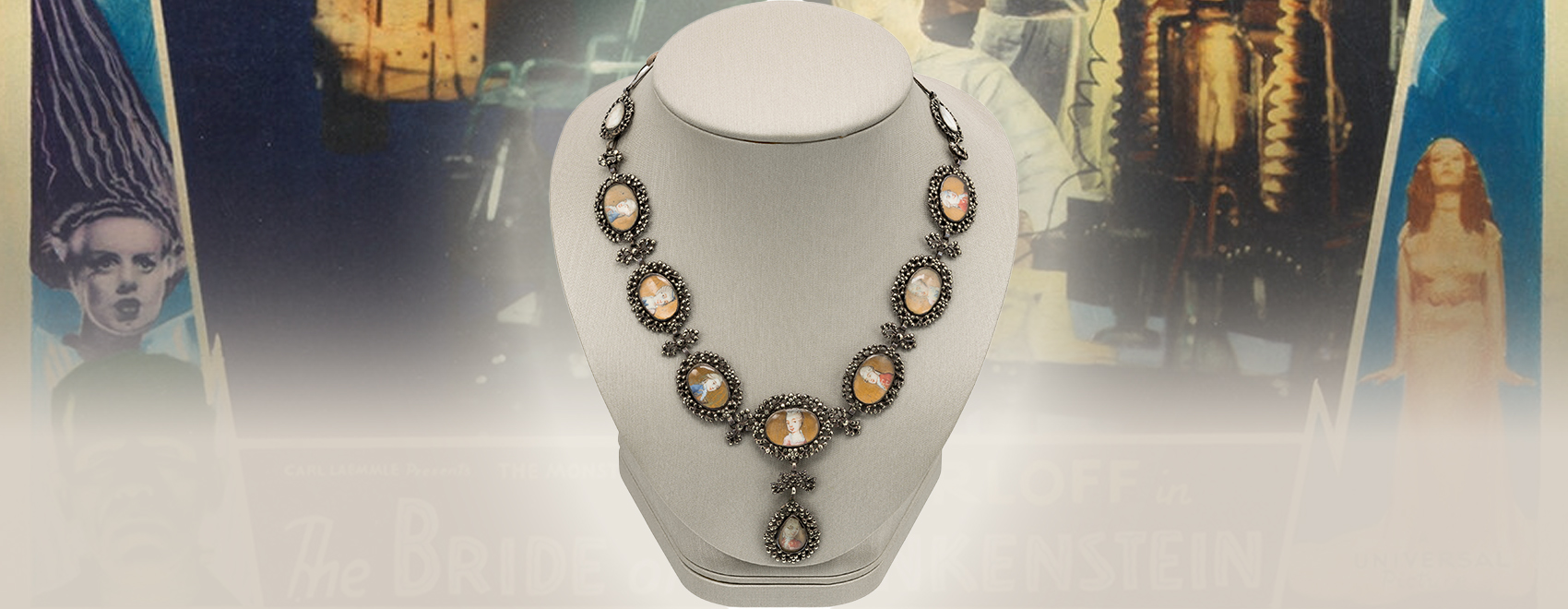
WHAT BEGAN AS A HUNCH BECAME AN EXTRAORDINARY JOURNEY THROUGH HORROR MOVIE HISTORY
By Colin Tait | July 7, 2026
Some stories feel as though they were written for the movies.
A curious collector discovers an antique necklace in a small shop. Weeks later, she sees the same necklace in a classic Hollywood film. Refusing to believe the coincidence, she embarks on a yearslong investigation that leads through archives, forgotten production records, and eventually to the estate of one of cinema’s most beloved actresses.
It sounds improbable. It sounds like fiction. Yet that is exactly what happened.
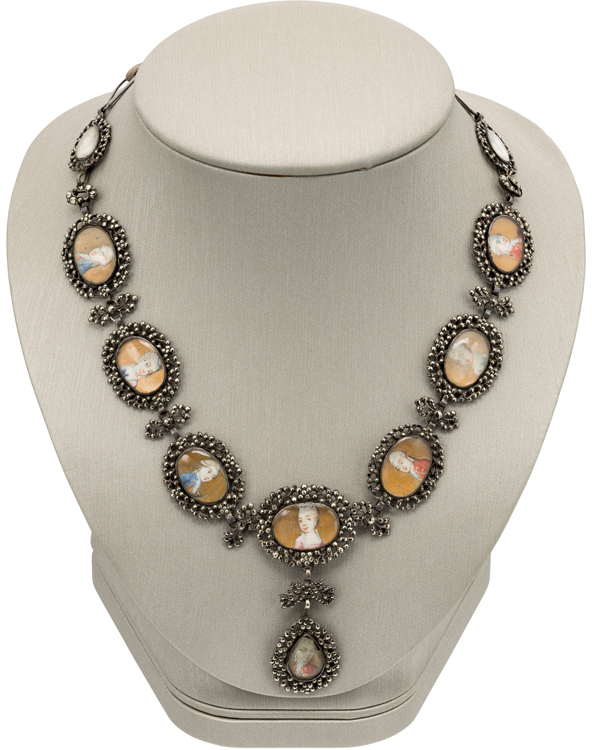
This 18th-century Gothic necklace, now available in Heritage’s July 13-17 Hollywood & Entertainment Signature® Auction, hails from the Estate of Elsa Lanchester and was worn by the actress in 1935’s ‘Bride of Frankenstein.’
The story begins, fittingly enough, with another story.
One stormy evening in 1816, a group of young writers gathered at the Villa Diodati on the shores of Lake Geneva. Trapped indoors by relentless rain, Lord Byron challenged his guests to devise the most frightening ghost story they could imagine. Among those present was an 18-year-old Mary Wollstonecraft Shelley. From that evening emerged Frankenstein; or, The Modern Prometheus — a novel that would not only become one of the most influential works of literature ever written but would also help establish the foundations of both modern science fiction and horror.
More than a century later, director James Whale returned to that famous gathering in the opening moments of Bride of Frankenstein (1935), his celebrated sequel to Frankenstein (1931). Before audiences encounter Boris Karloff’s Monster or the film’s iconic Bride, Whale frames his story with a dramatization of that rainy night. Elsa Lanchester appears as Mary Shelley, seated between Percy Shelley and Lord Byron, calmly recounting the continuation of her famous tale.
And it is here, in those opening moments of one of the most important horror films ever made, that another remarkable story begins.
In October 2013, vintage collector and costumer Tara Rech wandered into a Berkeley, California, antiques shop and noticed a striking necklace displayed in its own case. The piece immediately caught her attention.
“It was really beautiful,” Rech remembers. “But there was something just mildly creepy about it, which intrigued me.”
The necklace featured delicate reverse-painted portrait miniatures beneath glass, framed by intricate hand-cut marcasite. It was unusual, beautiful, and expensive enough that she hesitated. Instead, she photographed it and left the shop. Then, a few weeks later, on Halloween night, friends invited her to watch Bride of Frankenstein. As Whale’s opening sequence unfolded, Rech suddenly sat upright. There, portraying Mary Shelley, sat Elsa Lanchester wearing what appeared to be the very same necklace.
“Oh my God,” she remembered thinking. “That’s the necklace. I just saw that necklace.” Her friends did not believe her. “They said, ‘No way!’”
But she could not shake the feeling. Returning home, she compared her photographs with publicity stills from the film.
“I thought, that’s the necklace. It’s such a distinctive handmade necklace. How could it be a copy?”
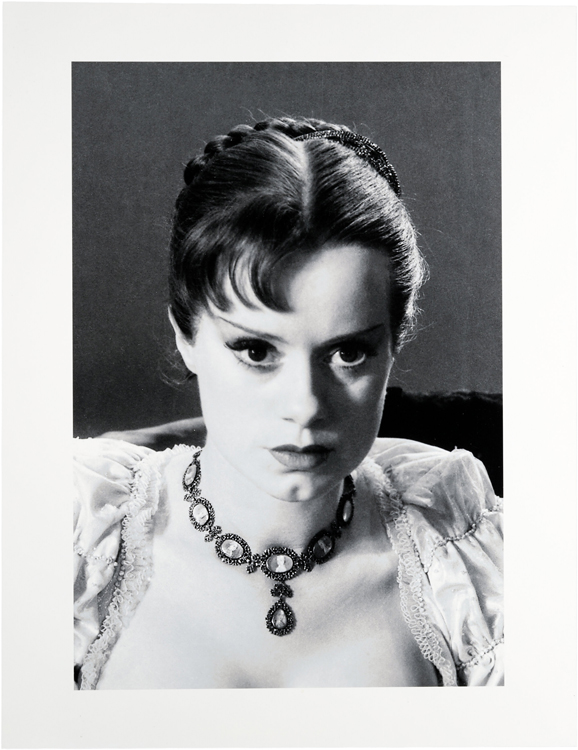
Lanchester donned the necklace in her portrayal of author Mary Wollstonecraft Shelley during the iconic prologue sequence in ‘Bride of Frankenstein.’
At that moment, two unbelievable narratives converged. One belonged to Mary Shelley, whose imagination helped create modern horror. The other belonged to Elsa Lanchester, whose dual performance as Shelley and the Bride helped define horror cinema itself. Through a single piece of jewelry, Rech suddenly found herself intimately connected to both.
Determined to prove what she suspected, and what she knew, she began to investigate. “I know you have to have provenance to make a claim like this,” she explains. “You have to make the link.”
Her search led her to the Margaret Herrick Library of the Academy of Motion Picture Arts and Sciences, where archivists located original production stills from the film. The resulting images confirmed her suspicions: The necklace in Berkeley and the necklace worn by Lanchester were one and the same.
As her research deepened, so too did her appreciation for the film itself. Released in 1935, Bride of Frankenstein is frequently cited as one of the greatest horror films ever made and among the finest sequels in cinema history. James Whale transformed a successful monster picture into something more ambitious, more emotional, and more sophisticated than its predecessor.
Alongside Dracula, Frankenstein, The Mummy, and other classics, it helped establish the Universal Horror cycle that shaped generations of filmmakers and audiences. Yet the film’s opening sequence remains among its most inspired ideas. By placing Mary Shelley at the center of the narrative, Whale reminded audiences that the genre itself owed an enormous debt to a young woman whose imagination altered literary history forever.
That influence remains visible today. More than two centuries after she first conceived Victor Frankenstein and his creation, Shelley continues to inspire artists and filmmakers. Contemporary reinterpretations — including Guillermo del Toro’s recent return to Frankenstein in 2025 — demonstrate the enduring power of the themes and questions Shelley first explored in 1816.
Meanwhile, Rech continued pursuing the necklace’s own history. The piece seemed too old, too beautiful, and too distinctive to have been manufactured for a modestly budgeted production. Documents located during her research failed to identify it as a studio-supplied costume accessory. Increasingly, she began to suspect the necklace belonged to Lanchester herself.
Eventually, her search led to Betty Goldfield, the representative responsible for liquidating the estate of Lanchester and her husband, Academy Award-winning actor Charles Laughton. Goldfield confirmed that the necklace originated from Lanchester’s personal collection and provided written documentation establishing its provenance.
The discovery transformed the necklace from a remarkable movie artifact into something even more intimate. This was not simply a costume piece worn in a famous film. It was a personal possession of Elsa Lanchester, selected by the actress for her portrayal of Mary Shelley and later returned to her private collection.
That connection feels especially fitting given Lanchester’s place within horror history. In one of cinema’s most celebrated dual performances, she portrays both Mary Shelley and the Bride herself. The pairing elegantly links creator and creation through a single performer. As Shelley, she represents the birth of a literary tradition. As the Bride, she created one of the most enduring images in cinematic history.
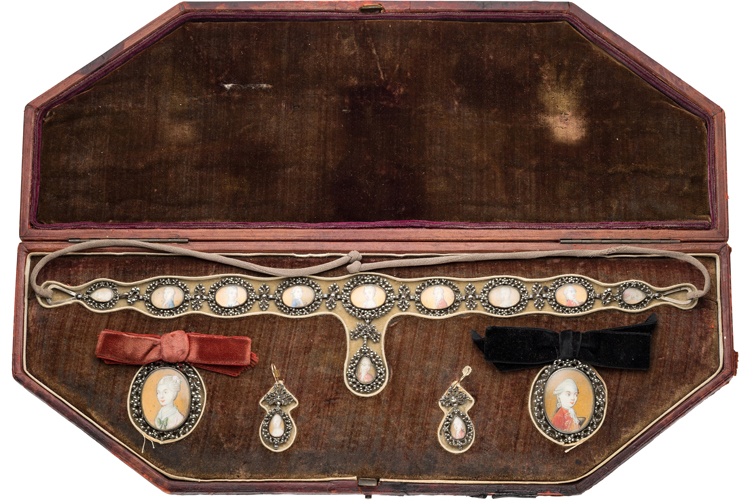
The necklace comes as part of a suite that includes a pair of earrings and two matching pins, all housed in their original red leather presentation case.
Although the Bride appears on screen for only a few minutes, her impact remains immeasurable. The electrified hair, the bandages, the white streaks, the haunting physicality, and Lanchester’s unforgettable performance helped establish a template for female horror icons that continues to resonate nearly a century later.
The necklace therefore offers more than a connection to a celebrated film. It provides an opportunity to revisit Mary Shelley, James Whale, Elsa Lanchester, and the creation of modern horror itself.
For Rech, the necklace’s appeal was never limited to its connection to Hollywood.
A lifelong costumer, performer, and collector with a particular passion for Gothic aesthetics and 18th-century dress, she was drawn to the piece long before she understood its cinematic significance. The necklace’s reverse-painted portraits, marcasite work, and slightly mysterious character appealed to interests she had cultivated for decades.
After uncovering the necklace’s remarkable provenance, Rech became its caretaker for more than a decade. During that time, she continued researching Lanchester’s life and career, even commissioning a recreation of the actress’s Mary Shelley costume from Bride of Frankenstein. On one memorable occasion, she wore the necklace herself alongside the recreated gown, briefly stepping into the same role that Lanchester had inhabited nearly 80 years earlier.
For Rech, the experience was less about ownership than stewardship. The necklace, which is now available in Heritage’s July 13-17 Hollywood & Entertainment Signature® Auction, represented an extraordinary convergence of interests that had shaped much of her life: antique jewelry, costume history, classic cinema, Gothic storytelling, and the enduring legacy of Mary Shelley and Elsa Lanchester.
“I had this weird feeling when I went back and bought the necklace,” she says. “That it wanted to be found.”
Without her persistence, the connection may never have been recognized. Instead, a chance encounter in a Berkeley antiques shop evolved into one of the most remarkable provenance discoveries in recent memory.
And, like the best stories, it now arrives at the beginning of a new chapter. After surviving centuries of history, crossing continents, appearing in one of the most influential horror films ever made, passing through the estate of Elsa Lanchester, and finding its way into the hands of a collector determined to uncover its secrets, the necklace is once again ready for a new custodian.
The next chapter belongs to its future owner, who will inherit not only an extraordinary piece of jewelry, but a story so unlikely that it might have come from the movies themselves.