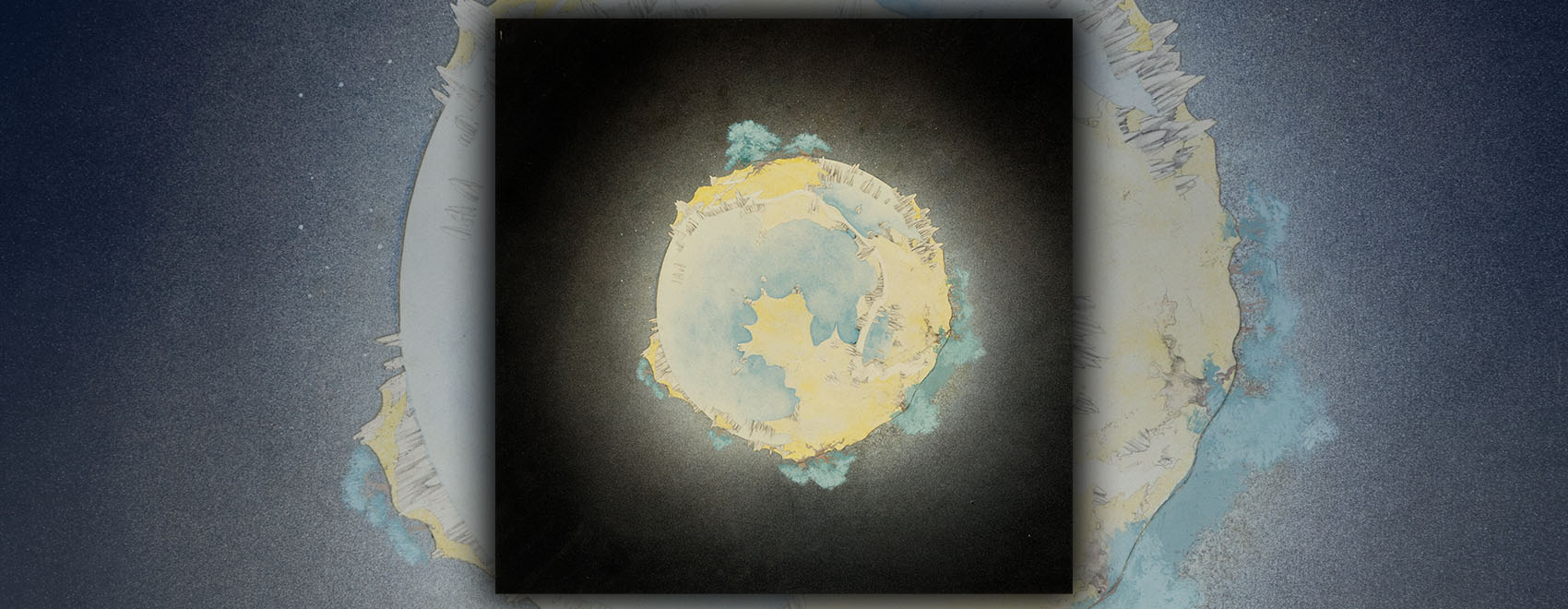
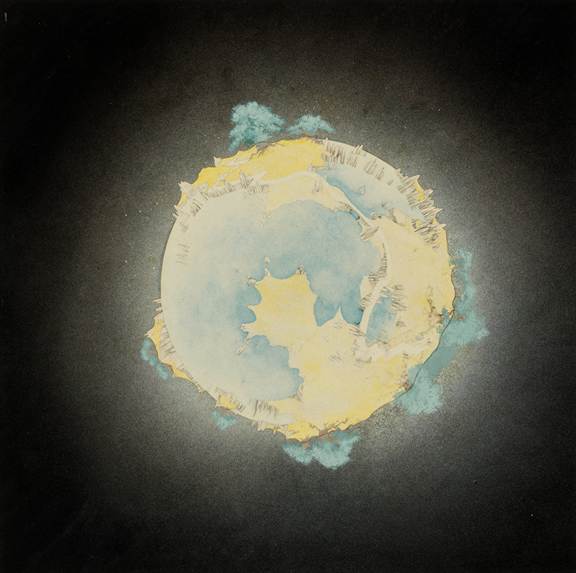
ROGER DEAN’S LONG-MISSING PAINTING FOR YES’ 1971 ALBUM FRAGILE RETURNS TO VIEW, INVITING A FRESH LOOK AT THE IDEAS THAT SHAPED THE ARTIST’S EXTRAORDINARY CAREER
By Michael J. Pearce, PhD | November 17, 2026
Roger Dean created Fragile as the cover of the fourth studio album by Yes in 1971. In the 55 years since its creation, the work has become internationally famous, an iconic example of the visionary art that emerged from the 20th-century counterculture.
Fragile was missing for half a century. It disappeared when it was taken from Dean’s archive in the late 1970s and was only recovered after diligent investigation by Art Recovery International. In the 1970s, the painting had been stored in a specially constructed archive room concealed beneath Dean’s house, and its loss went unnoticed until 2014, when he was contacted by the current owner, who had no idea it was stolen property and asked him to authenticate it. After several years, an agreement was made to sell the painting at auction. When Dean saw the picture at Heritage Auctions, where it is a featured lot in the firm’s November 30-December 3 Hollywood/Entertainment Signature® Auction, he was surprised by the memories it evoked. “I didn’t expect to be so moved by it at all,” he says. “I kind of already accepted that it had gone, but seeing it close-up was strange and quite emotional. It was quite a shock.”
When Dean was a struggling artist breaking into the rapidly growing world of album cover design, one of the doors he knocked on belonged to Phil Carson, an executive at Atlantic Records. Only two weeks after their meeting, Carson invited Dean to visit Yes while they recorded their new album at Advision Studios to discover if he would be a good fit for the cover of their fourth album, Fragile. Dean found the musicians in the studio control room having a break from working on their complex compositions. He was thinking on an epic scale, inspired by the conceptual art and total theater of Wagnerian opera. He imagined his art fully integrated with Yes’ music and sonic extravagance, giving the audience listening to the album an opportunity to enter the fantastic world conjured by both imagery and sound.
When Dean returned to the recording studio to share his developing ideas, he “pitched not a visual idea, but a story … a way of encapsulating music without music.”
Drawing inspiration from an edition of Wagner’s opera Lohengrin, designed and illustrated in the superb art nouveau style of artist Willy Pogany, Dean created Fragile as a complete “world that was magical and miniature and impossible but totally credible.” Trees in Lohengrin were a repeated icon and symbol of solid faith and steadfast truth, and though their branches bent beneath invisible winds and leaves scattered around beautiful nudes, they were resolute and certainly provided formative influences to Dean’s Fragile world. To Dean, Lohengrin was a model of combining fluid framing, landscapes, and lettering, and this was the nascent strategy he applied to Fragile. His later paintings and designs for classic Yes albums, especially Yessongs, would be deeply inspired by the sprawling symbolic morphology of Pogany’s work and continued his exploration of Wagnerian ideas about the total work of art.
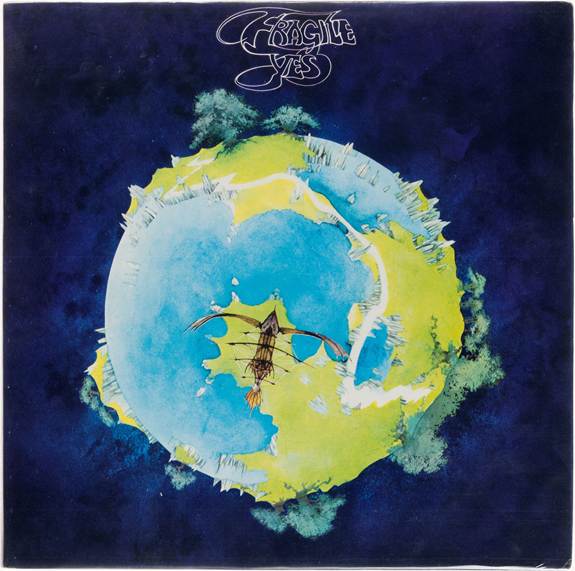
The final cover of ‘Fragile,’ Yes’ fourth studio album
While working on Fragile, Dean conceived a series of paintings depicting “…the idea of a world gradually dismantling and the fragments becoming spores shepherded to another planet, and that becoming alive, as it were, from these seeds sent through space.” In 1969, Buckminster Fuller’s idealistic book Operating Manual for Spaceship Earth had popularized the idea of our blue planet as a vessel, and all humanity as its crew, and the whimsical image was planted in Dean’s fertile imagination. What is not in the painting reveals a significant moment in the development of Dean’s ideas — during the printing process for the album Fragile Dean added an important feature to the cover: a beautiful flying ship floating over the land of the bonsai, a hybrid vessel of space and sail designed to haul the spores of the planet through space to heal other worlds. In a second painting that was reproduced on the back cover, the guiding ark ship hovered above the world as its fragments separated.
Dean saw the scene as an image of interplanetary hope. Between 1971 and 1973, the idea of an interplanetary rescue mission saving the inhabitants of a threatened world had intense cultural resonance — nuclear war seemed imminent. Newspaper front pages wore terrifying reports of bomb tests, of computer automation of weaponry guaranteeing mutually assured destruction, and frighteningly glib stories of missile treaties promising that the leaders of the American and Russian superpowers would exercise restraint.
When the album was released, listeners were seduced into otherworldly atmospheres by the opening track “Roundabout,” as Steve Howe’s delicate guitar introduction, Chris Squire’s astonishing bass line, and Rick Wakeman’s magical arpeggios set Dean’s planet in sonic space. Jon Anderson’s poetic virtuosity seemed to harmonize with the painting as he sang of mountains coming out of the sky. Soon he reassured his audience, “We have heaven,” and after a wind that seemed to whistle from the emptiness of the cosmos introduced “South Side of the Sky,” he sang of a river and a mountain that must be crossed and lost sunshine and cold so bitter that he wept. Fearing approaching disaster, he asked, “Were we ever colder on that day a million miles away? It seemed from all of eternity, ‘Move forward!’ was my friends’ only cry.” The melodies of Dean’s lyrical painting and the pictures of Anderson’s song were bound to each other in imagination.
“I didn’t expect to be so moved by it at all. … Seeing it close-up was strange and quite emotional. It was quite a shock.”
—Roger Dean on encountering ‘Fragile’ after more than 50 years
Dean didn’t know it at the time, but the art and narrative of Fragile would set the tone of his paintings for the next half-century and was crucially important to the development of his signature style as a major imaginative realist artist. It is remarkable that each feature of the Fragile planet’s managed landscape would appear and expand in Dean’s body of work as it emerged during the next 50 years. “It was like a thumbnail map as the beginning of a route for a career,” he says. “It was very, very indistinct. It was only when I came back, you know, looking back, and said, ‘Ah, that was the starting point.’”
Dean returned to the Fragile theme again when he was commissioned in 1972 to create more paintings for the Yessongs live triple album, when he designed three new Fragile world pieces, titled Red, Green, and Blue, and a series of a dozen more paintings to create further cohesion and detail. He ventured deeper into the story of the sporing planet when the band called on him again to create art for the cover for their next studio album, Close to the Edge. The allegory of Fragile’s idealistic story was about the collapse of the existing order and potential revival and rejuvenation, and as Dean’s fantastic world developed he told a story of evangelism via planetary spores, as fragments of the idealistic shattered world were transported across space to new earths.
Dean’s cultural impact has been enormous. Including posters, album covers, books, calendars, and cards, he has sold an estimated 100 to 150 million copies of his paintings. He has reinvented dragons, his floating islands and rocky sherds have been emulated repeatedly in science fiction movies, and his lithographic reproductions continue being distributed.
An icon in the history of visionary art and a breakthrough moment in the careers of both Roger Dean and Yes, Fragile is a foundational image in album cover art, with enduring cultural resonance for the generations of musicians, fans, and dreamers who have grown up in its legacy.
MICHAEL J. PEARCE, PhD is a thoughtful scholar and commentator on 21st-century art whose extensive writing has chronicled the re-emergence of figurative painting. He is a central figure in that resurgence, as chair of The Representational Art Conference series through 2019, and author of Kitsch, Propaganda, and the American Avant-Garde. He is deeply embedded in the contemporary culture of imaginative realist, visionary, and psychedelic art and author of a forthcoming monograph on Roger Dean to be published in 2028.
Help Google recognize your trusted sources.
Add Intelligent Collector as a Preferred Source.
Preferences improve Google’s recommendations for you.