THE NATIVE AMERICAN ARTIST’S LAYERED ABSTRACTIONS, ROOTED IN PLACE AND MEMORY, ARE FINALLY RECEIVING THE ATTENTION THEY HAVE LONG DESERVED
By Taylor Curry | April 21, 2026
W
hen Heritage Auctions set an auction record for George Morrison last year, it did not feel like an outlier, but part of a shift that’s been building. For years, Morrison’s work traded quietly relative to its significance, particularly when considered alongside his peers in postwar American abstraction. His market developed largely outside the spotlight, driven by informed collectors rather than public spectacle. As institutional recognition has expanded, especially beyond Morrison’s native Midwest, that underlying demand is now starting to register more visibly at auction.
Born in Chippewa City, Minnesota, an Ojibwe fishing village along Lake Superior, Morrison maintained a deep connection to place throughout his career. Even as he moved within the New York art world, that early landscape remained central. He returned to it repeatedly, not as subject, but as structure and memory. This sensibility, shaped by his training at the Art Students League and his proximity to the Abstract Expressionist circle, informed a practice grounded in material exploration and a sustained engagement with environment.
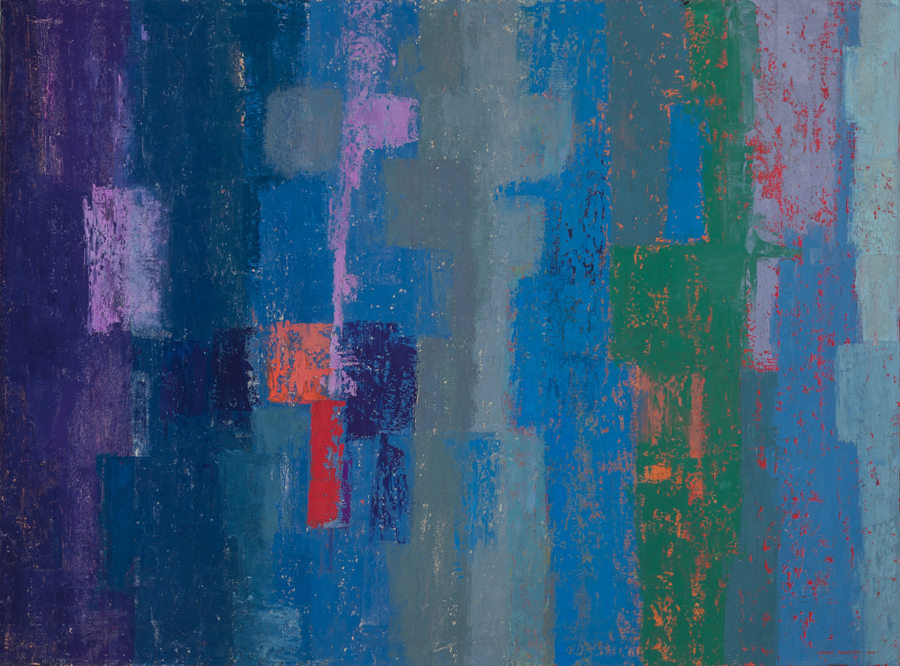
George Morrison ‘Palisade,’ 1958. Oil on canvas. 40 x 54 inches (101.6 x 137.2 cm). Available in Heritage’s May 7 Modern & Contemporary Art Signature® Auction.
Palisade, available in Heritage’s May 7 Modern & Contemporary Art Signature® Auction, arrives at a moment when this reassessment is fully underway. The Metropolitan Museum of Art’s recent exhibition examining Morrison’s early years in New York places his work within the core of the Abstract Expressionist movement, in dialogue with Willem de Kooning, Franz Kline, and Philip Guston. Archival material and early paintings reveal an artist deeply engaged with the dominant ideas of the period, while already developing a distinct visual language.
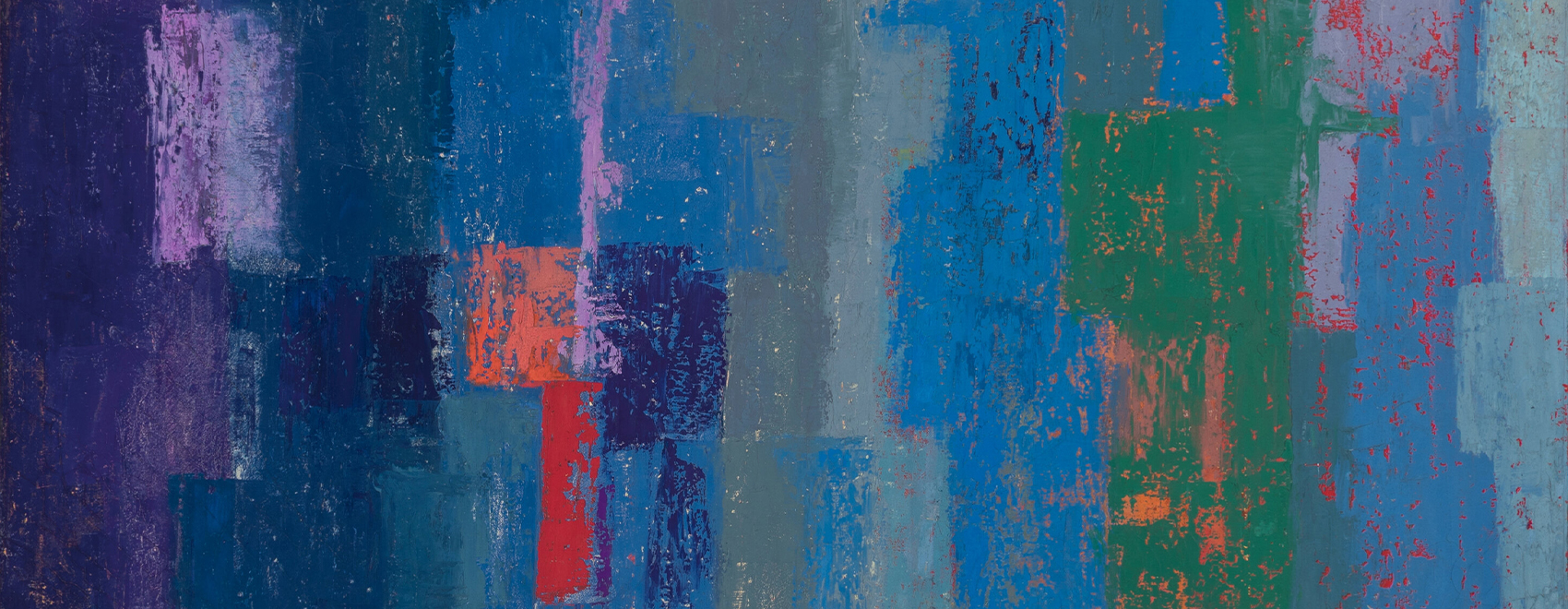
Executed in 1958, Palisade is a strong example of this. Saturated blues and violets are interrupted by vertical bands of green, slate, and gray, with passages of red and coral pushing through a heavily worked surface. Rectangular forms stack and interlock, creating a sense of compression and lift that recalls stratified rock along a shoreline. The reference is not literal, but the structure is clear.
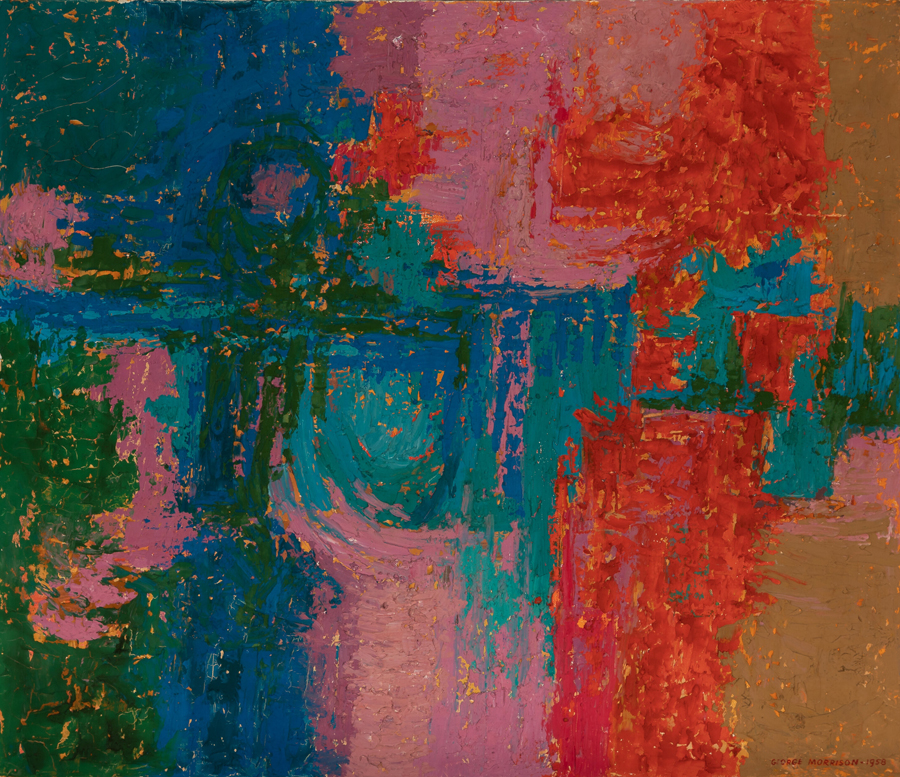
George Morrison ‘Blue & Red (Noon Reflection),’ 1958. Oil on canvas. 21-1/2 x 25-3/8 inches (54.6 x 64.3 cm). Sold for $300,000 in a November 2025 Heritage auction.
The surface is dense, built through scraping, layering, and areas of exposed underpainting that give it a weathered, almost geological presence. Morrison is not relying on gesture alone. The composition comes together gradually, through accumulation and control, with subtle shifts in tone and density doing most of the work. The result is immersive but grounded, holding onto the energy of Abstract Expressionism while anchoring it in something more physical and deliberate.
As institutional recognition and scholarship have grown, the market has begun to follow at auction, particularly for paintings that bring these elements together with clarity. Works such as Palisade, where composition, surface, and structure align, are beginning to define the upper end of Morrison’s market.
At Heritage, this growing momentum is already translating into meaningful results. As collector awareness deepens, Morrison’s strongest works are commanding increased attention at auction, and Palisade stands squarely within that conversation. It represents not only an exceptional example of Morrison’s practice, but an opportunity to engage with an artist whose place within postwar American abstraction is being more fully understood with each passing season.